

natural gas (LNG) exports from the USA (including the cost of liquefaction, transport and
gasification) can be held below $10/MMBtu,
which is still competitive when compared with
the current level of $16/MMBtu and $12/MMBtu
in Asia and Europe respectively. As the USA
gradually deregulates natural gas exports, its
impact on the world’s natural gas market will be
increasingly prominent (IEA 2017) (Fig. 9).
As a result of lower natural gas prices, many
coal-fired power plants in the USA have switched their fuel from coal to natural gas, resulting
in falling coal and electricity prices. This brings a
great opportunity to regenerate the manufacturing and chemical industries. Chemical companies
that shut down plants in the USA several years
ago, due to high natural gas prices, are planning
to reopen production facilities and are again
using low-price natural gas as a raw material to
produce ethylene, synthetic ammonia, chemical
fertilisers and diesel fuels.
In short, the large-scale extraction and use of
unconventional oil and gas resources make the
Americas one of the most important resource
exporters after the Middle East, Russia and North
Africa. US oil and gas exports will impact energy
trade between Europe and Russia for several
decades—reducing Europe’s dependence on its
neighbour and diversifying its energy import
structure. To safeguard energy exports, Russia
will strengthen energy cooperation with countries
in East and South Asia. The reduction in Europe’s energy dependence on Russia will further
consolidate the political, economic and military
alliance between Europe and the USA and
Canada. Russia’s political and economic cooperation with China, and with emerging economies in Asia, will also grow. China will
strengthen its energy cooperation with other
countries through the Belt and Road Initiative
(BRI). BRI covers two high-quality energy-rich
regions: Russia-Central Asia; and the Gulf
Region-Western Europe, the former endowed
with oil and gas, the latter with advanced energy
technologies and widely deployed renewables.
Stronger international energy cooperation
through BRI will connect Central Asia,
North-east Asia, South East Asia, Europe and the
Americas, creating regional energy communities
to deliver win-win cooperation.
1.3 Protecting the Environment
and Combating Climate
Change Are Global
Concerns
The large-scale development and use of fossil
energy severely impacts the air, water and environment. Fossil fuel use emits a large amount of
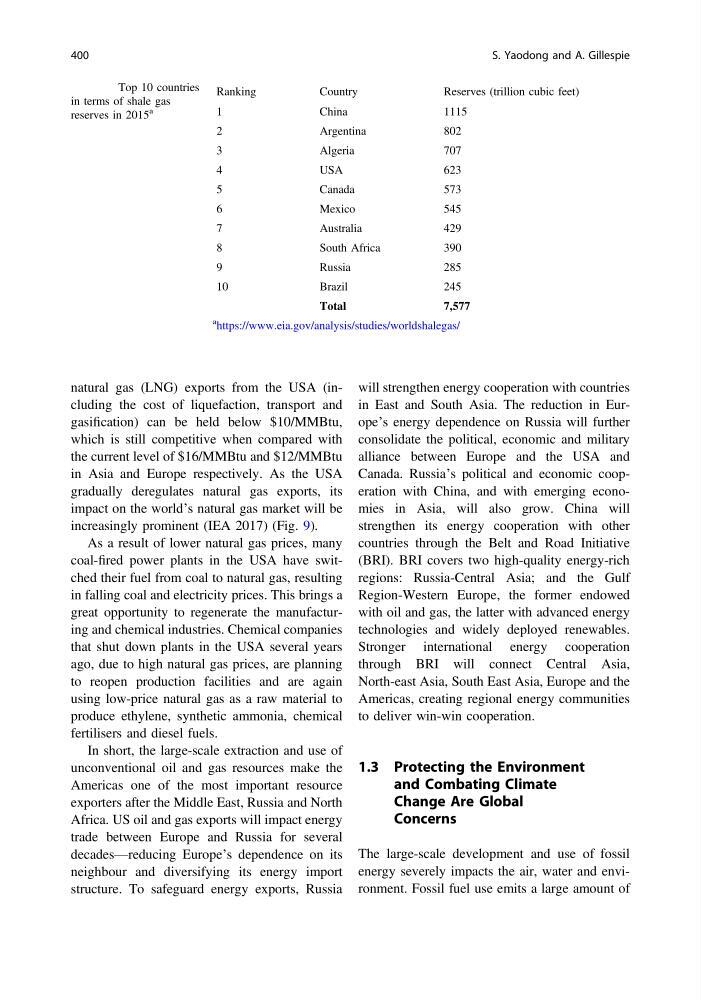
Table 2 Top 10 countries
in terms of shale gas
reserves in 2015
a
Ranking
Country
Reserves (trillion cubic feet)
1
China
1115
2
Argentina
802
3
Algeria
707
4
USA
623
5
Canada
573
6
Mexico
545
7
Australia
429
8
South Africa
390
9
Russia
285
10
Brazil
245
Total
7,577
a https://www.eia.gov/analysis/studies/worldshalegas/
400
S. Yaodong and A. Gillespie
gasification) can be held below $10/MMBtu,
which is still competitive when compared with
the current level of $16/MMBtu and $12/MMBtu
in Asia and Europe respectively. As the USA
gradually deregulates natural gas exports, its
impact on the world’s natural gas market will be
increasingly prominent (IEA 2017) (Fig. 9).
As a result of lower natural gas prices, many
coal-fired power plants in the USA have switched their fuel from coal to natural gas, resulting
in falling coal and electricity prices. This brings a
great opportunity to regenerate the manufacturing and chemical industries. Chemical companies
that shut down plants in the USA several years
ago, due to high natural gas prices, are planning
to reopen production facilities and are again
using low-price natural gas as a raw material to
produce ethylene, synthetic ammonia, chemical
fertilisers and diesel fuels.
In short, the large-scale extraction and use of
unconventional oil and gas resources make the
Americas one of the most important resource
exporters after the Middle East, Russia and North
Africa. US oil and gas exports will impact energy
trade between Europe and Russia for several
decades—reducing Europe’s dependence on its
neighbour and diversifying its energy import
structure. To safeguard energy exports, Russia
will strengthen energy cooperation with countries
in East and South Asia. The reduction in Europe’s energy dependence on Russia will further
consolidate the political, economic and military
alliance between Europe and the USA and
Canada. Russia’s political and economic cooperation with China, and with emerging economies in Asia, will also grow. China will
strengthen its energy cooperation with other
countries through the Belt and Road Initiative
(BRI). BRI covers two high-quality energy-rich
regions: Russia-Central Asia; and the Gulf
Region-Western Europe, the former endowed
with oil and gas, the latter with advanced energy
technologies and widely deployed renewables.
Stronger international energy cooperation
through BRI will connect Central Asia,
North-east Asia, South East Asia, Europe and the
Americas, creating regional energy communities
to deliver win-win cooperation.
1.3 Protecting the Environment
and Combating Climate
Change Are Global
Concerns
The large-scale development and use of fossil
energy severely impacts the air, water and environment. Fossil fuel use emits a large amount of
Table 2 Top 10 countries
in terms of shale gas
reserves in 2015
a
Ranking
Country
Reserves (trillion cubic feet)
1
China
1115
2
Argentina
802
3
Algeria
707
4
USA
623
5
Canada
573
6
Mexico
545
7
Australia
429
8
South Africa
390
9
Russia
285
10
Brazil
245
Total
7,577
a https://www.eia.gov/analysis/studies/worldshalegas/
400
S. Yaodong and A. Gillespie