

starting large-scale commercial development of
its shale gas resources. The IEA forecasts that
unconventional natural gas will account for about
half of world total natural gas production in
2035, with most produced in China, the USA and
Australia. In 2035, China’s shale gas production
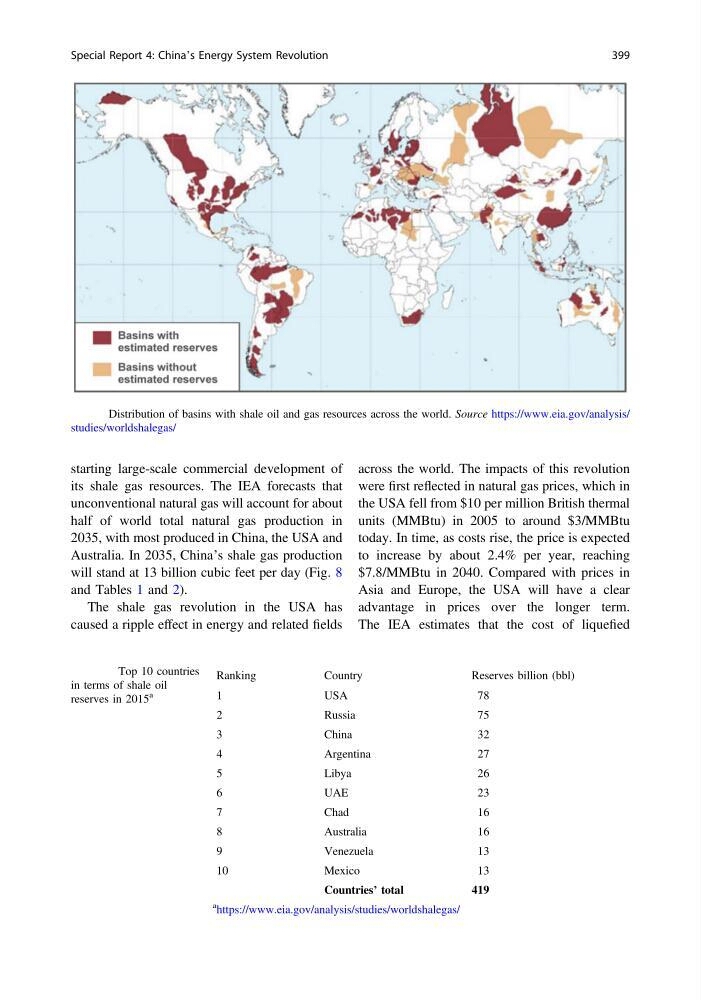
will stand at 13 billion cubic feet per day (Fig. 8
and Tables 1 and 2).
The shale gas revolution in the USA has
caused a ripple effect in energy and related fields
across the world. The impacts of this revolution
were first reflected in natural gas prices, which in
the USA fell from $10 per million British thermal
units (MMBtu) in 2005 to around $3/MMBtu
today. In time, as costs rise, the price is expected
to increase by about 2.4% per year, reaching
$7.8/MMBtu in 2040. Compared with prices in
Asia and Europe, the USA will have a clear
advantage in prices over the longer term.
The IEA estimates that the cost of liquefied
Fig. 8 Distribution of basins with shale oil and gas resources across the world. Source https://www.eia.gov/analysis/
studies/worldshalegas/
Table 1 Top 10 countries
in terms of shale oil
reserves in 2015
a
Ranking
Country
Reserves billion (bbl)
1
USA
78
2
Russia
75
3
China
32
4
Argentina
27
5
Libya
26
6
UAE
23
7
Chad
16
8
Australia
16
9
Venezuela
13
10
Mexico
13
Countries’ total
419
a https://www.eia.gov/analysis/studies/worldshalegas/
Special Report 4: China’s Energy System Revolution
399
its shale gas resources. The IEA forecasts that
unconventional natural gas will account for about
half of world total natural gas production in
2035, with most produced in China, the USA and
Australia. In 2035, China’s shale gas production
will stand at 13 billion cubic feet per day (Fig. 8
and Tables 1 and 2).
The shale gas revolution in the USA has
caused a ripple effect in energy and related fields
across the world. The impacts of this revolution
were first reflected in natural gas prices, which in
the USA fell from $10 per million British thermal
units (MMBtu) in 2005 to around $3/MMBtu
today. In time, as costs rise, the price is expected
to increase by about 2.4% per year, reaching
$7.8/MMBtu in 2040. Compared with prices in
Asia and Europe, the USA will have a clear
advantage in prices over the longer term.
The IEA estimates that the cost of liquefied
Fig. 8 Distribution of basins with shale oil and gas resources across the world. Source https://www.eia.gov/analysis/
studies/worldshalegas/
Table 1 Top 10 countries
in terms of shale oil
reserves in 2015
a
Ranking
Country
Reserves billion (bbl)
1
USA
78
2
Russia
75
3
China
32
4
Argentina
27
5
Libya
26
6
UAE
23
7
Chad
16
8
Australia
16
9
Venezuela
13
10
Mexico
13
Countries’ total
419
a https://www.eia.gov/analysis/studies/worldshalegas/
Special Report 4: China’s Energy System Revolution
399