

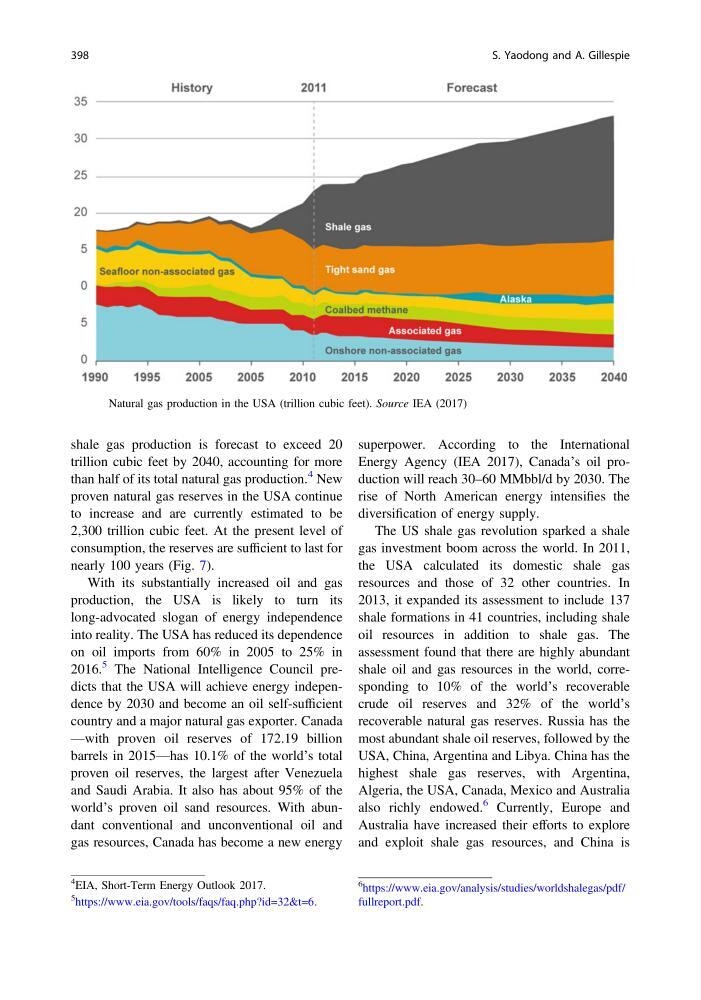
shale gas production is forecast to exceed 20
trillion cubic feet by 2040, accounting for more
than half of its total natural gas production.
4 New
proven natural gas reserves in the USA continue
to increase and are currently estimated to be
2,300 trillion cubic feet. At the present level of
consumption, the reserves are sufficient to last for
nearly 100 years (Fig. 7).
With its substantially increased oil and gas
production, the USA is likely to turn its
long-advocated slogan of energy independence
into reality. The USA has reduced its dependence
on oil imports from 60% in 2005 to 25% in
2016.
5 The National Intelligence Council predicts that the USA will achieve energy independence by 2030 and become an oil self-sufficient
country and a major natural gas exporter. Canada
—with proven oil reserves of 172.19 billion
barrels in 2015—has 10.1% of the world’s total
proven oil reserves, the largest after Venezuela
and Saudi Arabia. It also has about 95% of the
world’s proven oil sand resources. With abundant conventional and unconventional oil and
gas resources, Canada has become a new energy
superpower. According to the International
Energy Agency (IEA 2017), Canada’s oil production will reach 30–60 MMbbl/d by 2030. The
rise of North American energy intensifies the
diversification of energy supply.
The US shale gas revolution sparked a shale
gas investment boom across the world. In 2011,
the USA calculated its domestic shale gas
resources and those of 32 other countries. In
2013, it expanded its assessment to include 137
shale formations in 41 countries, including shale
oil resources in addition to shale gas. The
assessment found that there are highly abundant
shale oil and gas resources in the world, corresponding to 10% of the world’s recoverable
crude oil reserves and 32% of the world’s
recoverable natural gas reserves. Russia has the
most abundant shale oil reserves, followed by the
USA, China, Argentina and Libya. China has the
highest shale gas reserves, with Argentina,
Algeria, the USA, Canada, Mexico and Australia
also richly endowed.
6 Currently, Europe and
Australia have increased their efforts to explore
and exploit shale gas resources, and China is
Fig. 7 Natural gas production in the USA (trillion cubic feet). Source IEA (2017)
4
EIA, Short-Term Energy Outlook 2017.
5
https://www.eia.gov/tools/faqs/faq.php?id=32&t=6.
6
https://www.eia.gov/analysis/studies/worldshalegas/pdf/
fullreport.pdf.
398
S. Yaodong and A. Gillespie
trillion cubic feet by 2040, accounting for more
than half of its total natural gas production.
4 New
proven natural gas reserves in the USA continue
to increase and are currently estimated to be
2,300 trillion cubic feet. At the present level of
consumption, the reserves are sufficient to last for
nearly 100 years (Fig. 7).
With its substantially increased oil and gas
production, the USA is likely to turn its
long-advocated slogan of energy independence
into reality. The USA has reduced its dependence
on oil imports from 60% in 2005 to 25% in
2016.
5 The National Intelligence Council predicts that the USA will achieve energy independence by 2030 and become an oil self-sufficient
country and a major natural gas exporter. Canada
—with proven oil reserves of 172.19 billion
barrels in 2015—has 10.1% of the world’s total
proven oil reserves, the largest after Venezuela
and Saudi Arabia. It also has about 95% of the
world’s proven oil sand resources. With abundant conventional and unconventional oil and
gas resources, Canada has become a new energy
superpower. According to the International
Energy Agency (IEA 2017), Canada’s oil production will reach 30–60 MMbbl/d by 2030. The
rise of North American energy intensifies the
diversification of energy supply.
The US shale gas revolution sparked a shale
gas investment boom across the world. In 2011,
the USA calculated its domestic shale gas
resources and those of 32 other countries. In
2013, it expanded its assessment to include 137
shale formations in 41 countries, including shale
oil resources in addition to shale gas. The
assessment found that there are highly abundant
shale oil and gas resources in the world, corresponding to 10% of the world’s recoverable
crude oil reserves and 32% of the world’s
recoverable natural gas reserves. Russia has the
most abundant shale oil reserves, followed by the
USA, China, Argentina and Libya. China has the
highest shale gas reserves, with Argentina,
Algeria, the USA, Canada, Mexico and Australia
also richly endowed.
6 Currently, Europe and
Australia have increased their efforts to explore
and exploit shale gas resources, and China is
Fig. 7 Natural gas production in the USA (trillion cubic feet). Source IEA (2017)
4
EIA, Short-Term Energy Outlook 2017.
5
https://www.eia.gov/tools/faqs/faq.php?id=32&t=6.
6
https://www.eia.gov/analysis/studies/worldshalegas/pdf/
fullreport.pdf.
398
S. Yaodong and A. Gillespie