

3.4.4 Analysis of China’s INDC
China’s intended nationally determined contributions (INDC) reflect its goal of reducing its
carbon emission intensity by 60–65% by 2030.
This study simulates the evolution trends of
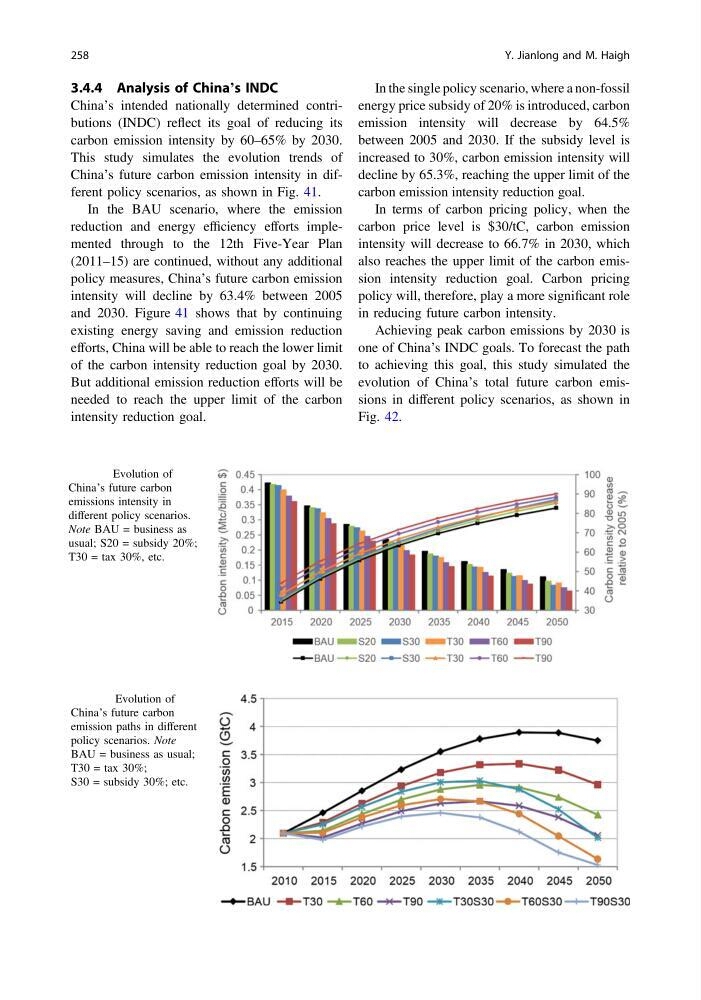
China’s future carbon emission intensity in different policy scenarios, as shown in Fig. 41.
In the BAU scenario, where the emission
reduction and energy efficiency efforts implemented through to the 12th Five-Year Plan
(2011–15) are continued, without any additional
policy measures, China’s future carbon emission
intensity will decline by 63.4% between 2005
and 2030. Figure 41 shows that by continuing
existing energy saving and emission reduction
efforts, China will be able to reach the lower limit
of the carbon intensity reduction goal by 2030.
But additional emission reduction efforts will be
needed to reach the upper limit of the carbon
intensity reduction goal.
In the single policy scenario, where a non-fossil
energy price subsidy of 20% is introduced, carbon
emission intensity will decrease by 64.5%
between 2005 and 2030. If the subsidy level is
increased to 30%, carbon emission intensity will
decline by 65.3%, reaching the upper limit of the
carbon emission intensity reduction goal.
In terms of carbon pricing policy, when the
carbon price level is $30/tC, carbon emission
intensity will decrease to 66.7% in 2030, which
also reaches the upper limit of the carbon emission intensity reduction goal. Carbon pricing
policy will, therefore, play a more significant role
in reducing future carbon intensity.
Achieving peak carbon emissions by 2030 is
one of China’s INDC goals. To forecast the path
to achieving this goal, this study simulated the
evolution of China’s total future carbon emissions in different policy scenarios, as shown in
Fig. 42.
Fig. 41 Evolution of
China’s future carbon
emissions intensity in
different policy scenarios.
Note BAU = business as
usual; S20 = subsidy 20%;
T30 = tax 30%, etc.
Fig. 42 Evolution of
China’s future carbon
emission paths in different
policy scenarios. Note
BAU = business as usual;
T30 = tax 30%;
S30 = subsidy 30%; etc.
258
Y. Jianlong and M. Haigh
China’s intended nationally determined contributions (INDC) reflect its goal of reducing its
carbon emission intensity by 60–65% by 2030.
This study simulates the evolution trends of
China’s future carbon emission intensity in different policy scenarios, as shown in Fig. 41.
In the BAU scenario, where the emission
reduction and energy efficiency efforts implemented through to the 12th Five-Year Plan
(2011–15) are continued, without any additional
policy measures, China’s future carbon emission
intensity will decline by 63.4% between 2005
and 2030. Figure 41 shows that by continuing
existing energy saving and emission reduction
efforts, China will be able to reach the lower limit
of the carbon intensity reduction goal by 2030.
But additional emission reduction efforts will be
needed to reach the upper limit of the carbon
intensity reduction goal.
In the single policy scenario, where a non-fossil
energy price subsidy of 20% is introduced, carbon
emission intensity will decrease by 64.5%
between 2005 and 2030. If the subsidy level is
increased to 30%, carbon emission intensity will
decline by 65.3%, reaching the upper limit of the
carbon emission intensity reduction goal.
In terms of carbon pricing policy, when the
carbon price level is $30/tC, carbon emission
intensity will decrease to 66.7% in 2030, which
also reaches the upper limit of the carbon emission intensity reduction goal. Carbon pricing
policy will, therefore, play a more significant role
in reducing future carbon intensity.
Achieving peak carbon emissions by 2030 is
one of China’s INDC goals. To forecast the path
to achieving this goal, this study simulated the
evolution of China’s total future carbon emissions in different policy scenarios, as shown in
Fig. 42.
Fig. 41 Evolution of
China’s future carbon
emissions intensity in
different policy scenarios.
Note BAU = business as
usual; S20 = subsidy 20%;
T30 = tax 30%, etc.
Fig. 42 Evolution of
China’s future carbon
emission paths in different
policy scenarios. Note
BAU = business as usual;
T30 = tax 30%;
S30 = subsidy 30%; etc.
258
Y. Jianlong and M. Haigh