

assumed that the two policies were introduced in
2015. The future evolution of total energy
demand, the energy mix and energy intensity are
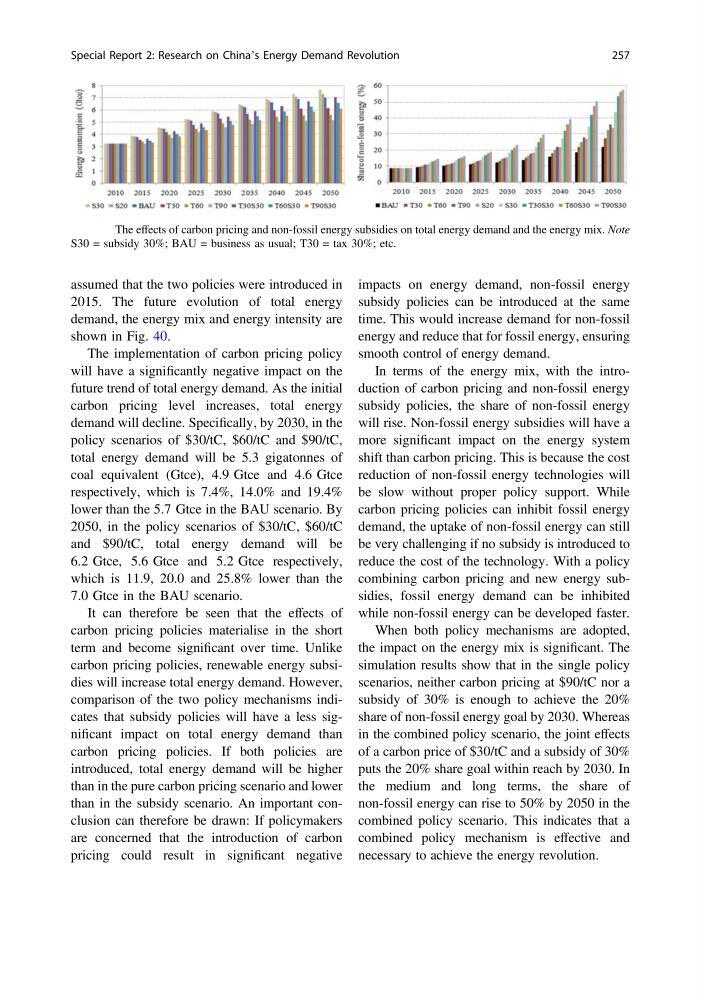
shown in Fig. 40.
The implementation of carbon pricing policy
will have a significantly negative impact on the
future trend of total energy demand. As the initial
carbon pricing level increases, total energy
demand will decline. Specifically, by 2030, in the
policy scenarios of $30/tC, $60/tC and $90/tC,
total energy demand will be 5.3 gigatonnes of
coal equivalent (Gtce), 4.9 Gtce and 4.6 Gtce
respectively, which is 7.4%, 14.0% and 19.4%
lower than the 5.7 Gtce in the BAU scenario. By
2050, in the policy scenarios of $30/tC, $60/tC
and $90/tC, total energy demand will be
6.2 Gtce, 5.6 Gtce and 5.2 Gtce respectively,
which is 11.9, 20.0 and 25.8% lower than the
7.0 Gtce in the BAU scenario.
It can therefore be seen that the effects of
carbon pricing policies materialise in the short
term and become significant over time. Unlike
carbon pricing policies, renewable energy subsidies will increase total energy demand. However,
comparison of the two policy mechanisms indicates that subsidy policies will have a less significant impact on total energy demand than
carbon pricing policies. If both policies are
introduced, total energy demand will be higher
than in the pure carbon pricing scenario and lower
than in the subsidy scenario. An important conclusion can therefore be drawn: If policymakers
are concerned that the introduction of carbon
pricing could result in significant negative
impacts on energy demand, non-fossil energy
subsidy policies can be introduced at the same
time. This would increase demand for non-fossil
energy and reduce that for fossil energy, ensuring
smooth control of energy demand.
In terms of the energy mix, with the introduction of carbon pricing and non-fossil energy
subsidy policies, the share of non-fossil energy
will rise. Non-fossil energy subsidies will have a
more significant impact on the energy system
shift than carbon pricing. This is because the cost
reduction of non-fossil energy technologies will
be slow without proper policy support. While
carbon pricing policies can inhibit fossil energy
demand, the uptake of non-fossil energy can still
be very challenging if no subsidy is introduced to
reduce the cost of the technology. With a policy
combining carbon pricing and new energy subsidies, fossil energy demand can be inhibited
while non-fossil energy can be developed faster.
When both policy mechanisms are adopted,
the impact on the energy mix is significant. The
simulation results show that in the single policy
scenarios, neither carbon pricing at $90/tC nor a
subsidy of 30% is enough to achieve the 20%
share of non-fossil energy goal by 2030. Whereas
in the combined policy scenario, the joint effects
of a carbon price of $30/tC and a subsidy of 30%
puts the 20% share goal within reach by 2030. In
the medium and long terms, the share of
non-fossil energy can rise to 50% by 2050 in the
combined policy scenario. This indicates that a
combined policy mechanism is effective and
necessary to achieve the energy revolution.
Fig. 40 The effects of carbon pricing and non-fossil energy subsidies on total energy demand and the energy mix. Note
S30 = subsidy 30%; BAU = business as usual; T30 = tax 30%; etc.
Special Report 2: Research on China’s Energy Demand Revolution
257
2015. The future evolution of total energy
demand, the energy mix and energy intensity are
shown in Fig. 40.
The implementation of carbon pricing policy
will have a significantly negative impact on the
future trend of total energy demand. As the initial
carbon pricing level increases, total energy
demand will decline. Specifically, by 2030, in the
policy scenarios of $30/tC, $60/tC and $90/tC,
total energy demand will be 5.3 gigatonnes of
coal equivalent (Gtce), 4.9 Gtce and 4.6 Gtce
respectively, which is 7.4%, 14.0% and 19.4%
lower than the 5.7 Gtce in the BAU scenario. By
2050, in the policy scenarios of $30/tC, $60/tC
and $90/tC, total energy demand will be
6.2 Gtce, 5.6 Gtce and 5.2 Gtce respectively,
which is 11.9, 20.0 and 25.8% lower than the
7.0 Gtce in the BAU scenario.
It can therefore be seen that the effects of
carbon pricing policies materialise in the short
term and become significant over time. Unlike
carbon pricing policies, renewable energy subsidies will increase total energy demand. However,
comparison of the two policy mechanisms indicates that subsidy policies will have a less significant impact on total energy demand than
carbon pricing policies. If both policies are
introduced, total energy demand will be higher
than in the pure carbon pricing scenario and lower
than in the subsidy scenario. An important conclusion can therefore be drawn: If policymakers
are concerned that the introduction of carbon
pricing could result in significant negative
impacts on energy demand, non-fossil energy
subsidy policies can be introduced at the same
time. This would increase demand for non-fossil
energy and reduce that for fossil energy, ensuring
smooth control of energy demand.
In terms of the energy mix, with the introduction of carbon pricing and non-fossil energy
subsidy policies, the share of non-fossil energy
will rise. Non-fossil energy subsidies will have a
more significant impact on the energy system
shift than carbon pricing. This is because the cost
reduction of non-fossil energy technologies will
be slow without proper policy support. While
carbon pricing policies can inhibit fossil energy
demand, the uptake of non-fossil energy can still
be very challenging if no subsidy is introduced to
reduce the cost of the technology. With a policy
combining carbon pricing and new energy subsidies, fossil energy demand can be inhibited
while non-fossil energy can be developed faster.
When both policy mechanisms are adopted,
the impact on the energy mix is significant. The
simulation results show that in the single policy
scenarios, neither carbon pricing at $90/tC nor a
subsidy of 30% is enough to achieve the 20%
share of non-fossil energy goal by 2030. Whereas
in the combined policy scenario, the joint effects
of a carbon price of $30/tC and a subsidy of 30%
puts the 20% share goal within reach by 2030. In
the medium and long terms, the share of
non-fossil energy can rise to 50% by 2050 in the
combined policy scenario. This indicates that a
combined policy mechanism is effective and
necessary to achieve the energy revolution.
Fig. 40 The effects of carbon pricing and non-fossil energy subsidies on total energy demand and the energy mix. Note
S30 = subsidy 30%; BAU = business as usual; T30 = tax 30%; etc.
Special Report 2: Research on China’s Energy Demand Revolution
257