

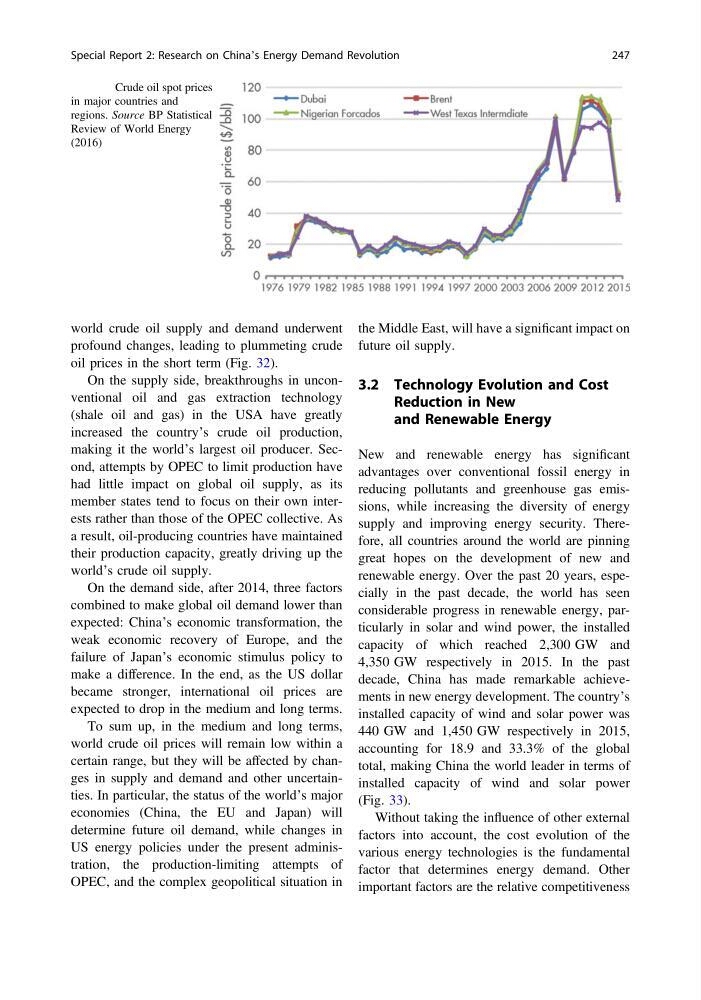
world crude oil supply and demand underwent
profound changes, leading to plummeting crude
oil prices in the short term (Fig. 32).
On the supply side, breakthroughs in unconventional oil and gas extraction technology
(shale oil and gas) in the USA have greatly
increased the country’s crude oil production,
making it the world’s largest oil producer. Second, attempts by OPEC to limit production have
had little impact on global oil supply, as its
member states tend to focus on their own interests rather than those of the OPEC collective. As
a result, oil-producing countries have maintained
their production capacity, greatly driving up the
world’s crude oil supply.
On the demand side, after 2014, three factors
combined to make global oil demand lower than
expected: China’s economic transformation, the
weak economic recovery of Europe, and the
failure of Japan’s economic stimulus policy to
make a difference. In the end, as the US dollar
became stronger, international oil prices are
expected to drop in the medium and long terms.
To sum up, in the medium and long terms,
world crude oil prices will remain low within a
certain range, but they will be affected by changes in supply and demand and other uncertainties. In particular, the status of the world’s major
economies (China, the EU and Japan) will
determine future oil demand, while changes in
US energy policies under the present administration, the production-limiting attempts of
OPEC, and the complex geopolitical situation in
the Middle East, will have a significant impact on
future oil supply.
3.2 Technology Evolution and Cost
Reduction in New
and Renewable Energy
New and renewable energy has significant
advantages over conventional fossil energy in
reducing pollutants and greenhouse gas emissions, while increasing the diversity of energy
supply and improving energy security. Therefore, all countries around the world are pinning
great hopes on the development of new and
renewable energy. Over the past 20 years, especially in the past decade, the world has seen
considerable progress in renewable energy, particularly in solar and wind power, the installed
capacity of which reached 2,300 GW and
4,350 GW respectively in 2015. In the past
decade, China has made remarkable achievements in new energy development. The country’s
installed capacity of wind and solar power was
440 GW and 1,450 GW respectively in 2015,
accounting for 18.9 and 33.3% of the global
total, making China the world leader in terms of
installed capacity of wind and solar power
(Fig. 33).
Without taking the influence of other external
factors into account, the cost evolution of the
various energy technologies is the fundamental
factor that determines energy demand. Other
important factors are the relative competitiveness
Fig. 32 Crude oil spot prices
in major countries and
regions. Source BP Statistical
Review of World Energy
(2016)
Special Report 2: Research on China’s Energy Demand Revolution
247
profound changes, leading to plummeting crude
oil prices in the short term (Fig. 32).
On the supply side, breakthroughs in unconventional oil and gas extraction technology
(shale oil and gas) in the USA have greatly
increased the country’s crude oil production,
making it the world’s largest oil producer. Second, attempts by OPEC to limit production have
had little impact on global oil supply, as its
member states tend to focus on their own interests rather than those of the OPEC collective. As
a result, oil-producing countries have maintained
their production capacity, greatly driving up the
world’s crude oil supply.
On the demand side, after 2014, three factors
combined to make global oil demand lower than
expected: China’s economic transformation, the
weak economic recovery of Europe, and the
failure of Japan’s economic stimulus policy to
make a difference. In the end, as the US dollar
became stronger, international oil prices are
expected to drop in the medium and long terms.
To sum up, in the medium and long terms,
world crude oil prices will remain low within a
certain range, but they will be affected by changes in supply and demand and other uncertainties. In particular, the status of the world’s major
economies (China, the EU and Japan) will
determine future oil demand, while changes in
US energy policies under the present administration, the production-limiting attempts of
OPEC, and the complex geopolitical situation in
the Middle East, will have a significant impact on
future oil supply.
3.2 Technology Evolution and Cost
Reduction in New
and Renewable Energy
New and renewable energy has significant
advantages over conventional fossil energy in
reducing pollutants and greenhouse gas emissions, while increasing the diversity of energy
supply and improving energy security. Therefore, all countries around the world are pinning
great hopes on the development of new and
renewable energy. Over the past 20 years, especially in the past decade, the world has seen
considerable progress in renewable energy, particularly in solar and wind power, the installed
capacity of which reached 2,300 GW and
4,350 GW respectively in 2015. In the past
decade, China has made remarkable achievements in new energy development. The country’s
installed capacity of wind and solar power was
440 GW and 1,450 GW respectively in 2015,
accounting for 18.9 and 33.3% of the global
total, making China the world leader in terms of
installed capacity of wind and solar power
(Fig. 33).
Without taking the influence of other external
factors into account, the cost evolution of the
various energy technologies is the fundamental
factor that determines energy demand. Other
important factors are the relative competitiveness
Fig. 32 Crude oil spot prices
in major countries and
regions. Source BP Statistical
Review of World Energy
(2016)
Special Report 2: Research on China’s Energy Demand Revolution
247