

year, coal prices rose rapidly: the price of thermal
coal doubled over the year as a whole, that of
coking coal almost tripled, and coke prices
quadrupled.
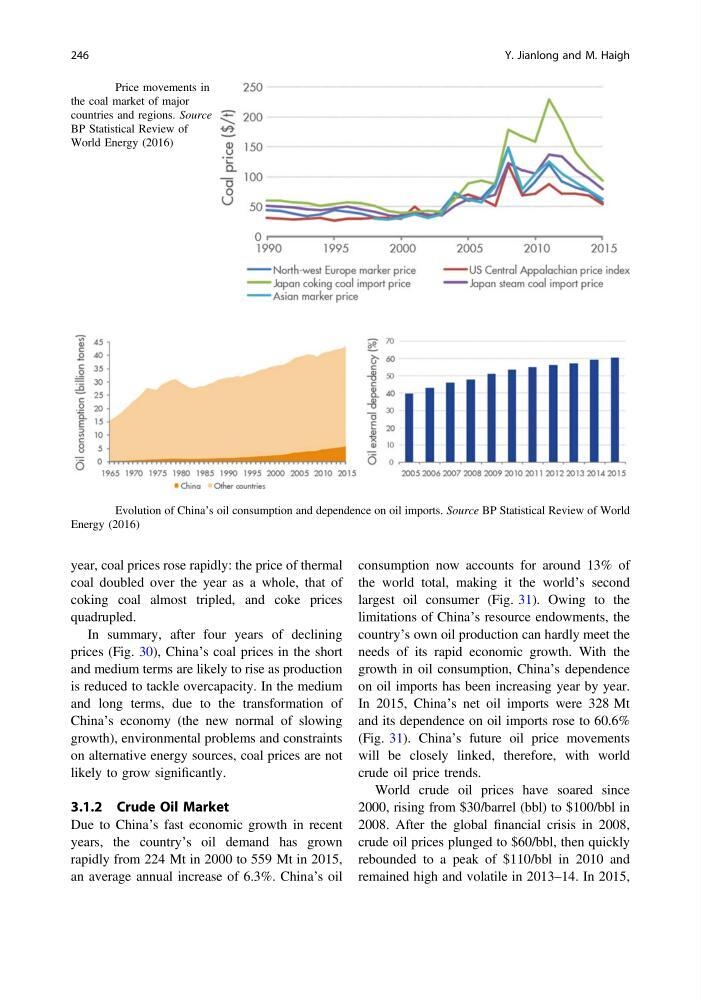
In summary, after four years of declining
prices (Fig. 30), China’s coal prices in the short
and medium terms are likely to rise as production
is reduced to tackle overcapacity. In the medium
and long terms, due to the transformation of
China’s economy (the new normal of slowing
growth), environmental problems and constraints
on alternative energy sources, coal prices are not
likely to grow significantly.
3.1.2 Crude Oil Market
Due to China’s fast economic growth in recent
years, the country’s oil demand has grown
rapidly from 224 Mt in 2000 to 559 Mt in 2015,
an average annual increase of 6.3%. China’s oil
consumption now accounts for around 13% of
the world total, making it the world’s second
largest oil consumer (Fig. 31). Owing to the
limitations of China’s resource endowments, the
country’s own oil production can hardly meet the
needs of its rapid economic growth. With the
growth in oil consumption, China’s dependence
on oil imports has been increasing year by year.
In 2015, China’s net oil imports were 328 Mt
and its dependence on oil imports rose to 60.6%
(Fig. 31). China’s future oil price movements
will be closely linked, therefore, with world
crude oil price trends.
World crude oil prices have soared since
2000, rising from $30/barrel (bbl) to $100/bbl in
2008. After the global financial crisis in 2008,
crude oil prices plunged to $60/bbl, then quickly
rebounded to a peak of $110/bbl in 2010 and
remained high and volatile in 2013–14. In 2015,
Fig. 30 Price movements in
the coal market of major
countries and regions. Source
BP Statistical Review of
World Energy (2016)
Fig. 31 Evolution of China’s oil consumption and dependence on oil imports. Source BP Statistical Review of World
Energy (2016)
246
Y. Jianlong and M. Haigh
coal doubled over the year as a whole, that of
coking coal almost tripled, and coke prices
quadrupled.
In summary, after four years of declining
prices (Fig. 30), China’s coal prices in the short
and medium terms are likely to rise as production
is reduced to tackle overcapacity. In the medium
and long terms, due to the transformation of
China’s economy (the new normal of slowing
growth), environmental problems and constraints
on alternative energy sources, coal prices are not
likely to grow significantly.
3.1.2 Crude Oil Market
Due to China’s fast economic growth in recent
years, the country’s oil demand has grown
rapidly from 224 Mt in 2000 to 559 Mt in 2015,
an average annual increase of 6.3%. China’s oil
consumption now accounts for around 13% of
the world total, making it the world’s second
largest oil consumer (Fig. 31). Owing to the
limitations of China’s resource endowments, the
country’s own oil production can hardly meet the
needs of its rapid economic growth. With the
growth in oil consumption, China’s dependence
on oil imports has been increasing year by year.
In 2015, China’s net oil imports were 328 Mt
and its dependence on oil imports rose to 60.6%
(Fig. 31). China’s future oil price movements
will be closely linked, therefore, with world
crude oil price trends.
World crude oil prices have soared since
2000, rising from $30/barrel (bbl) to $100/bbl in
2008. After the global financial crisis in 2008,
crude oil prices plunged to $60/bbl, then quickly
rebounded to a peak of $110/bbl in 2010 and
remained high and volatile in 2013–14. In 2015,
Fig. 30 Price movements in
the coal market of major
countries and regions. Source
BP Statistical Review of
World Energy (2016)
Fig. 31 Evolution of China’s oil consumption and dependence on oil imports. Source BP Statistical Review of World
Energy (2016)
246
Y. Jianlong and M. Haigh