

undoubtedly have a negative impact on
energy-driven economic growth, especially as
fossil fuels dominate total energy consumption.
However, as the subsidy policy takes hold and
the incentive effects become increasingly evident, renewable energy technologies like wind
and solar will mature and be deployed at scale,
replacing fossil energy technologies to support
and drive macroeconomic growth.
2.5.4 Proposals for Policy Choice
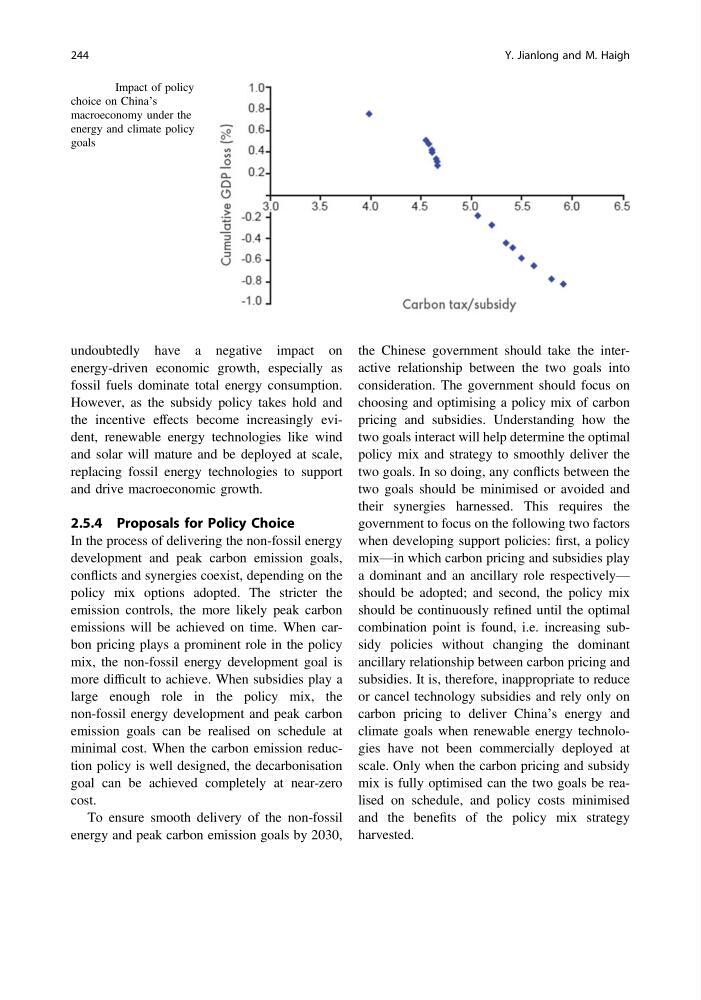
In the process of delivering the non-fossil energy
development and peak carbon emission goals,
conflicts and synergies coexist, depending on the
policy mix options adopted. The stricter the
emission controls, the more likely peak carbon
emissions will be achieved on time. When carbon pricing plays a prominent role in the policy
mix, the non-fossil energy development goal is
more difficult to achieve. When subsidies play a
large enough role in the policy mix, the
non-fossil energy development and peak carbon
emission goals can be realised on schedule at
minimal cost. When the carbon emission reduction policy is well designed, the decarbonisation
goal can be achieved completely at near-zero
cost.
To ensure smooth delivery of the non-fossil
energy and peak carbon emission goals by 2030,
the Chinese government should take the interactive relationship between the two goals into
consideration. The government should focus on
choosing and optimising a policy mix of carbon
pricing and subsidies. Understanding how the
two goals interact will help determine the optimal
policy mix and strategy to smoothly deliver the
two goals. In so doing, any conflicts between the
two goals should be minimised or avoided and
their synergies harnessed. This requires the
government to focus on the following two factors
when developing support policies: first, a policy
mix—in which carbon pricing and subsidies play
a dominant and an ancillary role respectively—
should be adopted; and second, the policy mix
should be continuously refined until the optimal
combination point is found, i.e. increasing subsidy policies without changing the dominant
ancillary relationship between carbon pricing and
subsidies. It is, therefore, inappropriate to reduce
or cancel technology subsidies and rely only on
carbon pricing to deliver China’s energy and
climate goals when renewable energy technologies have not been commercially deployed at
scale. Only when the carbon pricing and subsidy
mix is fully optimised can the two goals be realised on schedule, and policy costs minimised
and the benefits of the policy mix strategy
harvested.
Fig. 28 Impact of policy
choice on China’s
macroeconomy under the
energy and climate policy
goals
244
Y. Jianlong and M. Haigh
energy-driven economic growth, especially as
fossil fuels dominate total energy consumption.
However, as the subsidy policy takes hold and
the incentive effects become increasingly evident, renewable energy technologies like wind
and solar will mature and be deployed at scale,
replacing fossil energy technologies to support
and drive macroeconomic growth.
2.5.4 Proposals for Policy Choice
In the process of delivering the non-fossil energy
development and peak carbon emission goals,
conflicts and synergies coexist, depending on the
policy mix options adopted. The stricter the
emission controls, the more likely peak carbon
emissions will be achieved on time. When carbon pricing plays a prominent role in the policy
mix, the non-fossil energy development goal is
more difficult to achieve. When subsidies play a
large enough role in the policy mix, the
non-fossil energy development and peak carbon
emission goals can be realised on schedule at
minimal cost. When the carbon emission reduction policy is well designed, the decarbonisation
goal can be achieved completely at near-zero
cost.
To ensure smooth delivery of the non-fossil
energy and peak carbon emission goals by 2030,
the Chinese government should take the interactive relationship between the two goals into
consideration. The government should focus on
choosing and optimising a policy mix of carbon
pricing and subsidies. Understanding how the
two goals interact will help determine the optimal
policy mix and strategy to smoothly deliver the
two goals. In so doing, any conflicts between the
two goals should be minimised or avoided and
their synergies harnessed. This requires the
government to focus on the following two factors
when developing support policies: first, a policy
mix—in which carbon pricing and subsidies play
a dominant and an ancillary role respectively—
should be adopted; and second, the policy mix
should be continuously refined until the optimal
combination point is found, i.e. increasing subsidy policies without changing the dominant
ancillary relationship between carbon pricing and
subsidies. It is, therefore, inappropriate to reduce
or cancel technology subsidies and rely only on
carbon pricing to deliver China’s energy and
climate goals when renewable energy technologies have not been commercially deployed at
scale. Only when the carbon pricing and subsidy
mix is fully optimised can the two goals be realised on schedule, and policy costs minimised
and the benefits of the policy mix strategy
harvested.
Fig. 28 Impact of policy
choice on China’s
macroeconomy under the
energy and climate policy
goals
244
Y. Jianlong and M. Haigh