

dependency of economic development on oil and
the inertia of related industries prevent oil’s share
of demand from being squeezed by new energy
technologies. By 2050, the share of oil in energy
demand will decrease by only 3.3% from 2015.
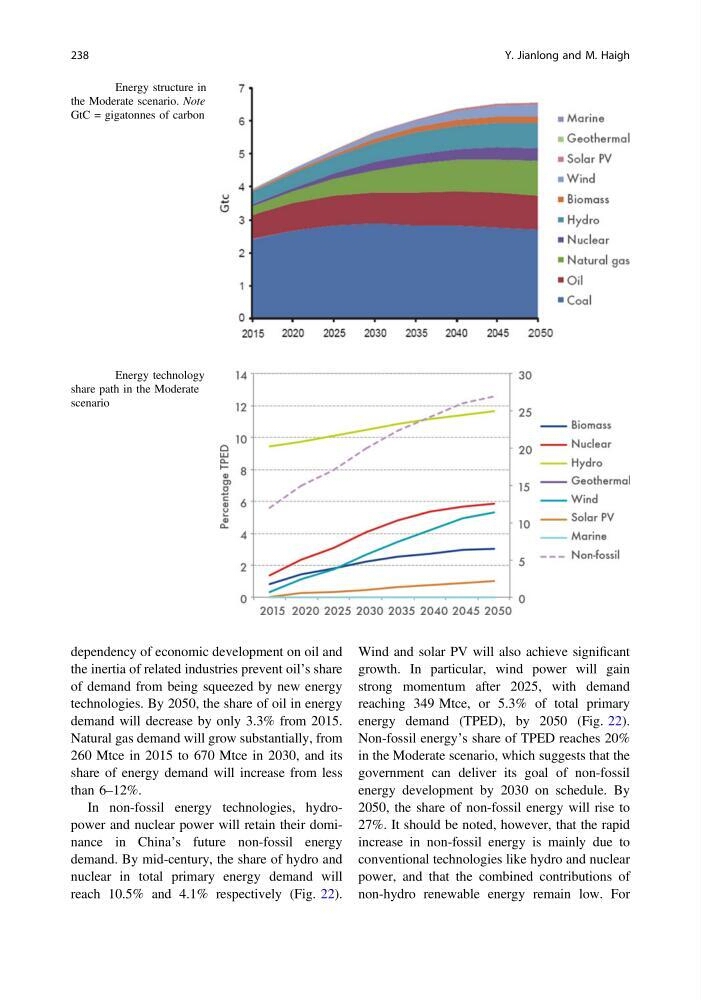
Natural gas demand will grow substantially, from
260 Mtce in 2015 to 670 Mtce in 2030, and its
share of energy demand will increase from less
than 6–12%.
In non-fossil energy technologies, hydropower and nuclear power will retain their dominance in China’s future non-fossil energy
demand. By mid-century, the share of hydro and
nuclear in total primary energy demand will
reach 10.5% and 4.1% respectively (Fig. 22).
Wind and solar PV will also achieve significant
growth. In particular, wind power will gain
strong momentum after 2025, with demand
reaching 349 Mtce, or 5.3% of total primary
energy demand (TPED), by 2050 (Fig. 22).
Non-fossil energy’s share of TPED reaches 20%
in the Moderate scenario, which suggests that the
government can deliver its goal of non-fossil
energy development by 2030 on schedule. By
2050, the share of non-fossil energy will rise to
27%. It should be noted, however, that the rapid
increase in non-fossil energy is mainly due to
conventional technologies like hydro and nuclear
power, and that the combined contributions of
non-hydro renewable energy remain low. For
Fig. 21 Energy structure in
the Moderate scenario. Note
GtC = gigatonnes of carbon
Fig. 22 Energy technology
share path in the Moderate
scenario
238
Y. Jianlong and M. Haigh
the inertia of related industries prevent oil’s share
of demand from being squeezed by new energy
technologies. By 2050, the share of oil in energy
demand will decrease by only 3.3% from 2015.
Natural gas demand will grow substantially, from
260 Mtce in 2015 to 670 Mtce in 2030, and its
share of energy demand will increase from less
than 6–12%.
In non-fossil energy technologies, hydropower and nuclear power will retain their dominance in China’s future non-fossil energy
demand. By mid-century, the share of hydro and
nuclear in total primary energy demand will
reach 10.5% and 4.1% respectively (Fig. 22).
Wind and solar PV will also achieve significant
growth. In particular, wind power will gain
strong momentum after 2025, with demand
reaching 349 Mtce, or 5.3% of total primary
energy demand (TPED), by 2050 (Fig. 22).
Non-fossil energy’s share of TPED reaches 20%
in the Moderate scenario, which suggests that the
government can deliver its goal of non-fossil
energy development by 2030 on schedule. By
2050, the share of non-fossil energy will rise to
27%. It should be noted, however, that the rapid
increase in non-fossil energy is mainly due to
conventional technologies like hydro and nuclear
power, and that the combined contributions of
non-hydro renewable energy remain low. For
Fig. 21 Energy structure in
the Moderate scenario. Note
GtC = gigatonnes of carbon
Fig. 22 Energy technology
share path in the Moderate
scenario
238
Y. Jianlong and M. Haigh