

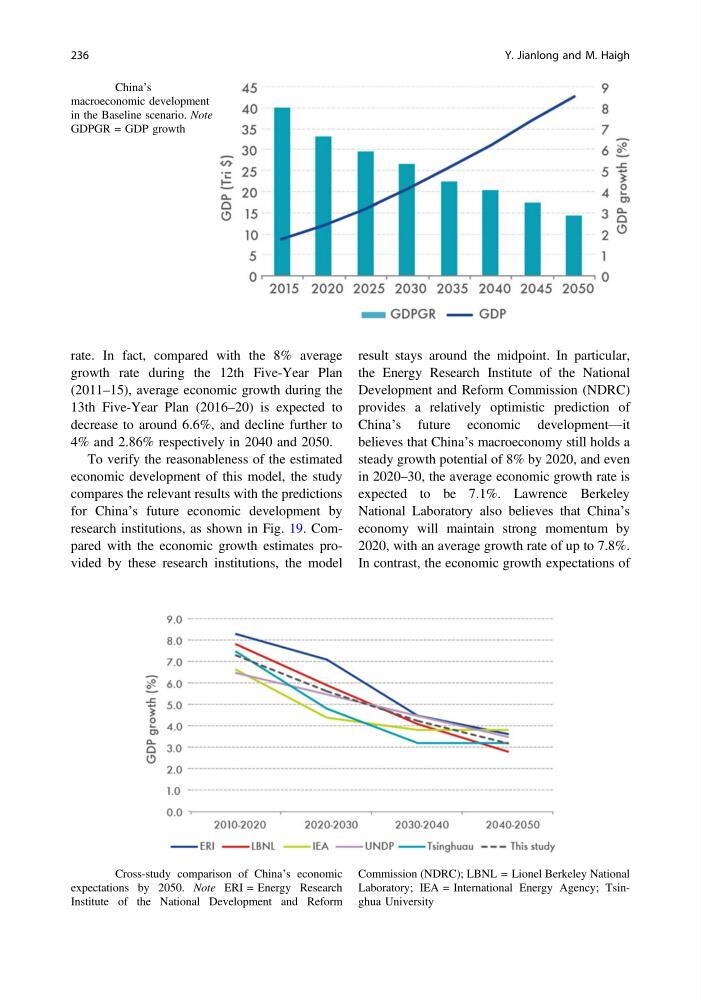
rate. In fact, compared with the 8% average
growth rate during the 12th Five-Year Plan
(2011–15), average economic growth during the
13th Five-Year Plan (2016–20) is expected to
decrease to around 6.6%, and decline further to
4% and 2.86% respectively in 2040 and 2050.
To verify the reasonableness of the estimated
economic development of this model, the study
compares the relevant results with the predictions
for China’s future economic development by
research institutions, as shown in Fig. 19. Compared with the economic growth estimates provided by these research institutions, the model
result stays around the midpoint. In particular,
the Energy Research Institute of the National
Development and Reform Commission (NDRC)
provides a relatively optimistic prediction of
China’s future economic development—it
believes that China’s macroeconomy still holds a
steady growth potential of 8% by 2020, and even
in 2020–30, the average economic growth rate is
expected to be 7.1%. Lawrence Berkeley
National Laboratory also believes that China’s
economy will maintain strong momentum by
2020, with an average growth rate of up to 7.8%.
In contrast, the economic growth expectations of
Fig. 18 China’s
macroeconomic development
in the Baseline scenario. Note
GDPGR = GDP growth
Fig. 19 Cross-study comparison of China’s economic
expectations by 2050. Note ERI = Energy Research
Institute of the National Development and Reform
Commission (NDRC); LBNL = Lionel Berkeley National
Laboratory; IEA = International Energy Agency; Tsinghua University
236
Y. Jianlong and M. Haigh
growth rate during the 12th Five-Year Plan
(2011–15), average economic growth during the
13th Five-Year Plan (2016–20) is expected to
decrease to around 6.6%, and decline further to
4% and 2.86% respectively in 2040 and 2050.
To verify the reasonableness of the estimated
economic development of this model, the study
compares the relevant results with the predictions
for China’s future economic development by
research institutions, as shown in Fig. 19. Compared with the economic growth estimates provided by these research institutions, the model
result stays around the midpoint. In particular,
the Energy Research Institute of the National
Development and Reform Commission (NDRC)
provides a relatively optimistic prediction of
China’s future economic development—it
believes that China’s macroeconomy still holds a
steady growth potential of 8% by 2020, and even
in 2020–30, the average economic growth rate is
expected to be 7.1%. Lawrence Berkeley
National Laboratory also believes that China’s
economy will maintain strong momentum by
2020, with an average growth rate of up to 7.8%.
In contrast, the economic growth expectations of
Fig. 18 China’s
macroeconomic development
in the Baseline scenario. Note
GDPGR = GDP growth
Fig. 19 Cross-study comparison of China’s economic
expectations by 2050. Note ERI = Energy Research
Institute of the National Development and Reform
Commission (NDRC); LBNL = Lionel Berkeley National
Laboratory; IEA = International Energy Agency; Tsinghua University
236
Y. Jianlong and M. Haigh