

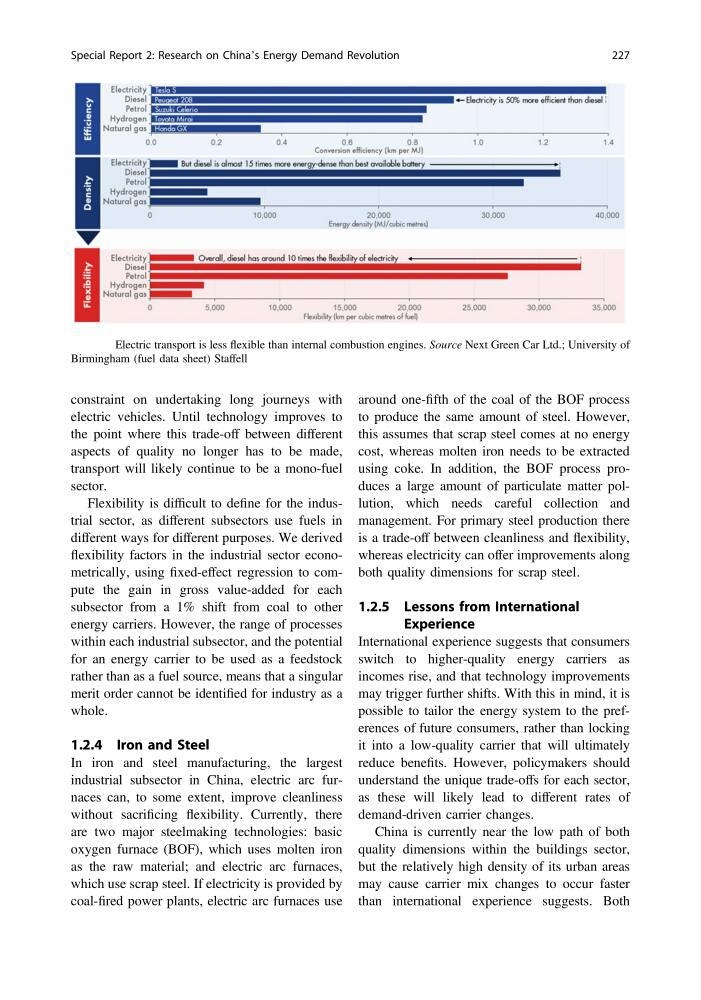
constraint on undertaking long journeys with
electric vehicles. Until technology improves to
the point where this trade-off between different
aspects of quality no longer has to be made,
transport will likely continue to be a mono-fuel
sector.
Flexibility is difficult to define for the industrial sector, as different subsectors use fuels in
different ways for different purposes. We derived
flexibility factors in the industrial sector econometrically, using fixed-effect regression to compute the gain in gross value-added for each
subsector from a 1% shift from coal to other
energy carriers. However, the range of processes
within each industrial subsector, and the potential
for an energy carrier to be used as a feedstock
rather than as a fuel source, means that a singular
merit order cannot be identified for industry as a
whole.
1.2.4 Iron and Steel
In iron and steel manufacturing, the largest
industrial subsector in China, electric arc furnaces can, to some extent, improve cleanliness
without sacrificing flexibility. Currently, there
are two major steelmaking technologies: basic
oxygen furnace (BOF), which uses molten iron
as the raw material; and electric arc furnaces,
which use scrap steel. If electricity is provided by
coal-fired power plants, electric arc furnaces use
around one-fifth of the coal of the BOF process
to produce the same amount of steel. However,
this assumes that scrap steel comes at no energy
cost, whereas molten iron needs to be extracted
using coke. In addition, the BOF process produces a large amount of particulate matter pollution, which needs careful collection and
management. For primary steel production there
is a trade-off between cleanliness and flexibility,
whereas electricity can offer improvements along
both quality dimensions for scrap steel.
1.2.5 Lessons from International
Experience
International experience suggests that consumers
switch to higher-quality energy carriers as
incomes rise, and that technology improvements
may trigger further shifts. With this in mind, it is
possible to tailor the energy system to the preferences of future consumers, rather than locking
it into a low-quality carrier that will ultimately
reduce benefits. However, policymakers should
understand the unique trade-offs for each sector,
as these will likely lead to different rates of
demand-driven carrier changes.
China is currently near the low path of both
quality dimensions within the buildings sector,
but the relatively high density of its urban areas
may cause carrier mix changes to occur faster
than international experience suggests. Both
Fig. 14 Electric transport is less flexible than internal combustion engines. Source Next Green Car Ltd.; University of
Birmingham (fuel data sheet) Staffell
Special Report 2: Research on China’s Energy Demand Revolution
227
electric vehicles. Until technology improves to
the point where this trade-off between different
aspects of quality no longer has to be made,
transport will likely continue to be a mono-fuel
sector.
Flexibility is difficult to define for the industrial sector, as different subsectors use fuels in
different ways for different purposes. We derived
flexibility factors in the industrial sector econometrically, using fixed-effect regression to compute the gain in gross value-added for each
subsector from a 1% shift from coal to other
energy carriers. However, the range of processes
within each industrial subsector, and the potential
for an energy carrier to be used as a feedstock
rather than as a fuel source, means that a singular
merit order cannot be identified for industry as a
whole.
1.2.4 Iron and Steel
In iron and steel manufacturing, the largest
industrial subsector in China, electric arc furnaces can, to some extent, improve cleanliness
without sacrificing flexibility. Currently, there
are two major steelmaking technologies: basic
oxygen furnace (BOF), which uses molten iron
as the raw material; and electric arc furnaces,
which use scrap steel. If electricity is provided by
coal-fired power plants, electric arc furnaces use
around one-fifth of the coal of the BOF process
to produce the same amount of steel. However,
this assumes that scrap steel comes at no energy
cost, whereas molten iron needs to be extracted
using coke. In addition, the BOF process produces a large amount of particulate matter pollution, which needs careful collection and
management. For primary steel production there
is a trade-off between cleanliness and flexibility,
whereas electricity can offer improvements along
both quality dimensions for scrap steel.
1.2.5 Lessons from International
Experience
International experience suggests that consumers
switch to higher-quality energy carriers as
incomes rise, and that technology improvements
may trigger further shifts. With this in mind, it is
possible to tailor the energy system to the preferences of future consumers, rather than locking
it into a low-quality carrier that will ultimately
reduce benefits. However, policymakers should
understand the unique trade-offs for each sector,
as these will likely lead to different rates of
demand-driven carrier changes.
China is currently near the low path of both
quality dimensions within the buildings sector,
but the relatively high density of its urban areas
may cause carrier mix changes to occur faster
than international experience suggests. Both
Fig. 14 Electric transport is less flexible than internal combustion engines. Source Next Green Car Ltd.; University of
Birmingham (fuel data sheet) Staffell
Special Report 2: Research on China’s Energy Demand Revolution
227