

cleanliness and flexibility become more important in buildings as population density increases.
As local pollution is a negative externality upon
an entire area, a highly dense population might
be willing to pay a higher price for clean energy
carriers than rural societies. The high cost of land
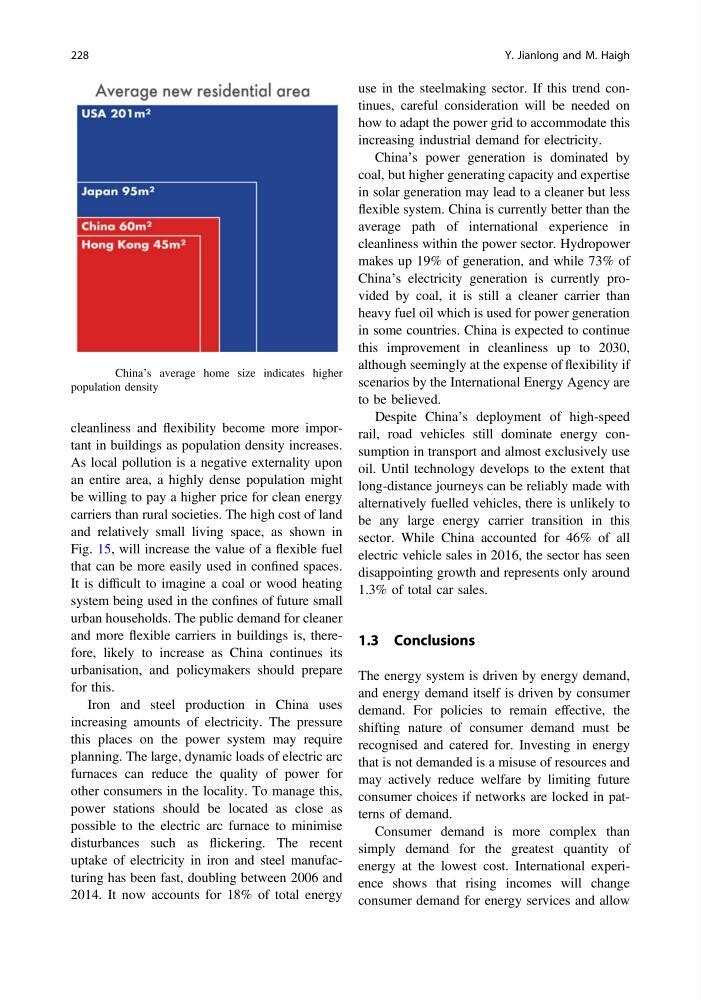
and relatively small living space, as shown in
Fig. 15, will increase the value of a flexible fuel
that can be more easily used in confined spaces.
It is difficult to imagine a coal or wood heating
system being used in the confines of future small
urban households. The public demand for cleaner
and more flexible carriers in buildings is, therefore, likely to increase as China continues its
urbanisation, and policymakers should prepare
for this.
Iron and steel production in China uses
increasing amounts of electricity. The pressure
this places on the power system may require
planning. The large, dynamic loads of electric arc
furnaces can reduce the quality of power for
other consumers in the locality. To manage this,
power stations should be located as close as
possible to the electric arc furnace to minimise
disturbances such as flickering. The recent
uptake of electricity in iron and steel manufacturing has been fast, doubling between 2006 and
2014. It now accounts for 18% of total energy
use in the steelmaking sector. If this trend continues, careful consideration will be needed on
how to adapt the power grid to accommodate this
increasing industrial demand for electricity.
China’s power generation is dominated by
coal, but higher generating capacity and expertise
in solar generation may lead to a cleaner but less
flexible system. China is currently better than the
average path of international experience in
cleanliness within the power sector. Hydropower
makes up 19% of generation, and while 73% of
China’s electricity generation is currently provided by coal, it is still a cleaner carrier than
heavy fuel oil which is used for power generation
in some countries. China is expected to continue
this improvement in cleanliness up to 2030,
although seemingly at the expense of flexibility if
scenarios by the International Energy Agency are
to be believed.
Despite China’s deployment of high-speed
rail, road vehicles still dominate energy consumption in transport and almost exclusively use
oil. Until technology develops to the extent that
long-distance journeys can be reliably made with
alternatively fuelled vehicles, there is unlikely to
be any large energy carrier transition in this
sector. While China accounted for 46% of all
electric vehicle sales in 2016, the sector has seen
disappointing growth and represents only around
1.3% of total car sales.
1.3 Conclusions
The energy system is driven by energy demand,
and energy demand itself is driven by consumer
demand. For policies to remain effective, the
shifting nature of consumer demand must be
recognised and catered for. Investing in energy
that is not demanded is a misuse of resources and
may actively reduce welfare by limiting future
consumer choices if networks are locked in patterns of demand.
Consumer demand is more complex than
simply demand for the greatest quantity of
energy at the lowest cost. International experience shows that rising incomes will change
consumer demand for energy services and allow
Fig. 15 China’s average home size indicates higher
population density
228
Y. Jianlong and M. Haigh
As local pollution is a negative externality upon
an entire area, a highly dense population might
be willing to pay a higher price for clean energy
carriers than rural societies. The high cost of land
and relatively small living space, as shown in
Fig. 15, will increase the value of a flexible fuel
that can be more easily used in confined spaces.
It is difficult to imagine a coal or wood heating
system being used in the confines of future small
urban households. The public demand for cleaner
and more flexible carriers in buildings is, therefore, likely to increase as China continues its
urbanisation, and policymakers should prepare
for this.
Iron and steel production in China uses
increasing amounts of electricity. The pressure
this places on the power system may require
planning. The large, dynamic loads of electric arc
furnaces can reduce the quality of power for
other consumers in the locality. To manage this,
power stations should be located as close as
possible to the electric arc furnace to minimise
disturbances such as flickering. The recent
uptake of electricity in iron and steel manufacturing has been fast, doubling between 2006 and
2014. It now accounts for 18% of total energy
use in the steelmaking sector. If this trend continues, careful consideration will be needed on
how to adapt the power grid to accommodate this
increasing industrial demand for electricity.
China’s power generation is dominated by
coal, but higher generating capacity and expertise
in solar generation may lead to a cleaner but less
flexible system. China is currently better than the
average path of international experience in
cleanliness within the power sector. Hydropower
makes up 19% of generation, and while 73% of
China’s electricity generation is currently provided by coal, it is still a cleaner carrier than
heavy fuel oil which is used for power generation
in some countries. China is expected to continue
this improvement in cleanliness up to 2030,
although seemingly at the expense of flexibility if
scenarios by the International Energy Agency are
to be believed.
Despite China’s deployment of high-speed
rail, road vehicles still dominate energy consumption in transport and almost exclusively use
oil. Until technology develops to the extent that
long-distance journeys can be reliably made with
alternatively fuelled vehicles, there is unlikely to
be any large energy carrier transition in this
sector. While China accounted for 46% of all
electric vehicle sales in 2016, the sector has seen
disappointing growth and represents only around
1.3% of total car sales.
1.3 Conclusions
The energy system is driven by energy demand,
and energy demand itself is driven by consumer
demand. For policies to remain effective, the
shifting nature of consumer demand must be
recognised and catered for. Investing in energy
that is not demanded is a misuse of resources and
may actively reduce welfare by limiting future
consumer choices if networks are locked in patterns of demand.
Consumer demand is more complex than
simply demand for the greatest quantity of
energy at the lowest cost. International experience shows that rising incomes will change
consumer demand for energy services and allow
Fig. 15 China’s average home size indicates higher
population density
228
Y. Jianlong and M. Haigh