

conventional power plants for the past 15 years
or more. As a result, Danish coal-fired power
plants have been optimised to have shorter
start-up rates, lower minimum loads and steeper
ramp-up rates than similar installations in other
countries.
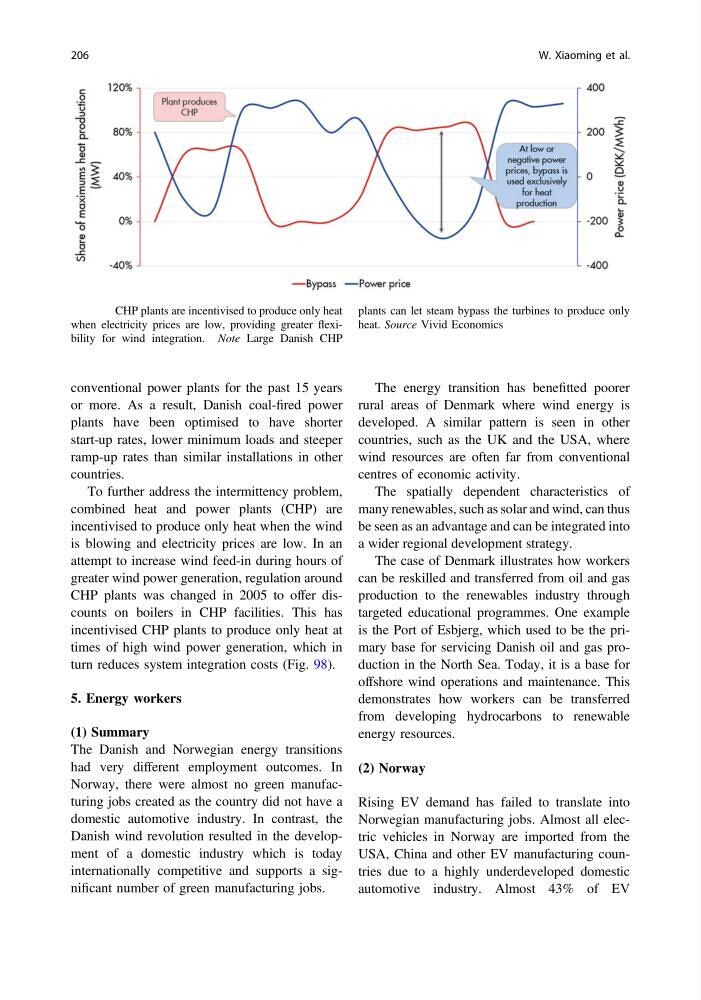
To further address the intermittency problem,
combined heat and power plants (CHP) are
incentivised to produce only heat when the wind
is blowing and electricity prices are low. In an
attempt to increase wind feed-in during hours of
greater wind power generation, regulation around
CHP plants was changed in 2005 to offer discounts on boilers in CHP facilities. This has
incentivised CHP plants to produce only heat at
times of high wind power generation, which in
turn reduces system integration costs (Fig. 98).
5. Energy workers
(1) Summary
The Danish and Norwegian energy transitions
had very different employment outcomes. In
Norway, there were almost no green manufacturing jobs created as the country did not have a
domestic automotive industry. In contrast, the
Danish wind revolution resulted in the development of a domestic industry which is today
internationally competitive and supports a significant number of green manufacturing jobs.
The energy transition has benefitted poorer
rural areas of Denmark where wind energy is
developed. A similar pattern is seen in other
countries, such as the UK and the USA, where
wind resources are often far from conventional
centres of economic activity.
The spatially dependent characteristics of
many renewables, such as solar and wind, can thus
be seen as an advantage and can be integrated into
a wider regional development strategy.
The case of Denmark illustrates how workers
can be reskilled and transferred from oil and gas
production to the renewables industry through
targeted educational programmes. One example
is the Port of Esbjerg, which used to be the primary base for servicing Danish oil and gas production in the North Sea. Today, it is a base for
offshore wind operations and maintenance. This
demonstrates how workers can be transferred
from developing hydrocarbons to renewable
energy resources.
(2) Norway
Rising EV demand has failed to translate into
Norwegian manufacturing jobs. Almost all electric vehicles in Norway are imported from the
USA, China and other EV manufacturing countries due to a highly underdeveloped domestic
automotive industry. Almost 43% of EV
Fig. 98 CHP plants are incentivised to produce only heat
when electricity prices are low, providing greater flexibility for wind integration. Note Large Danish CHP
plants can let steam bypass the turbines to produce only
heat. Source Vivid Economics
206
W. Xiaoming et al.
or more. As a result, Danish coal-fired power
plants have been optimised to have shorter
start-up rates, lower minimum loads and steeper
ramp-up rates than similar installations in other
countries.
To further address the intermittency problem,
combined heat and power plants (CHP) are
incentivised to produce only heat when the wind
is blowing and electricity prices are low. In an
attempt to increase wind feed-in during hours of
greater wind power generation, regulation around
CHP plants was changed in 2005 to offer discounts on boilers in CHP facilities. This has
incentivised CHP plants to produce only heat at
times of high wind power generation, which in
turn reduces system integration costs (Fig. 98).
5. Energy workers
(1) Summary
The Danish and Norwegian energy transitions
had very different employment outcomes. In
Norway, there were almost no green manufacturing jobs created as the country did not have a
domestic automotive industry. In contrast, the
Danish wind revolution resulted in the development of a domestic industry which is today
internationally competitive and supports a significant number of green manufacturing jobs.
The energy transition has benefitted poorer
rural areas of Denmark where wind energy is
developed. A similar pattern is seen in other
countries, such as the UK and the USA, where
wind resources are often far from conventional
centres of economic activity.
The spatially dependent characteristics of
many renewables, such as solar and wind, can thus
be seen as an advantage and can be integrated into
a wider regional development strategy.
The case of Denmark illustrates how workers
can be reskilled and transferred from oil and gas
production to the renewables industry through
targeted educational programmes. One example
is the Port of Esbjerg, which used to be the primary base for servicing Danish oil and gas production in the North Sea. Today, it is a base for
offshore wind operations and maintenance. This
demonstrates how workers can be transferred
from developing hydrocarbons to renewable
energy resources.
(2) Norway
Rising EV demand has failed to translate into
Norwegian manufacturing jobs. Almost all electric vehicles in Norway are imported from the
USA, China and other EV manufacturing countries due to a highly underdeveloped domestic
automotive industry. Almost 43% of EV
Fig. 98 CHP plants are incentivised to produce only heat
when electricity prices are low, providing greater flexibility for wind integration. Note Large Danish CHP
plants can let steam bypass the turbines to produce only
heat. Source Vivid Economics
206
W. Xiaoming et al.