

significant offshore wind resources with high
wind speeds of 8.5–9.0 metres per second at 50
metres height. Denmark therefore offered the
ideal testing ground for deploying offshore wind,
and DONG Energy utilised this.
Government support together with favourable
investment conditions provided DONG Energy
with the financial resources needed for its transformation. In addition to government subsidies,
the significant volume of government tenders and
large test facilities reduced offshore wind
deployment costs. DONG also collaborated closely with publicly financed research institutions
to ensure certification, testing and standards,
which later contributed to its international
competitiveness. Finally, financially stable
returns and credible policies have made offshore
wind energy as attractive as some financial
bonds. This has allowed DONG to convince
institutional investors, such as pension funds, to
help finance their wind investments at relatively
low cost (Fig. 97).
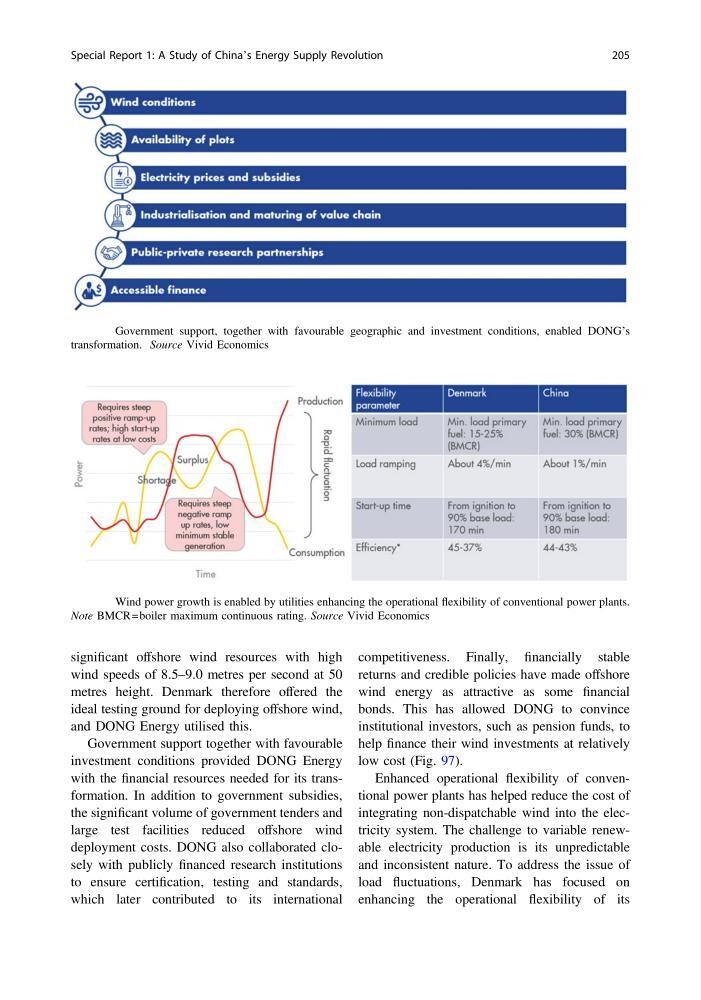
Enhanced operational flexibility of conventional power plants has helped reduce the cost of
integrating non-dispatchable wind into the electricity system. The challenge to variable renewable electricity production is its unpredictable
and inconsistent nature. To address the issue of
load fluctuations, Denmark has focused on
enhancing the operational flexibility of its
Fig. 97 Wind power growth is enabled by utilities enhancing the operational flexibility of conventional power plants.
Note BMCR=boiler maximum continuous rating. Source Vivid Economics
Fig. 96 Government support, together with favourable geographic and investment conditions, enabled DONG’s
transformation. Source Vivid Economics
Special Report 1: A Study of China’s Energy Supply Revolution
205
wind speeds of 8.5–9.0 metres per second at 50
metres height. Denmark therefore offered the
ideal testing ground for deploying offshore wind,
and DONG Energy utilised this.
Government support together with favourable
investment conditions provided DONG Energy
with the financial resources needed for its transformation. In addition to government subsidies,
the significant volume of government tenders and
large test facilities reduced offshore wind
deployment costs. DONG also collaborated closely with publicly financed research institutions
to ensure certification, testing and standards,
which later contributed to its international
competitiveness. Finally, financially stable
returns and credible policies have made offshore
wind energy as attractive as some financial
bonds. This has allowed DONG to convince
institutional investors, such as pension funds, to
help finance their wind investments at relatively
low cost (Fig. 97).
Enhanced operational flexibility of conventional power plants has helped reduce the cost of
integrating non-dispatchable wind into the electricity system. The challenge to variable renewable electricity production is its unpredictable
and inconsistent nature. To address the issue of
load fluctuations, Denmark has focused on
enhancing the operational flexibility of its
Fig. 97 Wind power growth is enabled by utilities enhancing the operational flexibility of conventional power plants.
Note BMCR=boiler maximum continuous rating. Source Vivid Economics
Fig. 96 Government support, together with favourable geographic and investment conditions, enabled DONG’s
transformation. Source Vivid Economics
Special Report 1: A Study of China’s Energy Supply Revolution
205