

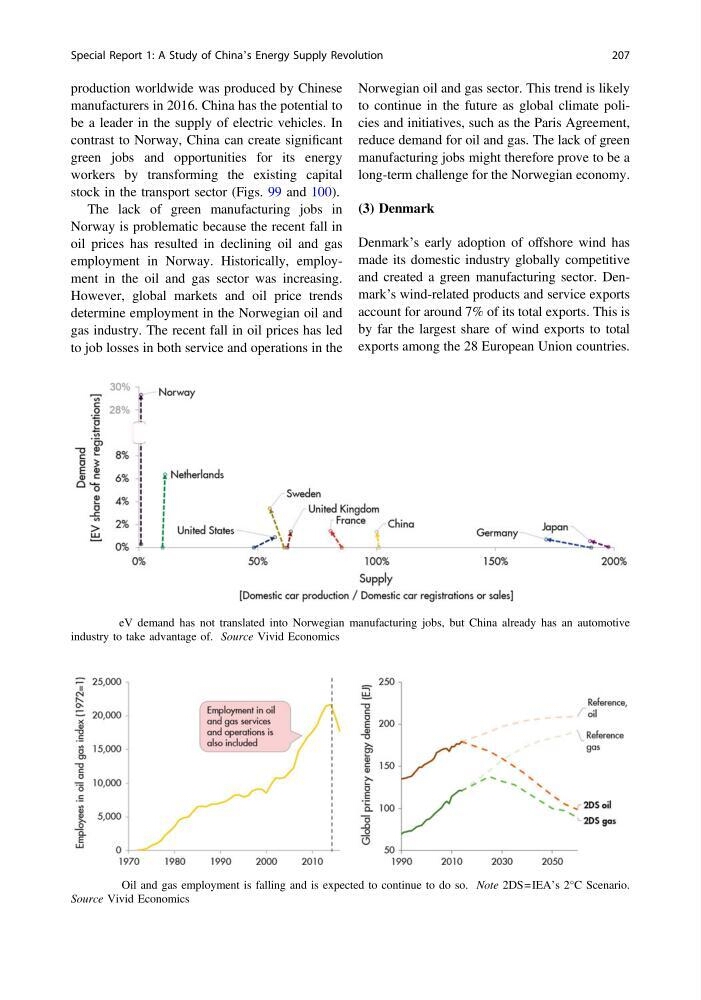
production worldwide was produced by Chinese
manufacturers in 2016. China has the potential to
be a leader in the supply of electric vehicles. In
contrast to Norway, China can create significant
green jobs and opportunities for its energy
workers by transforming the existing capital
stock in the transport sector (Figs. 99 and 100).
The lack of green manufacturing jobs in
Norway is problematic because the recent fall in
oil prices has resulted in declining oil and gas
employment in Norway. Historically, employment in the oil and gas sector was increasing.
However, global markets and oil price trends
determine employment in the Norwegian oil and
gas industry. The recent fall in oil prices has led
to job losses in both service and operations in the
Norwegian oil and gas sector. This trend is likely
to continue in the future as global climate policies and initiatives, such as the Paris Agreement,
reduce demand for oil and gas. The lack of green
manufacturing jobs might therefore prove to be a
long-term challenge for the Norwegian economy.
(3) Denmark
Denmark’s early adoption of offshore wind has
made its domestic industry globally competitive
and created a green manufacturing sector. Denmark’s wind-related products and service exports
account for around 7% of its total exports. This is
by far the largest share of wind exports to total
exports among the 28 European Union countries.
Fig. 100 Oil and gas employment is falling and is expected to continue to do so. Note 2DS=IEA’s 2°C Scenario.
Source Vivid Economics
Fig. 99 eV demand has not translated into Norwegian manufacturing jobs, but China already has an automotive
industry to take advantage of. Source Vivid Economics
Special Report 1: A Study of China’s Energy Supply Revolution
207
manufacturers in 2016. China has the potential to
be a leader in the supply of electric vehicles. In
contrast to Norway, China can create significant
green jobs and opportunities for its energy
workers by transforming the existing capital
stock in the transport sector (Figs. 99 and 100).
The lack of green manufacturing jobs in
Norway is problematic because the recent fall in
oil prices has resulted in declining oil and gas
employment in Norway. Historically, employment in the oil and gas sector was increasing.
However, global markets and oil price trends
determine employment in the Norwegian oil and
gas industry. The recent fall in oil prices has led
to job losses in both service and operations in the
Norwegian oil and gas sector. This trend is likely
to continue in the future as global climate policies and initiatives, such as the Paris Agreement,
reduce demand for oil and gas. The lack of green
manufacturing jobs might therefore prove to be a
long-term challenge for the Norwegian economy.
(3) Denmark
Denmark’s early adoption of offshore wind has
made its domestic industry globally competitive
and created a green manufacturing sector. Denmark’s wind-related products and service exports
account for around 7% of its total exports. This is
by far the largest share of wind exports to total
exports among the 28 European Union countries.
Fig. 100 Oil and gas employment is falling and is expected to continue to do so. Note 2DS=IEA’s 2°C Scenario.
Source Vivid Economics
Fig. 99 eV demand has not translated into Norwegian manufacturing jobs, but China already has an automotive
industry to take advantage of. Source Vivid Economics
Special Report 1: A Study of China’s Energy Supply Revolution
207