

research into alternative energy sources. In contrast to neighbouring Sweden, Denmark quickly
abandoned nuclear power as a part of its future
energy system. This was largely because a strong
anti-nuclear movement fostered public concern
about the safety of nuclear power. Due to public
sentiment, the Danish government decided to
exclude nuclear and include wind in its future
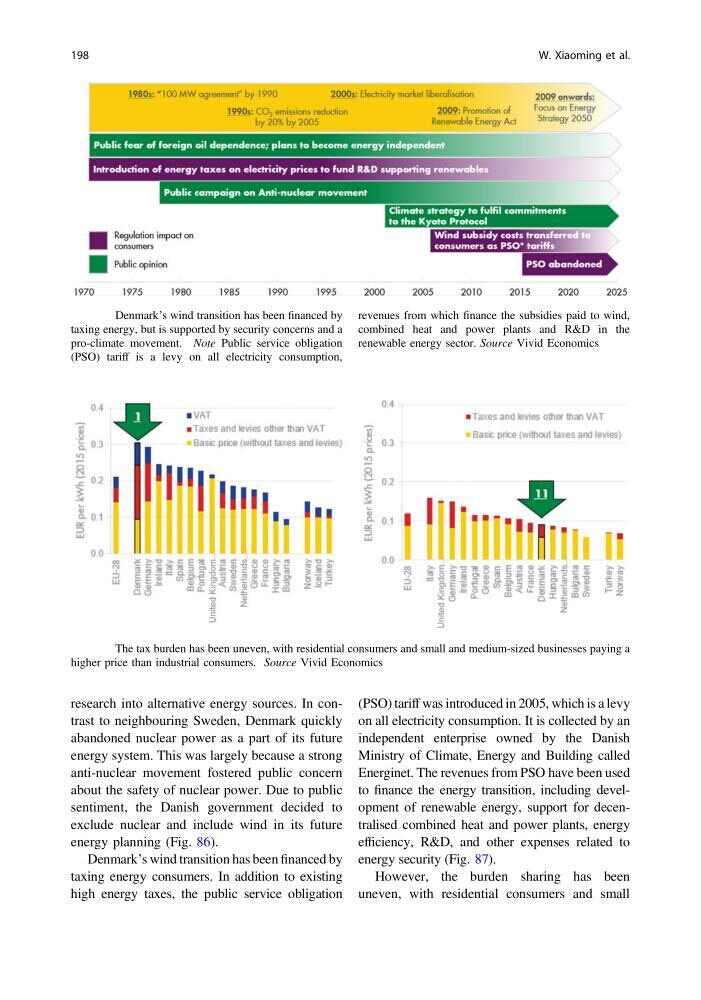
energy planning (Fig. 86).
Denmark’s wind transition has been financed by
taxing energy consumers. In addition to existing
high energy taxes, the public service obligation
(PSO) tariff was introduced in 2005, which is a levy
on all electricity consumption. It is collected by an
independent enterprise owned by the Danish
Ministry of Climate, Energy and Building called
Energinet. The revenues from PSO have been used
to finance the energy transition, including development of renewable energy, support for decentralised combined heat and power plants, energy
efficiency, R&D, and other expenses related to
energy security (Fig. 87).
However, the burden sharing has been
uneven, with residential consumers and small
Fig. 87 The tax burden has been uneven, with residential consumers and small and medium-sized businesses paying a
higher price than industrial consumers. Source Vivid Economics
Fig. 86 Denmark’s wind transition has been financed by
taxing energy, but is supported by security concerns and a
pro-climate movement. Note Public service obligation
(PSO) tariff is a levy on all electricity consumption,
revenues from which finance the subsidies paid to wind,
combined heat and power plants and R&D in the
renewable energy sector. Source Vivid Economics
198
W. Xiaoming et al.
abandoned nuclear power as a part of its future
energy system. This was largely because a strong
anti-nuclear movement fostered public concern
about the safety of nuclear power. Due to public
sentiment, the Danish government decided to
exclude nuclear and include wind in its future
energy planning (Fig. 86).
Denmark’s wind transition has been financed by
taxing energy consumers. In addition to existing
high energy taxes, the public service obligation
(PSO) tariff was introduced in 2005, which is a levy
on all electricity consumption. It is collected by an
independent enterprise owned by the Danish
Ministry of Climate, Energy and Building called
Energinet. The revenues from PSO have been used
to finance the energy transition, including development of renewable energy, support for decentralised combined heat and power plants, energy
efficiency, R&D, and other expenses related to
energy security (Fig. 87).
However, the burden sharing has been
uneven, with residential consumers and small
Fig. 87 The tax burden has been uneven, with residential consumers and small and medium-sized businesses paying a
higher price than industrial consumers. Source Vivid Economics
Fig. 86 Denmark’s wind transition has been financed by
taxing energy, but is supported by security concerns and a
pro-climate movement. Note Public service obligation
(PSO) tariff is a levy on all electricity consumption,
revenues from which finance the subsidies paid to wind,
combined heat and power plants and R&D in the
renewable energy sector. Source Vivid Economics
198
W. Xiaoming et al.