

and medium-sized enterprises (SMEs) paying a
much higher tax than industrial consumers.
Residential and SMEs in Sweden pay the highest
price for electricity in the EU. The cost of electricity represents only around 30% of the overall
price and energy taxes are almost three times the
European average. In contrast, industrial consumers are not subject to the same high energy
taxes. This is primarily because the government
has sought to ensure global competitiveness for
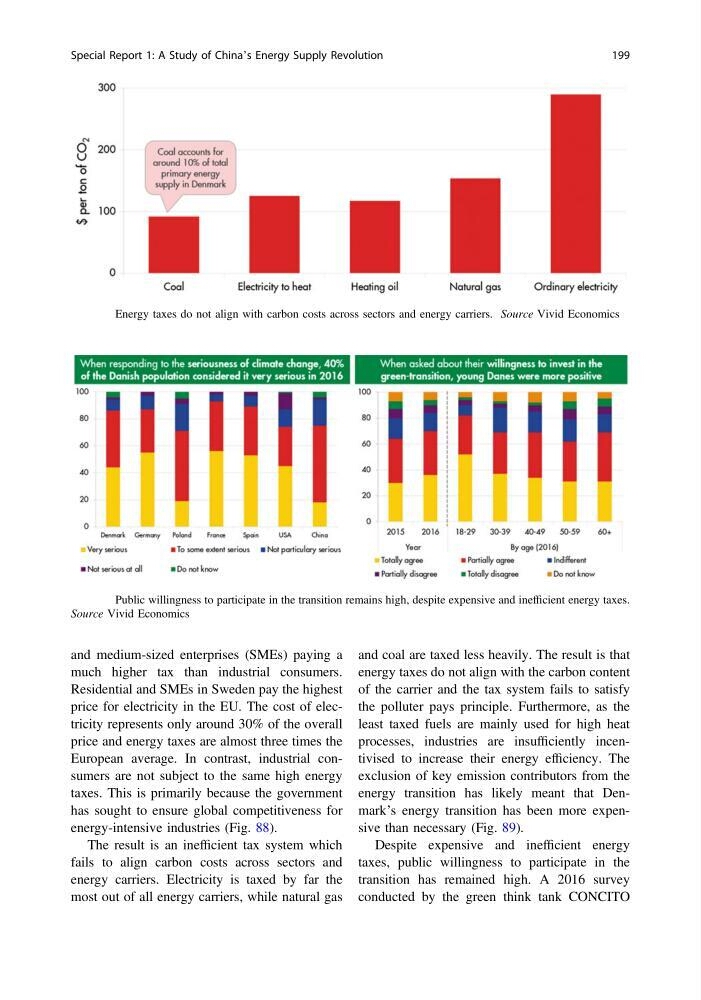
energy-intensive industries (Fig. 88).
The result is an inefficient tax system which
fails to align carbon costs across sectors and
energy carriers. Electricity is taxed by far the
most out of all energy carriers, while natural gas
and coal are taxed less heavily. The result is that
energy taxes do not align with the carbon content
of the carrier and the tax system fails to satisfy
the polluter pays principle. Furthermore, as the
least taxed fuels are mainly used for high heat
processes, industries are insufficiently incentivised to increase their energy efficiency. The
exclusion of key emission contributors from the
energy transition has likely meant that Denmark’s energy transition has been more expensive than necessary (Fig. 89).
Despite expensive and inefficient energy
taxes, public willingness to participate in the
transition has remained high. A 2016 survey
conducted by the green think tank CONCITO
Fig. 89 Public willingness to participate in the transition remains high, despite expensive and inefficient energy taxes.
Source Vivid Economics
Fig. 88 Energy taxes do not align with carbon costs across sectors and energy carriers. Source Vivid Economics
Special Report 1: A Study of China’s Energy Supply Revolution
199
much higher tax than industrial consumers.
Residential and SMEs in Sweden pay the highest
price for electricity in the EU. The cost of electricity represents only around 30% of the overall
price and energy taxes are almost three times the
European average. In contrast, industrial consumers are not subject to the same high energy
taxes. This is primarily because the government
has sought to ensure global competitiveness for
energy-intensive industries (Fig. 88).
The result is an inefficient tax system which
fails to align carbon costs across sectors and
energy carriers. Electricity is taxed by far the
most out of all energy carriers, while natural gas
and coal are taxed less heavily. The result is that
energy taxes do not align with the carbon content
of the carrier and the tax system fails to satisfy
the polluter pays principle. Furthermore, as the
least taxed fuels are mainly used for high heat
processes, industries are insufficiently incentivised to increase their energy efficiency. The
exclusion of key emission contributors from the
energy transition has likely meant that Denmark’s energy transition has been more expensive than necessary (Fig. 89).
Despite expensive and inefficient energy
taxes, public willingness to participate in the
transition has remained high. A 2016 survey
conducted by the green think tank CONCITO
Fig. 89 Public willingness to participate in the transition remains high, despite expensive and inefficient energy taxes.
Source Vivid Economics
Fig. 88 Energy taxes do not align with carbon costs across sectors and energy carriers. Source Vivid Economics
Special Report 1: A Study of China’s Energy Supply Revolution
199