

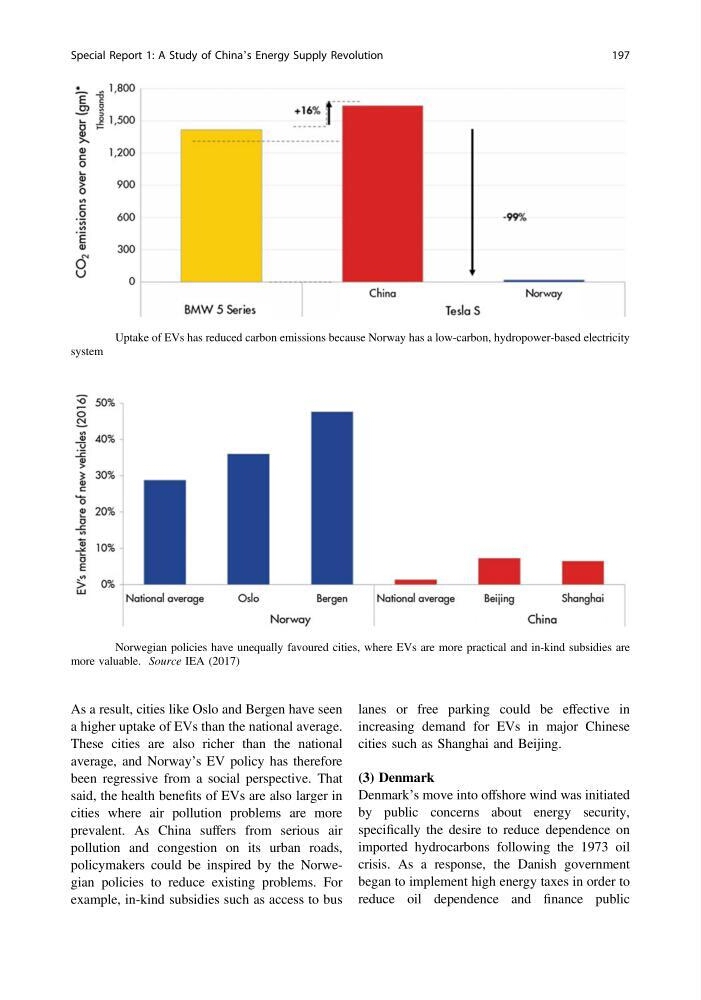
As a result, cities like Oslo and Bergen have seen
a higher uptake of EVs than the national average.
These cities are also richer than the national
average, and Norway’s EV policy has therefore
been regressive from a social perspective. That
said, the health benefits of EVs are also larger in
cities where air pollution problems are more
prevalent. As China suffers from serious air
pollution and congestion on its urban roads,
policymakers could be inspired by the Norwegian policies to reduce existing problems. For
example, in-kind subsidies such as access to bus
lanes or free parking could be effective in
increasing demand for EVs in major Chinese
cities such as Shanghai and Beijing.
(3) Denmark
Denmark’s move into offshore wind was initiated
by public concerns about energy security,
specifically the desire to reduce dependence on
imported hydrocarbons following the 1973 oil
crisis. As a response, the Danish government
began to implement high energy taxes in order to
reduce oil dependence and finance public
Fig. 85 Norwegian policies have unequally favoured cities, where EVs are more practical and in-kind subsidies are
more valuable. Source IEA (2017)
Fig. 84 Uptake of EVs has reduced carbon emissions because Norway has a low-carbon, hydropower-based electricity
system
Special Report 1: A Study of China’s Energy Supply Revolution
197
a higher uptake of EVs than the national average.
These cities are also richer than the national
average, and Norway’s EV policy has therefore
been regressive from a social perspective. That
said, the health benefits of EVs are also larger in
cities where air pollution problems are more
prevalent. As China suffers from serious air
pollution and congestion on its urban roads,
policymakers could be inspired by the Norwegian policies to reduce existing problems. For
example, in-kind subsidies such as access to bus
lanes or free parking could be effective in
increasing demand for EVs in major Chinese
cities such as Shanghai and Beijing.
(3) Denmark
Denmark’s move into offshore wind was initiated
by public concerns about energy security,
specifically the desire to reduce dependence on
imported hydrocarbons following the 1973 oil
crisis. As a response, the Danish government
began to implement high energy taxes in order to
reduce oil dependence and finance public
Fig. 85 Norwegian policies have unequally favoured cities, where EVs are more practical and in-kind subsidies are
more valuable. Source IEA (2017)
Fig. 84 Uptake of EVs has reduced carbon emissions because Norway has a low-carbon, hydropower-based electricity
system
Special Report 1: A Study of China’s Energy Supply Revolution
197