

Cars are traditionally taxed heavily in Norway
and tax exemptions therefore work as a significant subsidy to EV consumers. For example,
when the total ownership cost of a Tesla S is
compared with a BMW 5 Series, which has a
42% cheaper base price, the BMW turns out to
be 16% more expensive when taxes are included.
In addition, fuel costs over the lifetime of a
BMW 5 are more than double those of a Tesla S.
The same pattern is seen with smaller EVs where
ownership cost differentials are even higher. For
example, an otherwise cheaper Volkswagen Golf
becomes 46% more expensive than a Nissan LEAF when taxes are included (Fig. 83).
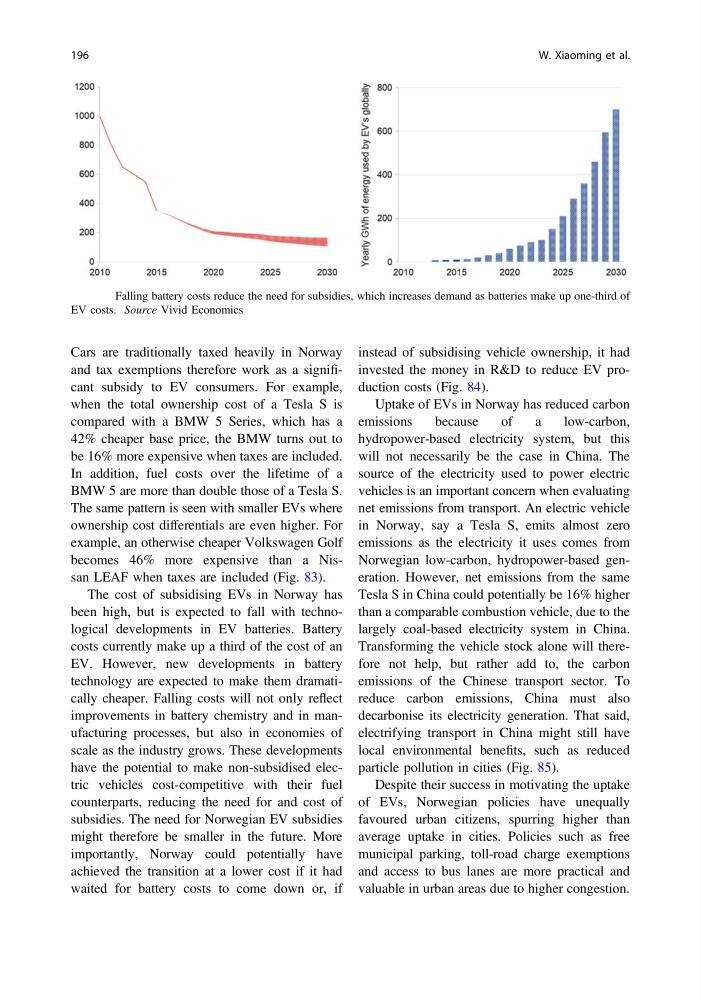
The cost of subsidising EVs in Norway has
been high, but is expected to fall with technological developments in EV batteries. Battery
costs currently make up a third of the cost of an
EV. However, new developments in battery
technology are expected to make them dramatically cheaper. Falling costs will not only reflect
improvements in battery chemistry and in manufacturing processes, but also in economies of
scale as the industry grows. These developments
have the potential to make non-subsidised electric vehicles cost-competitive with their fuel
counterparts, reducing the need for and cost of
subsidies. The need for Norwegian EV subsidies
might therefore be smaller in the future. More
importantly, Norway could potentially have
achieved the transition at a lower cost if it had
waited for battery costs to come down or, if
instead of subsidising vehicle ownership, it had
invested the money in R&D to reduce EV production costs (Fig. 84).
Uptake of EVs in Norway has reduced carbon
emissions
because
of
a
low-carbon,
hydropower-based electricity system, but this
will not necessarily be the case in China. The
source of the electricity used to power electric
vehicles is an important concern when evaluating
net emissions from transport. An electric vehicle
in Norway, say a Tesla S, emits almost zero
emissions as the electricity it uses comes from
Norwegian low-carbon, hydropower-based generation. However, net emissions from the same
Tesla S in China could potentially be 16% higher
than a comparable combustion vehicle, due to the
largely coal-based electricity system in China.
Transforming the vehicle stock alone will therefore not help, but rather add to, the carbon
emissions of the Chinese transport sector. To
reduce carbon emissions, China must also
decarbonise its electricity generation. That said,
electrifying transport in China might still have
local environmental benefits, such as reduced
particle pollution in cities (Fig. 85).
Despite their success in motivating the uptake
of EVs, Norwegian policies have unequally
favoured urban citizens, spurring higher than
average uptake in cities. Policies such as free
municipal parking, toll-road charge exemptions
and access to bus lanes are more practical and
valuable in urban areas due to higher congestion.
Fig. 83 Falling battery costs reduce the need for subsidies, which increases demand as batteries make up one-third of
EV costs. Source Vivid Economics
196
W. Xiaoming et al.
and tax exemptions therefore work as a significant subsidy to EV consumers. For example,
when the total ownership cost of a Tesla S is
compared with a BMW 5 Series, which has a
42% cheaper base price, the BMW turns out to
be 16% more expensive when taxes are included.
In addition, fuel costs over the lifetime of a
BMW 5 are more than double those of a Tesla S.
The same pattern is seen with smaller EVs where
ownership cost differentials are even higher. For
example, an otherwise cheaper Volkswagen Golf
becomes 46% more expensive than a Nissan LEAF when taxes are included (Fig. 83).
The cost of subsidising EVs in Norway has
been high, but is expected to fall with technological developments in EV batteries. Battery
costs currently make up a third of the cost of an
EV. However, new developments in battery
technology are expected to make them dramatically cheaper. Falling costs will not only reflect
improvements in battery chemistry and in manufacturing processes, but also in economies of
scale as the industry grows. These developments
have the potential to make non-subsidised electric vehicles cost-competitive with their fuel
counterparts, reducing the need for and cost of
subsidies. The need for Norwegian EV subsidies
might therefore be smaller in the future. More
importantly, Norway could potentially have
achieved the transition at a lower cost if it had
waited for battery costs to come down or, if
instead of subsidising vehicle ownership, it had
invested the money in R&D to reduce EV production costs (Fig. 84).
Uptake of EVs in Norway has reduced carbon
emissions
because
of
a
low-carbon,
hydropower-based electricity system, but this
will not necessarily be the case in China. The
source of the electricity used to power electric
vehicles is an important concern when evaluating
net emissions from transport. An electric vehicle
in Norway, say a Tesla S, emits almost zero
emissions as the electricity it uses comes from
Norwegian low-carbon, hydropower-based generation. However, net emissions from the same
Tesla S in China could potentially be 16% higher
than a comparable combustion vehicle, due to the
largely coal-based electricity system in China.
Transforming the vehicle stock alone will therefore not help, but rather add to, the carbon
emissions of the Chinese transport sector. To
reduce carbon emissions, China must also
decarbonise its electricity generation. That said,
electrifying transport in China might still have
local environmental benefits, such as reduced
particle pollution in cities (Fig. 85).
Despite their success in motivating the uptake
of EVs, Norwegian policies have unequally
favoured urban citizens, spurring higher than
average uptake in cities. Policies such as free
municipal parking, toll-road charge exemptions
and access to bus lanes are more practical and
valuable in urban areas due to higher congestion.
Fig. 83 Falling battery costs reduce the need for subsidies, which increases demand as batteries make up one-third of
EV costs. Source Vivid Economics
196
W. Xiaoming et al.