

municipal parking and access to bus lanes. This
series of policies has led the way for the uptake
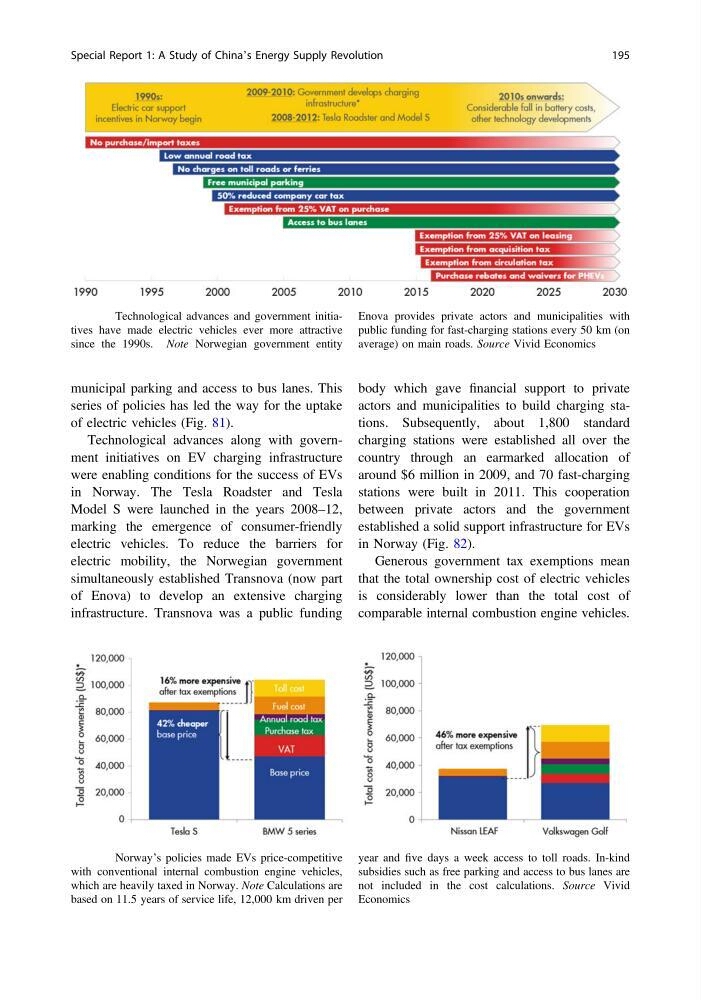
of electric vehicles (Fig. 81).
Technological advances along with government initiatives on EV charging infrastructure
were enabling conditions for the success of EVs
in Norway. The Tesla Roadster and Tesla
Model S were launched in the years 2008–12,
marking the emergence of consumer-friendly
electric vehicles. To reduce the barriers for
electric mobility, the Norwegian government
simultaneously established Transnova (now part
of Enova) to develop an extensive charging
infrastructure. Transnova was a public funding
body which gave financial support to private
actors and municipalities to build charging stations. Subsequently, about 1,800 standard
charging stations were established all over the
country through an earmarked allocation of
around $6 million in 2009, and 70 fast-charging
stations were built in 2011. This cooperation
between private actors and the government
established a solid support infrastructure for EVs
in Norway (Fig. 82).
Generous government tax exemptions mean
that the total ownership cost of electric vehicles
is considerably lower than the total cost of
comparable internal combustion engine vehicles.
Fig. 81 Technological advances and government initiatives have made electric vehicles ever more attractive
since the 1990s. Note Norwegian government entity
Enova provides private actors and municipalities with
public funding for fast-charging stations every 50 km (on
average) on main roads. Source Vivid Economics
Fig. 82 Norway’s policies made EVs price-competitive
with conventional internal combustion engine vehicles,
which are heavily taxed in Norway. Note Calculations are
based on 11.5 years of service life, 12,000 km driven per
year and five days a week access to toll roads. In-kind
subsidies such as free parking and access to bus lanes are
not included in the cost calculations. Source Vivid
Economics
Special Report 1: A Study of China’s Energy Supply Revolution
195
series of policies has led the way for the uptake
of electric vehicles (Fig. 81).
Technological advances along with government initiatives on EV charging infrastructure
were enabling conditions for the success of EVs
in Norway. The Tesla Roadster and Tesla
Model S were launched in the years 2008–12,
marking the emergence of consumer-friendly
electric vehicles. To reduce the barriers for
electric mobility, the Norwegian government
simultaneously established Transnova (now part
of Enova) to develop an extensive charging
infrastructure. Transnova was a public funding
body which gave financial support to private
actors and municipalities to build charging stations. Subsequently, about 1,800 standard
charging stations were established all over the
country through an earmarked allocation of
around $6 million in 2009, and 70 fast-charging
stations were built in 2011. This cooperation
between private actors and the government
established a solid support infrastructure for EVs
in Norway (Fig. 82).
Generous government tax exemptions mean
that the total ownership cost of electric vehicles
is considerably lower than the total cost of
comparable internal combustion engine vehicles.
Fig. 81 Technological advances and government initiatives have made electric vehicles ever more attractive
since the 1990s. Note Norwegian government entity
Enova provides private actors and municipalities with
public funding for fast-charging stations every 50 km (on
average) on main roads. Source Vivid Economics
Fig. 82 Norway’s policies made EVs price-competitive
with conventional internal combustion engine vehicles,
which are heavily taxed in Norway. Note Calculations are
based on 11.5 years of service life, 12,000 km driven per
year and five days a week access to toll roads. In-kind
subsidies such as free parking and access to bus lanes are
not included in the cost calculations. Source Vivid
Economics
Special Report 1: A Study of China’s Energy Supply Revolution
195