

to turn a corner to achieve outright reductions;
renewables growth, along with nuclear growth in
China, will be the key to this in both cases; and
• the potential for deep oil demand reductions
mainly reside in light-duty vehicle efficiency
and EVs, but EVs have little effect until after
2035. Efficiency improvements are 10 times
more important to 2030.
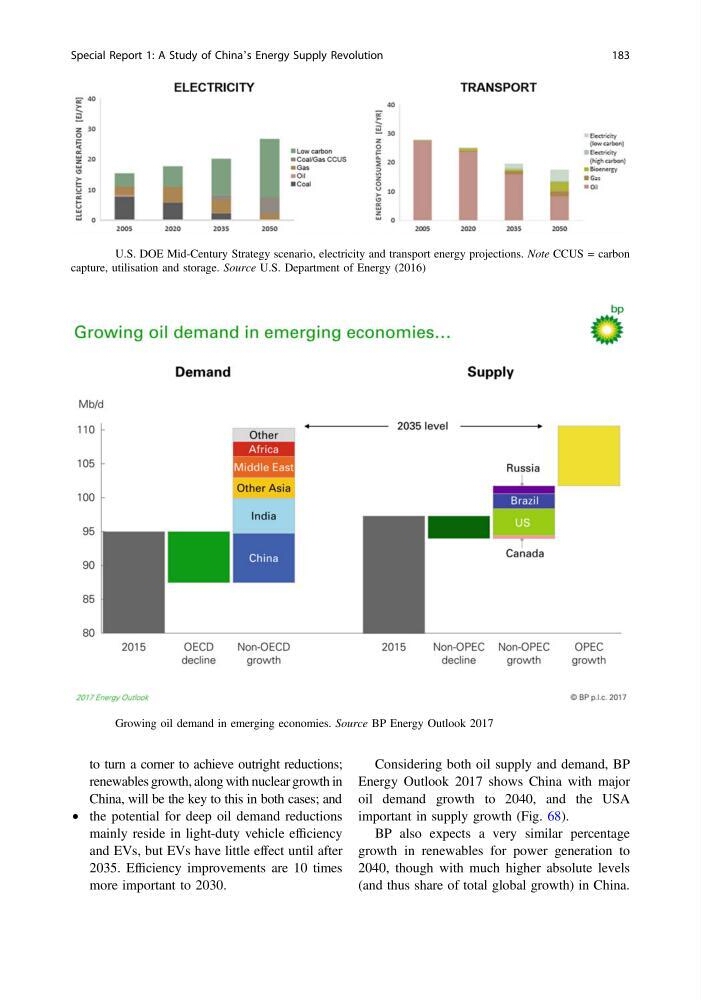
Considering both oil supply and demand, BP
Energy Outlook 2017 shows China with major
oil demand growth to 2040, and the USA
important in supply growth (Fig. 68).
BP also expects a very similar percentage
growth in renewables for power generation to
2040, though with much higher absolute levels
(and thus share of total global growth) in China.
Fig. 67 U.S. DOE Mid-Century Strategy scenario, electricity and transport energy projections. Note CCUS = carbon
capture, utilisation and storage. Source U.S. Department of Energy (2016)
Fig. 68 Growing oil demand in emerging economies. Source BP Energy Outlook 2017
Special Report 1: A Study of China’s Energy Supply Revolution
183
renewables growth, along with nuclear growth in
China, will be the key to this in both cases; and
• the potential for deep oil demand reductions
mainly reside in light-duty vehicle efficiency
and EVs, but EVs have little effect until after
2035. Efficiency improvements are 10 times
more important to 2030.
Considering both oil supply and demand, BP
Energy Outlook 2017 shows China with major
oil demand growth to 2040, and the USA
important in supply growth (Fig. 68).
BP also expects a very similar percentage
growth in renewables for power generation to
2040, though with much higher absolute levels
(and thus share of total global growth) in China.
Fig. 67 U.S. DOE Mid-Century Strategy scenario, electricity and transport energy projections. Note CCUS = carbon
capture, utilisation and storage. Source U.S. Department of Energy (2016)
Fig. 68 Growing oil demand in emerging economies. Source BP Energy Outlook 2017
Special Report 1: A Study of China’s Energy Supply Revolution
183