

Appendix 2: United States Energy Transitions
to 2050: Trends, Challenges and Targets
This appendix summarises the slide deck created
by University of California, Davis, for Shell on
United States transitions to 2050: Trends, challenges and opportunities, and serves as a companion to that presentation. It covers recent
research reports on US energy futures to 2050
and draws conclusions on where the US energy
system is headed, and how policies might change
this future. It also relates the US situation to that
of China and draws lessons that may be of
interest to the Chinese context.
We relied on several major reports, including
those of the U.S. Energy Information Administration (EIA 2017), the U.S. Department of
Energy (DOE 2016), the International Energy
Agency (IEA 2017) and BP (BP 2017), as well
as other reports for specific topics. These are
listed at the end of the appendix.
1. Summary of our findings
Our key findings include:
• given current trends, the USA will reach flat
energy use and marginally declining oil and
CO 2 emissions after 2030; there will be no
deep reductions without major new policies;
• natural gas rises to match oil as the biggest
US energy source after 2030; renewables
remain far below;
• however, renewables for power generation
rise dramatically to 2040, nearly matching
gas; both rise at the expense of coal;
• wind power becomes the top renewable
power source after 2020 (passing hydro);
solar passes hydro a decade later;
• CO 2 emissions decline little overall, as decreases in transport and power generation are partially offset by rising industrial emissions; and
• the potential for large oil reductions mainly
resides in light-duty vehicle efficiency and
electric vehicles, but EVs have little effect
until after 2035. Efficiency improvements are
10 times more important to 2030.
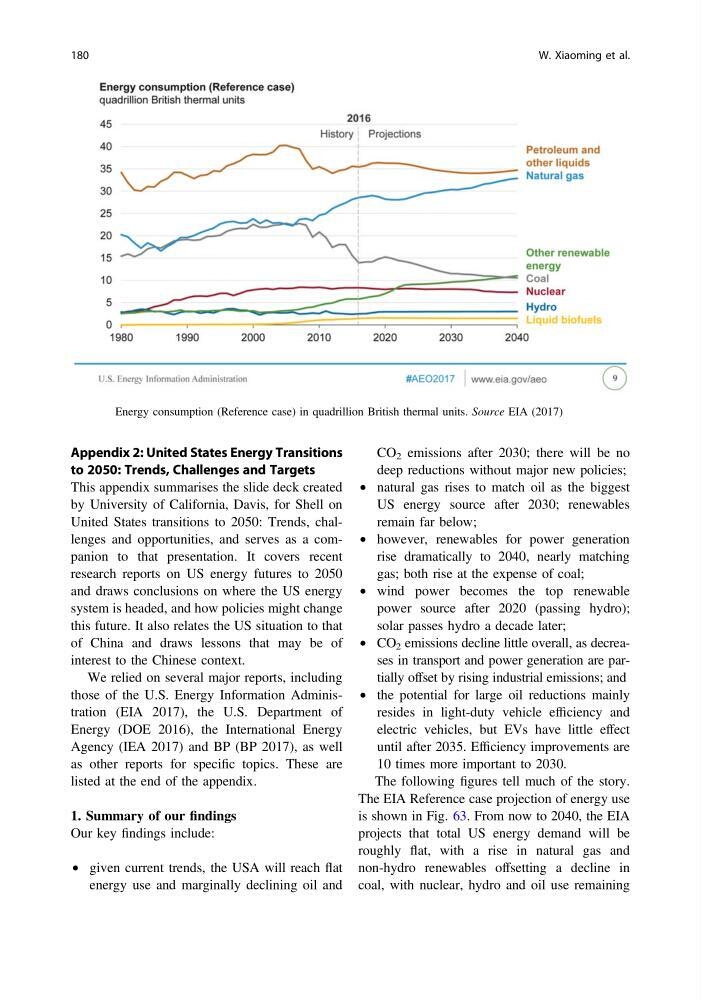
The following figures tell much of the story.
The EIA Reference case projection of energy use
is shown in Fig. 63. From now to 2040, the EIA
projects that total US energy demand will be
roughly flat, with a rise in natural gas and
non-hydro renewables offsetting a decline in
coal, with nuclear, hydro and oil use remaining
Fig. 63 Energy consumption (Reference case) in quadrillion British thermal units. Source EIA (2017)
180
W. Xiaoming et al.
to 2050: Trends, Challenges and Targets
This appendix summarises the slide deck created
by University of California, Davis, for Shell on
United States transitions to 2050: Trends, challenges and opportunities, and serves as a companion to that presentation. It covers recent
research reports on US energy futures to 2050
and draws conclusions on where the US energy
system is headed, and how policies might change
this future. It also relates the US situation to that
of China and draws lessons that may be of
interest to the Chinese context.
We relied on several major reports, including
those of the U.S. Energy Information Administration (EIA 2017), the U.S. Department of
Energy (DOE 2016), the International Energy
Agency (IEA 2017) and BP (BP 2017), as well
as other reports for specific topics. These are
listed at the end of the appendix.
1. Summary of our findings
Our key findings include:
• given current trends, the USA will reach flat
energy use and marginally declining oil and
CO 2 emissions after 2030; there will be no
deep reductions without major new policies;
• natural gas rises to match oil as the biggest
US energy source after 2030; renewables
remain far below;
• however, renewables for power generation
rise dramatically to 2040, nearly matching
gas; both rise at the expense of coal;
• wind power becomes the top renewable
power source after 2020 (passing hydro);
solar passes hydro a decade later;
• CO 2 emissions decline little overall, as decreases in transport and power generation are partially offset by rising industrial emissions; and
• the potential for large oil reductions mainly
resides in light-duty vehicle efficiency and
electric vehicles, but EVs have little effect
until after 2035. Efficiency improvements are
10 times more important to 2030.
The following figures tell much of the story.
The EIA Reference case projection of energy use
is shown in Fig. 63. From now to 2040, the EIA
projects that total US energy demand will be
roughly flat, with a rise in natural gas and
non-hydro renewables offsetting a decline in
coal, with nuclear, hydro and oil use remaining
Fig. 63 Energy consumption (Reference case) in quadrillion British thermal units. Source EIA (2017)
180
W. Xiaoming et al.