

the short term and labour supply improved in the
long term. The public employment service and
social security systems should also be improved
to match labour supply with demand and provide
basic job security.
(1) Short-term optimisation of labour demand
(i) The structure of the energy industry should be
adjusted and emerging businesses with a strong
job-creating capability developed. The service
industry has stronger job-creating potential than
manufacturing, so its share of employment
should increase.
(ii) Adjustment of the corporate ownership
structure should be speeded up, and medium,
small and micro-sized private enterprises prioritised. Private enterprise has become the main
channel to address the employment challenge.
Relevant support policies need to be implemented to encourage and grow more private
enterprises, especially those in technology.
(2) Long-term improvement of labour supply
(i) Adjustment of academic disciplines should be
accelerated to effectively lead and match societal
requirements. Universities and colleges should
adjust their academic disciplines and programmes to correspond with socioeconomic
developments. They should channel more effort
into developing talent and play an effective role
in leading and supporting industry advancement.
(ii) Adjustment of the educational structure
should be faster and vocational education
strongly promoted. Vocational education should
be included in the national education plan and
given priority. Investment in vocational education should be increased. Vocational schools
should be guided to collaborate with companies,
to develop the talent and skills needed by society.
(3) Improvement of the public employment service and social security systems
(i) The social security system should be
improved and include a basic government guarantee. The share of commercial insurance in
healthcare and the pension system should be
gradually increased. Cross-provincial commercial insurance should be improved to reduce
labour transfer costs and integrate labour markets
across China. This will facilitate cross-provincial
coordination of employment.
(ii) The public employment service should be
improved to match labour supply with demand.
Existing employment and training policies
should be optimised to improve quality and
provide the skills required for job transfers and
reemployment, thus creating an effective
employment training system.
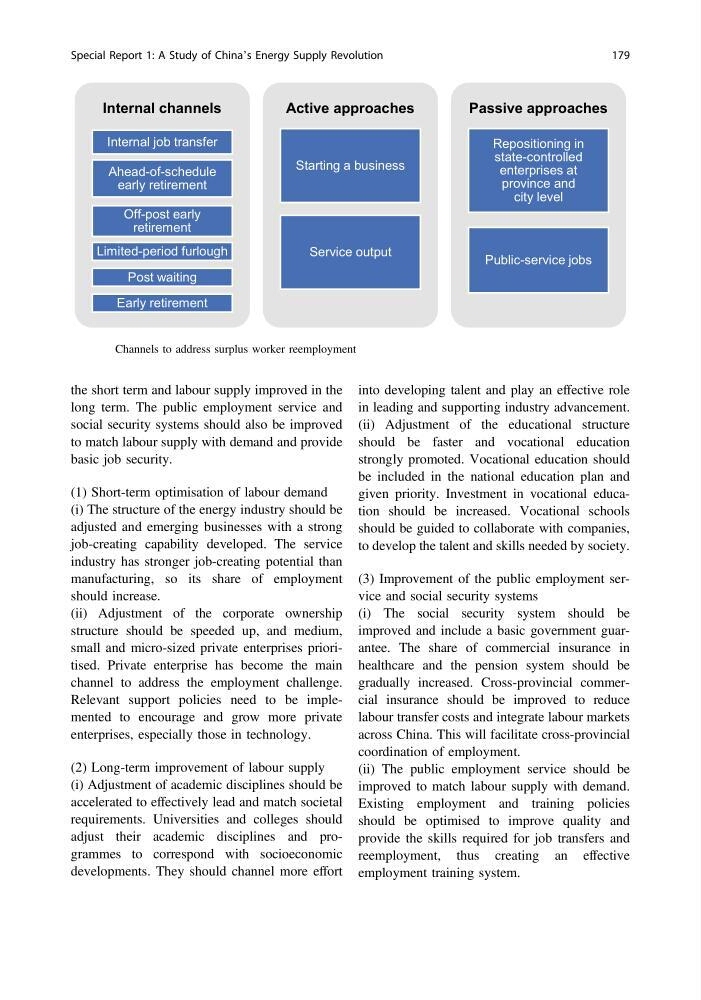
Internal channels
Internal job transfer
Ahead-of-schedule
early retirement
Off-post early
retirement
Limited-period furlough
Post waiting
Early retirement
Active approaches
Starting a business
Service output
Passive approaches
Repositioning in
state-controlled
enterprises at
province and
city level
Public-service jobs
Fig. 62 Channels to address surplus worker reemployment
Special Report 1: A Study of China’s Energy Supply Revolution
179
long term. The public employment service and
social security systems should also be improved
to match labour supply with demand and provide
basic job security.
(1) Short-term optimisation of labour demand
(i) The structure of the energy industry should be
adjusted and emerging businesses with a strong
job-creating capability developed. The service
industry has stronger job-creating potential than
manufacturing, so its share of employment
should increase.
(ii) Adjustment of the corporate ownership
structure should be speeded up, and medium,
small and micro-sized private enterprises prioritised. Private enterprise has become the main
channel to address the employment challenge.
Relevant support policies need to be implemented to encourage and grow more private
enterprises, especially those in technology.
(2) Long-term improvement of labour supply
(i) Adjustment of academic disciplines should be
accelerated to effectively lead and match societal
requirements. Universities and colleges should
adjust their academic disciplines and programmes to correspond with socioeconomic
developments. They should channel more effort
into developing talent and play an effective role
in leading and supporting industry advancement.
(ii) Adjustment of the educational structure
should be faster and vocational education
strongly promoted. Vocational education should
be included in the national education plan and
given priority. Investment in vocational education should be increased. Vocational schools
should be guided to collaborate with companies,
to develop the talent and skills needed by society.
(3) Improvement of the public employment service and social security systems
(i) The social security system should be
improved and include a basic government guarantee. The share of commercial insurance in
healthcare and the pension system should be
gradually increased. Cross-provincial commercial insurance should be improved to reduce
labour transfer costs and integrate labour markets
across China. This will facilitate cross-provincial
coordination of employment.
(ii) The public employment service should be
improved to match labour supply with demand.
Existing employment and training policies
should be optimised to improve quality and
provide the skills required for job transfers and
reemployment, thus creating an effective
employment training system.
Internal channels
Internal job transfer
Ahead-of-schedule
early retirement
Off-post early
retirement
Limited-period furlough
Post waiting
Early retirement
Active approaches
Starting a business
Service output
Passive approaches
Repositioning in
state-controlled
enterprises at
province and
city level
Public-service jobs
Fig. 62 Channels to address surplus worker reemployment
Special Report 1: A Study of China’s Energy Supply Revolution
179