

6.1 Energy Supply
As a result of the energy revolution, China’s
future energy supply system will be diversified,
comprising the clean and efficient use of coal and
the robust development of other types of energy
—oil, gas, nuclear power, new and renewable
energy—as well as stronger transmission and
distribution networks and the widespread use of
energy storage. This will require changes in the
way energy is produced and innovation in energy
supply technologies.
6.1.1 Energy Supply Structure: The
Energy Supply System Will
Prioritise Non-fossil Energy
and Conversion to Electricity
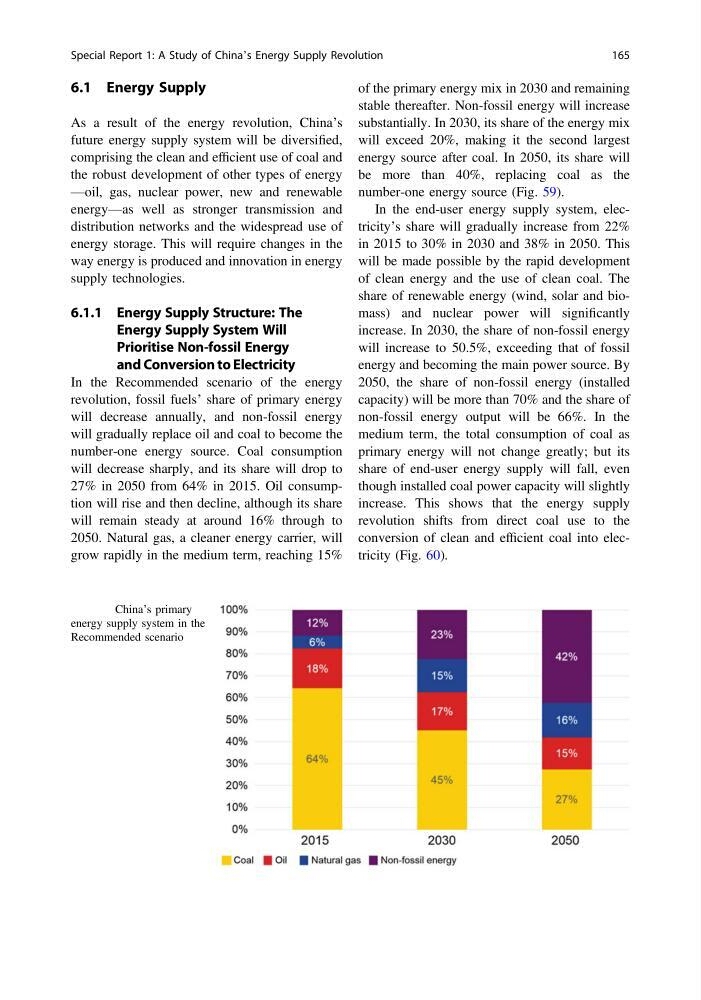
In the Recommended scenario of the energy
revolution, fossil fuels’ share of primary energy
will decrease annually, and non-fossil energy
will gradually replace oil and coal to become the
number-one energy source. Coal consumption
will decrease sharply, and its share will drop to
27% in 2050 from 64% in 2015. Oil consumption will rise and then decline, although its share
will remain steady at around 16% through to
2050. Natural gas, a cleaner energy carrier, will
grow rapidly in the medium term, reaching 15%
of the primary energy mix in 2030 and remaining
stable thereafter. Non-fossil energy will increase
substantially. In 2030, its share of the energy mix
will exceed 20%, making it the second largest
energy source after coal. In 2050, its share will
be more than 40%, replacing coal as the
number-one energy source (Fig. 59).
In the end-user energy supply system, electricity’s share will gradually increase from 22%
in 2015 to 30% in 2030 and 38% in 2050. This
will be made possible by the rapid development
of clean energy and the use of clean coal. The
share of renewable energy (wind, solar and biomass) and nuclear power will significantly
increase. In 2030, the share of non-fossil energy
will increase to 50.5%, exceeding that of fossil
energy and becoming the main power source. By
2050, the share of non-fossil energy (installed
capacity) will be more than 70% and the share of
non-fossil energy output will be 66%. In the
medium term, the total consumption of coal as
primary energy will not change greatly; but its
share of end-user energy supply will fall, even
though installed coal power capacity will slightly
increase. This shows that the energy supply
revolution shifts from direct coal use to the
conversion of clean and efficient coal into electricity (Fig. 60).
Fig. 59 China’s primary
energy supply system in the
Recommended scenario
Special Report 1: A Study of China’s Energy Supply Revolution
165
As a result of the energy revolution, China’s
future energy supply system will be diversified,
comprising the clean and efficient use of coal and
the robust development of other types of energy
—oil, gas, nuclear power, new and renewable
energy—as well as stronger transmission and
distribution networks and the widespread use of
energy storage. This will require changes in the
way energy is produced and innovation in energy
supply technologies.
6.1.1 Energy Supply Structure: The
Energy Supply System Will
Prioritise Non-fossil Energy
and Conversion to Electricity
In the Recommended scenario of the energy
revolution, fossil fuels’ share of primary energy
will decrease annually, and non-fossil energy
will gradually replace oil and coal to become the
number-one energy source. Coal consumption
will decrease sharply, and its share will drop to
27% in 2050 from 64% in 2015. Oil consumption will rise and then decline, although its share
will remain steady at around 16% through to
2050. Natural gas, a cleaner energy carrier, will
grow rapidly in the medium term, reaching 15%
of the primary energy mix in 2030 and remaining
stable thereafter. Non-fossil energy will increase
substantially. In 2030, its share of the energy mix
will exceed 20%, making it the second largest
energy source after coal. In 2050, its share will
be more than 40%, replacing coal as the
number-one energy source (Fig. 59).
In the end-user energy supply system, electricity’s share will gradually increase from 22%
in 2015 to 30% in 2030 and 38% in 2050. This
will be made possible by the rapid development
of clean energy and the use of clean coal. The
share of renewable energy (wind, solar and biomass) and nuclear power will significantly
increase. In 2030, the share of non-fossil energy
will increase to 50.5%, exceeding that of fossil
energy and becoming the main power source. By
2050, the share of non-fossil energy (installed
capacity) will be more than 70% and the share of
non-fossil energy output will be 66%. In the
medium term, the total consumption of coal as
primary energy will not change greatly; but its
share of end-user energy supply will fall, even
though installed coal power capacity will slightly
increase. This shows that the energy supply
revolution shifts from direct coal use to the
conversion of clean and efficient coal into electricity (Fig. 60).
Fig. 59 China’s primary
energy supply system in the
Recommended scenario
Special Report 1: A Study of China’s Energy Supply Revolution
165