

6.1.2 Energy Production: A Combination
of Centralised
and Distributed Clean
and Conventional Energy
One of the main goals of the energy revolution is
to increase the use of clean, renewable energy.
China’s clean energy sources and load centres
are separated, in west and east China respectively. To achieve the goal of the energy revolution, the development of clean energy in these
two regions needs to be coordinated. Coordination will result in an optimised energy system
comprising large centralised renewable energy
plants and outgoing transmission systems in west
China and distributed energy systems in east and
central China. These smaller distributed energy
systems will consist of small wind farms, solar
power, gas-fired combined cooling, heat and
power (CCHP) and ground-source heat pumps
(GSHP) connected to microgrids or local power
distribution systems.
Coal will remain the main energy source in
China in the longer term. To meet the targets of
the energy revolution, coal needs to follow the
principles of safe production, efficient development and ecological priority. At the exploitation
stage (as primary energy), coal will change from
extensive development to intensive and green
production. In conversion (as secondary energy),
coal-fired plants will be upgraded to ultra-low
emission units using clean coal and high efficiency generating processes.
6.1.3 Energy Supply Technology: The
Energy Internet
and Demand-Side
Response Will Optimise
Supply from Multiple
Energy Sources
Lateral multi-energy interconnection and vertical
supply- and demand-side coordination will be an
important way to implement the energy revolution. To integrate and coordinate multiple energy
sources, networks, loads and energy storage, new
energy supply technologies like the Energy
Internet and demand response are needed.
The Energy Internet will enable deep integration between different energy sectors (coal,
gas, renewables, etc.) and between the energy
industry and other industries. It will also improve
fossil energy use efficiency across all industries
through digitalisation and the use of big data.
Moreover, the Energy Internet will harness the
full potential of the power system by increasing
the share of clean energy in end-user energy
consumption. This represents a shift in China’s
long-established way of supplying and using
energy, and a transformation of the link between
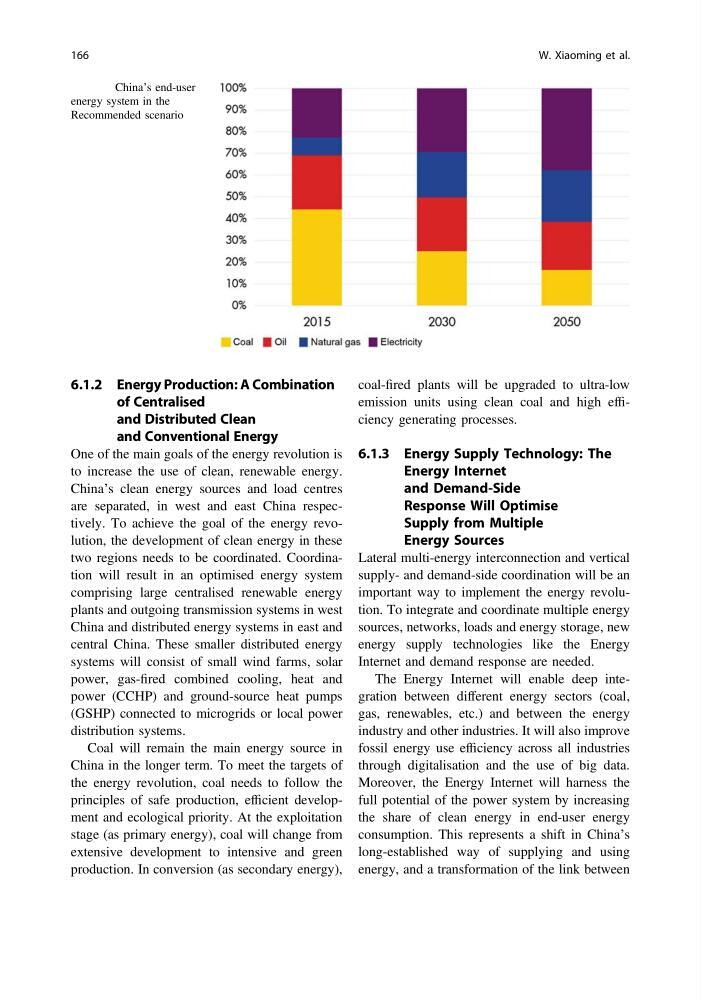
Fig. 60 China’s end-user
energy system in the
Recommended scenario
166
W. Xiaoming et al.
of Centralised
and Distributed Clean
and Conventional Energy
One of the main goals of the energy revolution is
to increase the use of clean, renewable energy.
China’s clean energy sources and load centres
are separated, in west and east China respectively. To achieve the goal of the energy revolution, the development of clean energy in these
two regions needs to be coordinated. Coordination will result in an optimised energy system
comprising large centralised renewable energy
plants and outgoing transmission systems in west
China and distributed energy systems in east and
central China. These smaller distributed energy
systems will consist of small wind farms, solar
power, gas-fired combined cooling, heat and
power (CCHP) and ground-source heat pumps
(GSHP) connected to microgrids or local power
distribution systems.
Coal will remain the main energy source in
China in the longer term. To meet the targets of
the energy revolution, coal needs to follow the
principles of safe production, efficient development and ecological priority. At the exploitation
stage (as primary energy), coal will change from
extensive development to intensive and green
production. In conversion (as secondary energy),
coal-fired plants will be upgraded to ultra-low
emission units using clean coal and high efficiency generating processes.
6.1.3 Energy Supply Technology: The
Energy Internet
and Demand-Side
Response Will Optimise
Supply from Multiple
Energy Sources
Lateral multi-energy interconnection and vertical
supply- and demand-side coordination will be an
important way to implement the energy revolution. To integrate and coordinate multiple energy
sources, networks, loads and energy storage, new
energy supply technologies like the Energy
Internet and demand response are needed.
The Energy Internet will enable deep integration between different energy sectors (coal,
gas, renewables, etc.) and between the energy
industry and other industries. It will also improve
fossil energy use efficiency across all industries
through digitalisation and the use of big data.
Moreover, the Energy Internet will harness the
full potential of the power system by increasing
the share of clean energy in end-user energy
consumption. This represents a shift in China’s
long-established way of supplying and using
energy, and a transformation of the link between
Fig. 60 China’s end-user
energy system in the
Recommended scenario
166
W. Xiaoming et al.