

annual coal imports are 200 Mt, its domestic coal
capacity will be 3.6 Bt in 2030 and 2.2 Bt in 2050.
As China’s current coal capacity exceeds 5.0 Bt,
the major task facing its coal sector is steady
capacity cutting. Meanwhile, coal mining safety
and production efficiency should be improved.
(2) Oil supply
Although EVs can significantly reduce future oil
demand, in the Recommended scenario China’s
oil demand and oil processing capacity peak at
more than 650 Mt and 720 Mt respectively in
2030. Even in 2050, China’s oil demand will still
be around 650 Mt. Demand control and structural
adjustment are the major tasks ahead, in particular:
improving chemical refining capacity to speed up
the shift from oil refining to chemical production.
(3) Natural gas supply
In 2016, China’s domestic natural gas, conventional natural gas and shale gas production was
136.9 billion cubic metres, 123.0 billion cubic
metres and 7.9 billion cubic metres respectively,
and the volume of coalbed methane surface
extraction was about 4.4 billion cubic metres.
Natural gas imports in 2016 were 72.1 billion
cubic metres, which is 35% of the country’s total
gas consumption. China’s natural gas demand is
expected to grow rapidly, largely from replacing
scattered coal with gas. To ensure that demand can
be met, supply capacity needs to improve significantly. If China’s import dependency is consistently controlled at around 35%, then 260 billion
cubic metres, 450 billion cubic metres and 490
billion cubic metres of natural gas will be needed
in 2020, 2030 and 2050 respectively. Therefore,
China still needs to vigorously explore and exploit
conventional gas, tight gas, shale gas and coalbed
methane. It also needs to drive research on how to
exploit natural gas hydrates (Table 16).
4 China’s Energy Revolution:
Changes in Primary Energy
4.1 Characteristics of Fossil Energy
Supply
4.1.1 Coal: Secure, Clean and Efficient
For a long time, coal has been the dominant
source of energy supply in China. Coal makes up
more than 70% of China’s total primary energy
production and more than 70% of its total power
output. However, extensive development of coal
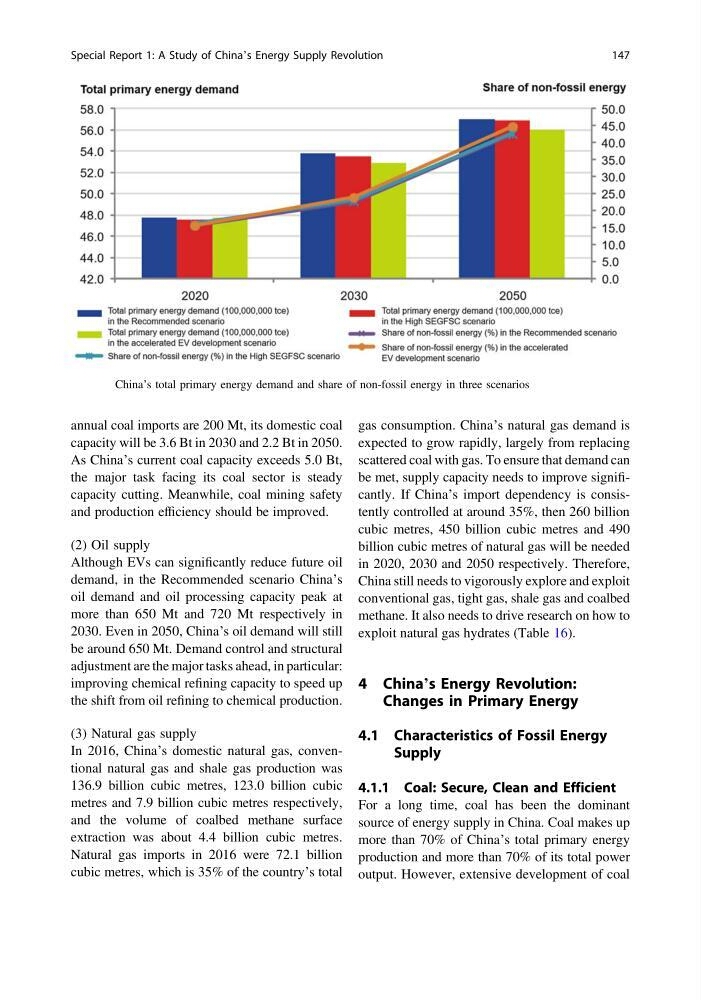
Fig. 58 China’s total primary energy demand and share of non-fossil energy in three scenarios
Special Report 1: A Study of China’s Energy Supply Revolution
147
capacity will be 3.6 Bt in 2030 and 2.2 Bt in 2050.
As China’s current coal capacity exceeds 5.0 Bt,
the major task facing its coal sector is steady
capacity cutting. Meanwhile, coal mining safety
and production efficiency should be improved.
(2) Oil supply
Although EVs can significantly reduce future oil
demand, in the Recommended scenario China’s
oil demand and oil processing capacity peak at
more than 650 Mt and 720 Mt respectively in
2030. Even in 2050, China’s oil demand will still
be around 650 Mt. Demand control and structural
adjustment are the major tasks ahead, in particular:
improving chemical refining capacity to speed up
the shift from oil refining to chemical production.
(3) Natural gas supply
In 2016, China’s domestic natural gas, conventional natural gas and shale gas production was
136.9 billion cubic metres, 123.0 billion cubic
metres and 7.9 billion cubic metres respectively,
and the volume of coalbed methane surface
extraction was about 4.4 billion cubic metres.
Natural gas imports in 2016 were 72.1 billion
cubic metres, which is 35% of the country’s total
gas consumption. China’s natural gas demand is
expected to grow rapidly, largely from replacing
scattered coal with gas. To ensure that demand can
be met, supply capacity needs to improve significantly. If China’s import dependency is consistently controlled at around 35%, then 260 billion
cubic metres, 450 billion cubic metres and 490
billion cubic metres of natural gas will be needed
in 2020, 2030 and 2050 respectively. Therefore,
China still needs to vigorously explore and exploit
conventional gas, tight gas, shale gas and coalbed
methane. It also needs to drive research on how to
exploit natural gas hydrates (Table 16).
4 China’s Energy Revolution:
Changes in Primary Energy
4.1 Characteristics of Fossil Energy
Supply
4.1.1 Coal: Secure, Clean and Efficient
For a long time, coal has been the dominant
source of energy supply in China. Coal makes up
more than 70% of China’s total primary energy
production and more than 70% of its total power
output. However, extensive development of coal
Fig. 58 China’s total primary energy demand and share of non-fossil energy in three scenarios
Special Report 1: A Study of China’s Energy Supply Revolution
147