

3.3.6 Strategic Pathways for China’s
Energy Revolution
(1) Total end-use energy demand
Based on the analysis of China’s energy demand
above, our predictions for China’s future end-use
energy demand in the SEGFSC, Recommended
and EV Extreme scenarios are in Table 12.
In the Recommended scenario, the share of
electricity in end-use energy demand will steadily increase from 23% in 2015 to 26% in 2020,
29% in 2030, 32% in 2035 and 38% in 2050. The
share of clean energy, including electricity and
natural gas, will increase from 30% in 2015 to
50% in 2030, 54% in 2035 and 62% in 2050.
Thanks to the higher efficiency of using
electricity and gas instead of coal and oil,
end-use energy demand will decrease in the
SEGFSC scenarios, though not drastically. Even
by 2050, the largest decline will not exceed 4%.
Although faster replacement of scattered coal
with electricity and gas will increase demand for
both alternatives, the pressure this will create in the
energy system is not excessive. In the High SEGFSC
scenario, demand for natural gas and electricity in
2030 will be 24 billion cubic metres and 80,000
GWh higher than in the Recommended scenario.
Such increases make up only 4% of end-use natural
gas demand and 0.9% of end-use electricity demand
in 2030, so the pressure they create is relatively
small. However, regional and peak-hour supply
shortages in the colder months and regions, caused
by greater use of electricity and gas instead of scattered coal, should not be ignored.
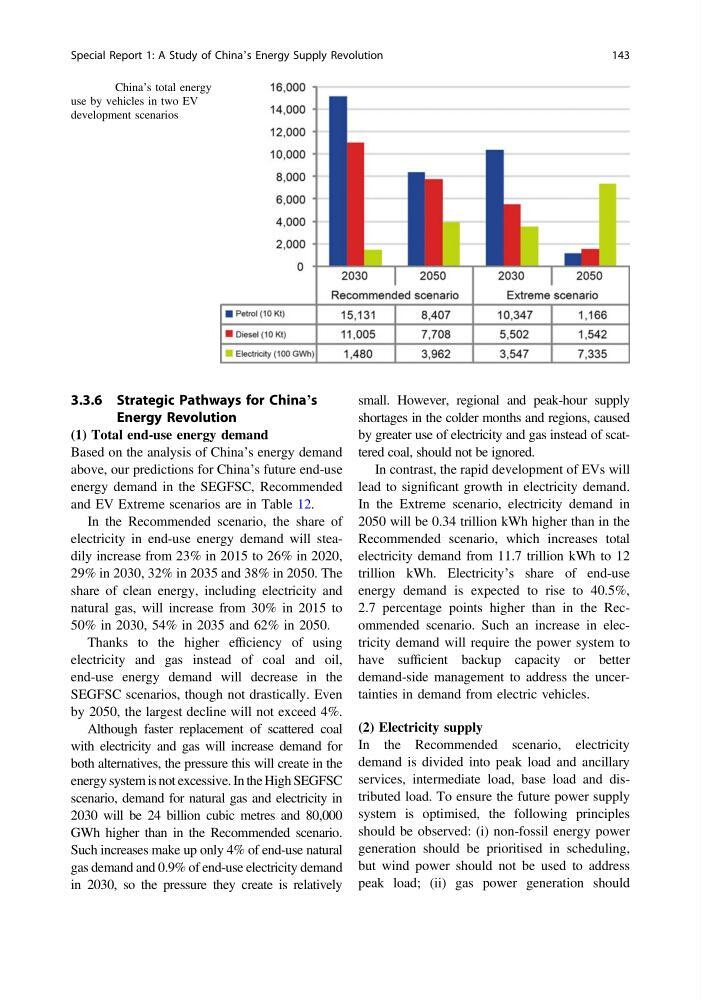
In contrast, the rapid development of EVs will
lead to significant growth in electricity demand.
In the Extreme scenario, electricity demand in
2050 will be 0.34 trillion kWh higher than in the
Recommended scenario, which increases total
electricity demand from 11.7 trillion kWh to 12
trillion kWh. Electricity’s share of end-use
energy demand is expected to rise to 40.5%,
2.7 percentage points higher than in the Recommended scenario. Such an increase in electricity demand will require the power system to
have sufficient backup capacity or better
demand-side management to address the uncertainties in demand from electric vehicles.
(2) Electricity supply
In the Recommended scenario, electricity
demand is divided into peak load and ancillary
services, intermediate load, base load and distributed load. To ensure the future power supply
system is optimised, the following principles
should be observed: (i) non-fossil energy power
generation should be prioritised in scheduling,
but wind power should not be used to address
peak load; (ii) gas power generation should
Fig. 56 China’s total energy
use by vehicles in two EV
development scenarios
Special Report 1: A Study of China’s Energy Supply Revolution
143
Energy Revolution
(1) Total end-use energy demand
Based on the analysis of China’s energy demand
above, our predictions for China’s future end-use
energy demand in the SEGFSC, Recommended
and EV Extreme scenarios are in Table 12.
In the Recommended scenario, the share of
electricity in end-use energy demand will steadily increase from 23% in 2015 to 26% in 2020,
29% in 2030, 32% in 2035 and 38% in 2050. The
share of clean energy, including electricity and
natural gas, will increase from 30% in 2015 to
50% in 2030, 54% in 2035 and 62% in 2050.
Thanks to the higher efficiency of using
electricity and gas instead of coal and oil,
end-use energy demand will decrease in the
SEGFSC scenarios, though not drastically. Even
by 2050, the largest decline will not exceed 4%.
Although faster replacement of scattered coal
with electricity and gas will increase demand for
both alternatives, the pressure this will create in the
energy system is not excessive. In the High SEGFSC
scenario, demand for natural gas and electricity in
2030 will be 24 billion cubic metres and 80,000
GWh higher than in the Recommended scenario.
Such increases make up only 4% of end-use natural
gas demand and 0.9% of end-use electricity demand
in 2030, so the pressure they create is relatively
small. However, regional and peak-hour supply
shortages in the colder months and regions, caused
by greater use of electricity and gas instead of scattered coal, should not be ignored.
In contrast, the rapid development of EVs will
lead to significant growth in electricity demand.
In the Extreme scenario, electricity demand in
2050 will be 0.34 trillion kWh higher than in the
Recommended scenario, which increases total
electricity demand from 11.7 trillion kWh to 12
trillion kWh. Electricity’s share of end-use
energy demand is expected to rise to 40.5%,
2.7 percentage points higher than in the Recommended scenario. Such an increase in electricity demand will require the power system to
have sufficient backup capacity or better
demand-side management to address the uncertainties in demand from electric vehicles.
(2) Electricity supply
In the Recommended scenario, electricity
demand is divided into peak load and ancillary
services, intermediate load, base load and distributed load. To ensure the future power supply
system is optimised, the following principles
should be observed: (i) non-fossil energy power
generation should be prioritised in scheduling,
but wind power should not be used to address
peak load; (ii) gas power generation should
Fig. 56 China’s total energy
use by vehicles in two EV
development scenarios
Special Report 1: A Study of China’s Energy Supply Revolution
143