

3.3.5 Analysis of Two EV Development
Scenarios
The development of electric vehicles (EVs) is of
great importance for China. First, EVs can help
reduce fossil fuel consumption in transport and
lower CO 2 emissions and environmental pollution; second, EVs can alleviate oil supply and
demand pressure, reduce China’s dependency on
oil imports and improve energy security; and
third, as one of the strategic emerging industries,
EVs are expected to become a pillar of China’s
future economic development.
According to the Strategy of Energy Production and Consumption Revolution (2016–30),
China’s EV ownership will reach 3 million units
in 2020, 80 million units in 2030 and 270 million
units in 2050. From the current industry development trend, however, the possibility of accelerated EV development cannot be ignored:
(i) there is a global boom in EV R&D—
mainly around such critical technologies as batteries, automated driving systems, charging
infrastructure and support systems—and in issues
like leasing, financial services and shared business models. All these factors can speed up the
current development trend even more;
(ii) as artificial intelligence technology
evolves, automated driving and EVs could
become a standard means of future transport,
extending vehicles from a travel tool to a home
on wheels. Such new travel experiences can help
speed up the transition from conventional vehicles to EVs in the medium and long terms; and
(iii) EVs can serve as both a means of transport and a distributed energy storage facility
linked to smart grid technologies. They can play
an important role in making the most of installed
renewable energy capacity and supporting China’s long-term development of renewable
energy.
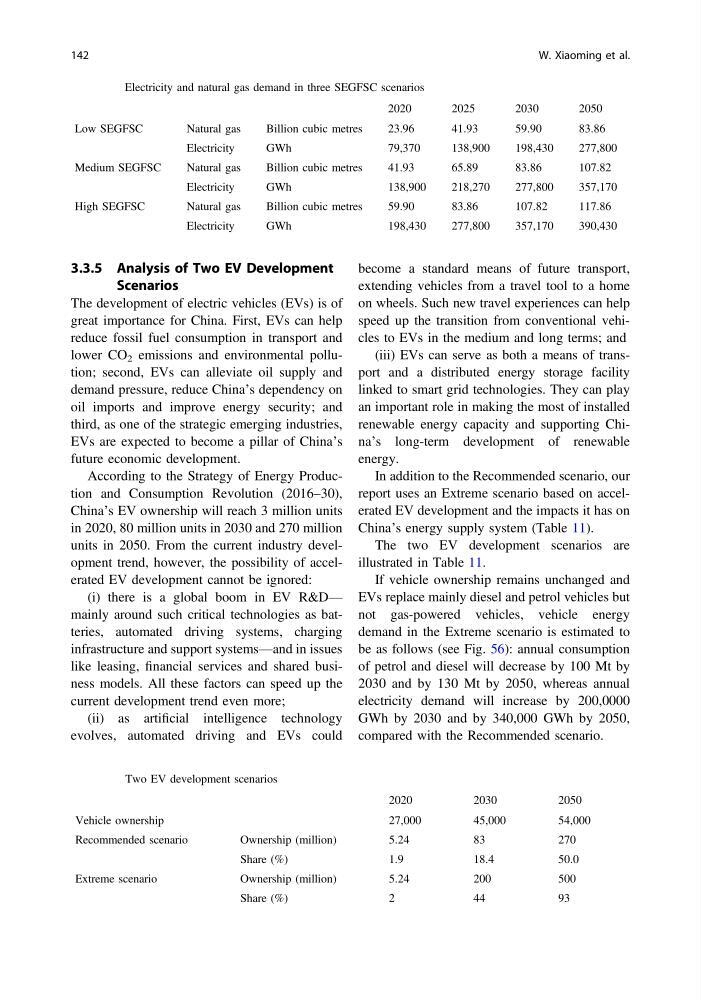
In addition to the Recommended scenario, our
report uses an Extreme scenario based on accelerated EV development and the impacts it has on
China’s energy supply system (Table 11).
The two EV development scenarios are
illustrated in Table 11.
If vehicle ownership remains unchanged and
EVs replace mainly diesel and petrol vehicles but
not gas-powered vehicles, vehicle energy
demand in the Extreme scenario is estimated to
be as follows (see Fig. 56): annual consumption
of petrol and diesel will decrease by 100 Mt by
2030 and by 130 Mt by 2050, whereas annual
electricity demand will increase by 200,0000
GWh by 2030 and by 340,000 GWh by 2050,
compared with the Recommended scenario.
Table 10 Electricity and natural gas demand in three SEGFSC scenarios
2020
2025
2030
2050
Low SEGFSC
Natural gas
Billion cubic metres
23.96
41.93
59.90
83.86
Electricity
GWh
79,370
138,900
198,430
277,800
Medium SEGFSC
Natural gas
Billion cubic metres
41.93
65.89
83.86
107.82
Electricity
GWh
138,900
218,270
277,800
357,170
High SEGFSC
Natural gas
Billion cubic metres
59.90
83.86
107.82
117.86
Electricity
GWh
198,430
277,800
357,170
390,430
Table 11 Two EV development scenarios
2020
2030
2050
Vehicle ownership
27,000
45,000
54,000
Recommended scenario
Ownership (million)
5.24
83
270
Share (%)
1.9
18.4
50.0
Extreme scenario
Ownership (million)
5.24
200
500
Share (%)
2
44
93
142
W. Xiaoming et al.
Scenarios
The development of electric vehicles (EVs) is of
great importance for China. First, EVs can help
reduce fossil fuel consumption in transport and
lower CO 2 emissions and environmental pollution; second, EVs can alleviate oil supply and
demand pressure, reduce China’s dependency on
oil imports and improve energy security; and
third, as one of the strategic emerging industries,
EVs are expected to become a pillar of China’s
future economic development.
According to the Strategy of Energy Production and Consumption Revolution (2016–30),
China’s EV ownership will reach 3 million units
in 2020, 80 million units in 2030 and 270 million
units in 2050. From the current industry development trend, however, the possibility of accelerated EV development cannot be ignored:
(i) there is a global boom in EV R&D—
mainly around such critical technologies as batteries, automated driving systems, charging
infrastructure and support systems—and in issues
like leasing, financial services and shared business models. All these factors can speed up the
current development trend even more;
(ii) as artificial intelligence technology
evolves, automated driving and EVs could
become a standard means of future transport,
extending vehicles from a travel tool to a home
on wheels. Such new travel experiences can help
speed up the transition from conventional vehicles to EVs in the medium and long terms; and
(iii) EVs can serve as both a means of transport and a distributed energy storage facility
linked to smart grid technologies. They can play
an important role in making the most of installed
renewable energy capacity and supporting China’s long-term development of renewable
energy.
In addition to the Recommended scenario, our
report uses an Extreme scenario based on accelerated EV development and the impacts it has on
China’s energy supply system (Table 11).
The two EV development scenarios are
illustrated in Table 11.
If vehicle ownership remains unchanged and
EVs replace mainly diesel and petrol vehicles but
not gas-powered vehicles, vehicle energy
demand in the Extreme scenario is estimated to
be as follows (see Fig. 56): annual consumption
of petrol and diesel will decrease by 100 Mt by
2030 and by 130 Mt by 2050, whereas annual
electricity demand will increase by 200,0000
GWh by 2030 and by 340,000 GWh by 2050,
compared with the Recommended scenario.
Table 10 Electricity and natural gas demand in three SEGFSC scenarios
2020
2025
2030
2050
Low SEGFSC
Natural gas
Billion cubic metres
23.96
41.93
59.90
83.86
Electricity
GWh
79,370
138,900
198,430
277,800
Medium SEGFSC
Natural gas
Billion cubic metres
41.93
65.89
83.86
107.82
Electricity
GWh
138,900
218,270
277,800
357,170
High SEGFSC
Natural gas
Billion cubic metres
59.90
83.86
107.82
117.86
Electricity
GWh
198,430
277,800
357,170
390,430
Table 11 Two EV development scenarios
2020
2030
2050
Vehicle ownership
27,000
45,000
54,000
Recommended scenario
Ownership (million)
5.24
83
270
Share (%)
1.9
18.4
50.0
Extreme scenario
Ownership (million)
5.24
200
500
Share (%)
2
44
93
142
W. Xiaoming et al.