

other relevant local policies, the measures for
reducing scattered coal use in residential heating
include central heating with gas-fired boilers,
geothermal heating or waste heat recovery; and
using electricity instead of scattered coal in areas
where central heating is not possible. The measures for replacing scattered coal with electricity
and gas in industry and commerce include shutting down small coal-fired boilers and using
waste heat recovery and other energy-efficient
technologies (Fig. 54).
Given the gap between China’s Class 2 air
quality (35 parts per million, ppm) and the current average air quality in major cities (50 ppm),
this report predicts that more than 35% of scattered coal will be displaced by 2020 and about
70% by 2030.
To understand the impact of varying degrees
of SEGFSC on primary energy, we made the
following sensitivity analysis in three different
scenarios: in the High SEGFSC scenario, if
scattered coal is to be completely replaced by
2030, more than 35% and about 70% will have to
be substituted by 2020 and by 2030 respectively.
In the Low SEGFSC scenario, and if there are no
additional policy measures after 2017, 20% and
50% of scattered coal should be substituted by
2020 and by 2030 respectively.
Scattered coal consumption in the High,
Medium and Low SEGFSC scenarios is shown
in Fig. 55: (i) in the Medium SEGFSC scenario,
scattered coal use will decrease to 400 Mt in
2020, 180 Mt in 2030 and 60 Mt in 2050; (ii) in
the High SEGFSC scenario, scattered coal
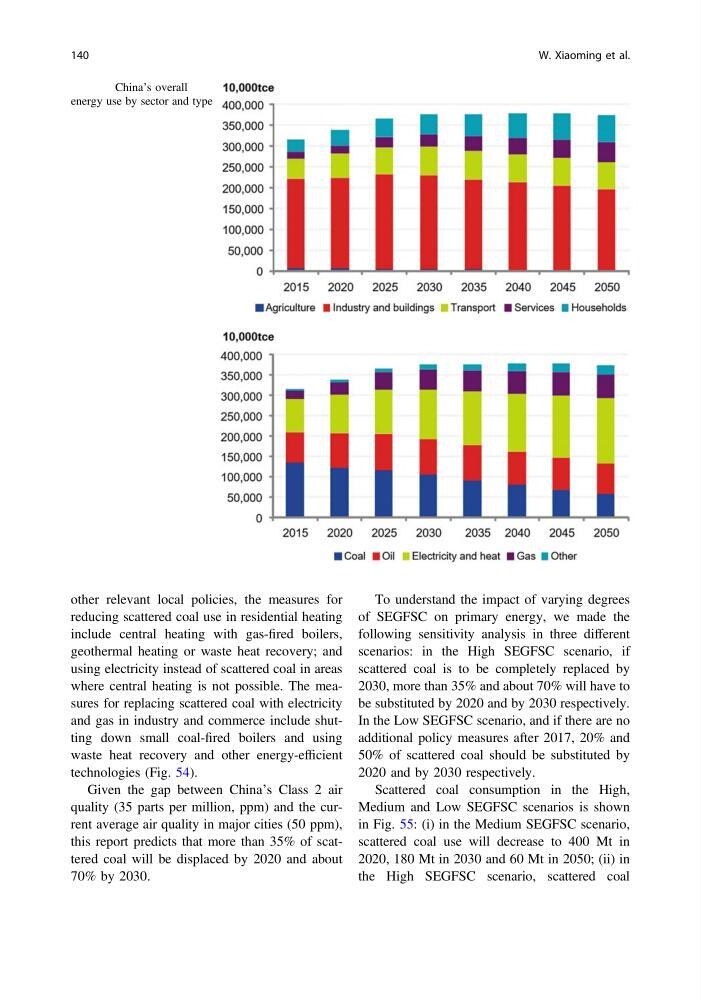
Fig. 53 China’s overall
energy use by sector and type
140
W. Xiaoming et al.
reducing scattered coal use in residential heating
include central heating with gas-fired boilers,
geothermal heating or waste heat recovery; and
using electricity instead of scattered coal in areas
where central heating is not possible. The measures for replacing scattered coal with electricity
and gas in industry and commerce include shutting down small coal-fired boilers and using
waste heat recovery and other energy-efficient
technologies (Fig. 54).
Given the gap between China’s Class 2 air
quality (35 parts per million, ppm) and the current average air quality in major cities (50 ppm),
this report predicts that more than 35% of scattered coal will be displaced by 2020 and about
70% by 2030.
To understand the impact of varying degrees
of SEGFSC on primary energy, we made the
following sensitivity analysis in three different
scenarios: in the High SEGFSC scenario, if
scattered coal is to be completely replaced by
2030, more than 35% and about 70% will have to
be substituted by 2020 and by 2030 respectively.
In the Low SEGFSC scenario, and if there are no
additional policy measures after 2017, 20% and
50% of scattered coal should be substituted by
2020 and by 2030 respectively.
Scattered coal consumption in the High,
Medium and Low SEGFSC scenarios is shown
in Fig. 55: (i) in the Medium SEGFSC scenario,
scattered coal use will decrease to 400 Mt in
2020, 180 Mt in 2030 and 60 Mt in 2050; (ii) in
the High SEGFSC scenario, scattered coal
Fig. 53 China’s overall
energy use by sector and type
140
W. Xiaoming et al.