

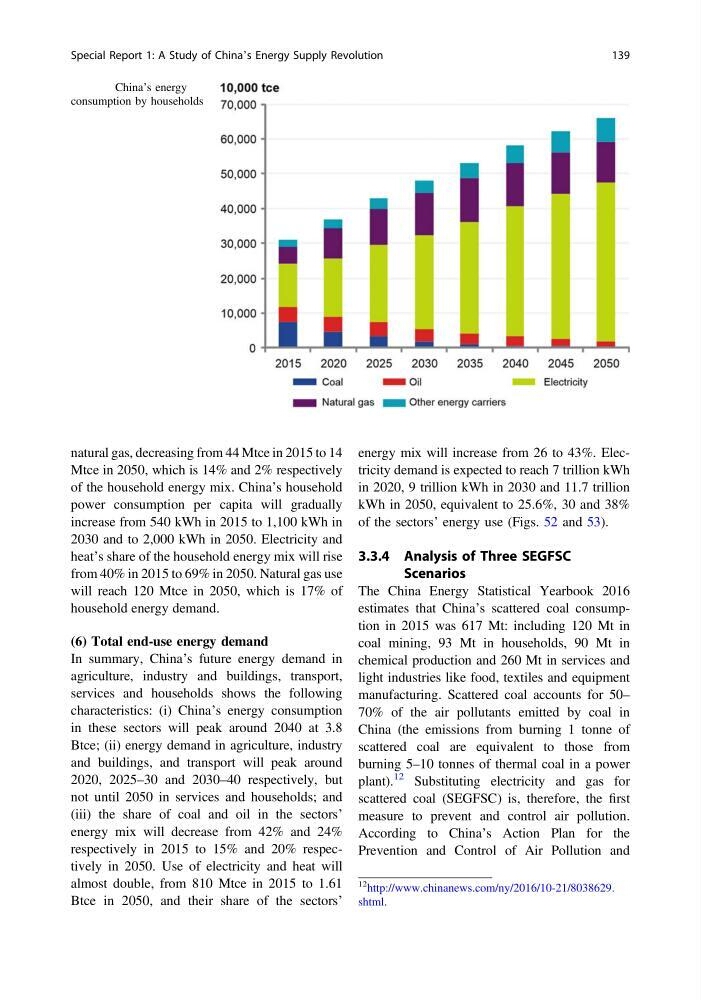
natural gas, decreasing from 44 Mtce in 2015 to 14
Mtce in 2050, which is 14% and 2% respectively
of the household energy mix. China’s household
power consumption per capita will gradually
increase from 540 kWh in 2015 to 1,100 kWh in
2030 and to 2,000 kWh in 2050. Electricity and
heat’s share of the household energy mix will rise
from 40% in 2015 to 69% in 2050. Natural gas use
will reach 120 Mtce in 2050, which is 17% of
household energy demand.
(6) Total end-use energy demand
In summary, China’s future energy demand in
agriculture, industry and buildings, transport,
services and households shows the following
characteristics: (i) China’s energy consumption
in these sectors will peak around 2040 at 3.8
Btce; (ii) energy demand in agriculture, industry
and buildings, and transport will peak around
2020, 2025–30 and 2030–40 respectively, but
not until 2050 in services and households; and
(iii) the share of coal and oil in the sectors’
energy mix will decrease from 42% and 24%
respectively in 2015 to 15% and 20% respectively in 2050. Use of electricity and heat will
almost double, from 810 Mtce in 2015 to 1.61
Btce in 2050, and their share of the sectors’
energy mix will increase from 26 to 43%. Electricity demand is expected to reach 7 trillion kWh
in 2020, 9 trillion kWh in 2030 and 11.7 trillion
kWh in 2050, equivalent to 25.6%, 30 and 38%
of the sectors’ energy use (Figs. 52 and 53).
3.3.4 Analysis of Three SEGFSC
Scenarios
The China Energy Statistical Yearbook 2016
estimates that China’s scattered coal consumption in 2015 was 617 Mt: including 120 Mt in
coal mining, 93 Mt in households, 90 Mt in
chemical production and 260 Mt in services and
light industries like food, textiles and equipment
manufacturing. Scattered coal accounts for 50–
70% of the air pollutants emitted by coal in
China (the emissions from burning 1 tonne of
scattered coal are equivalent to those from
burning 5–10 tonnes of thermal coal in a power
plant).
12 Substituting electricity and gas for
scattered coal (SEGFSC) is, therefore, the first
measure to prevent and control air pollution.
According to China’s Action Plan for the
Prevention and Control of Air Pollution and
Fig. 52 China’s energy
consumption by households
12
http://www.chinanews.com/ny/2016/10-21/8038629.
shtml.
Special Report 1: A Study of China’s Energy Supply Revolution
139
Mtce in 2050, which is 14% and 2% respectively
of the household energy mix. China’s household
power consumption per capita will gradually
increase from 540 kWh in 2015 to 1,100 kWh in
2030 and to 2,000 kWh in 2050. Electricity and
heat’s share of the household energy mix will rise
from 40% in 2015 to 69% in 2050. Natural gas use
will reach 120 Mtce in 2050, which is 17% of
household energy demand.
(6) Total end-use energy demand
In summary, China’s future energy demand in
agriculture, industry and buildings, transport,
services and households shows the following
characteristics: (i) China’s energy consumption
in these sectors will peak around 2040 at 3.8
Btce; (ii) energy demand in agriculture, industry
and buildings, and transport will peak around
2020, 2025–30 and 2030–40 respectively, but
not until 2050 in services and households; and
(iii) the share of coal and oil in the sectors’
energy mix will decrease from 42% and 24%
respectively in 2015 to 15% and 20% respectively in 2050. Use of electricity and heat will
almost double, from 810 Mtce in 2015 to 1.61
Btce in 2050, and their share of the sectors’
energy mix will increase from 26 to 43%. Electricity demand is expected to reach 7 trillion kWh
in 2020, 9 trillion kWh in 2030 and 11.7 trillion
kWh in 2050, equivalent to 25.6%, 30 and 38%
of the sectors’ energy use (Figs. 52 and 53).
3.3.4 Analysis of Three SEGFSC
Scenarios
The China Energy Statistical Yearbook 2016
estimates that China’s scattered coal consumption in 2015 was 617 Mt: including 120 Mt in
coal mining, 93 Mt in households, 90 Mt in
chemical production and 260 Mt in services and
light industries like food, textiles and equipment
manufacturing. Scattered coal accounts for 50–
70% of the air pollutants emitted by coal in
China (the emissions from burning 1 tonne of
scattered coal are equivalent to those from
burning 5–10 tonnes of thermal coal in a power
plant).
12 Substituting electricity and gas for
scattered coal (SEGFSC) is, therefore, the first
measure to prevent and control air pollution.
According to China’s Action Plan for the
Prevention and Control of Air Pollution and
Fig. 52 China’s energy
consumption by households
12
http://www.chinanews.com/ny/2016/10-21/8038629.
shtml.
Special Report 1: A Study of China’s Energy Supply Revolution
139