

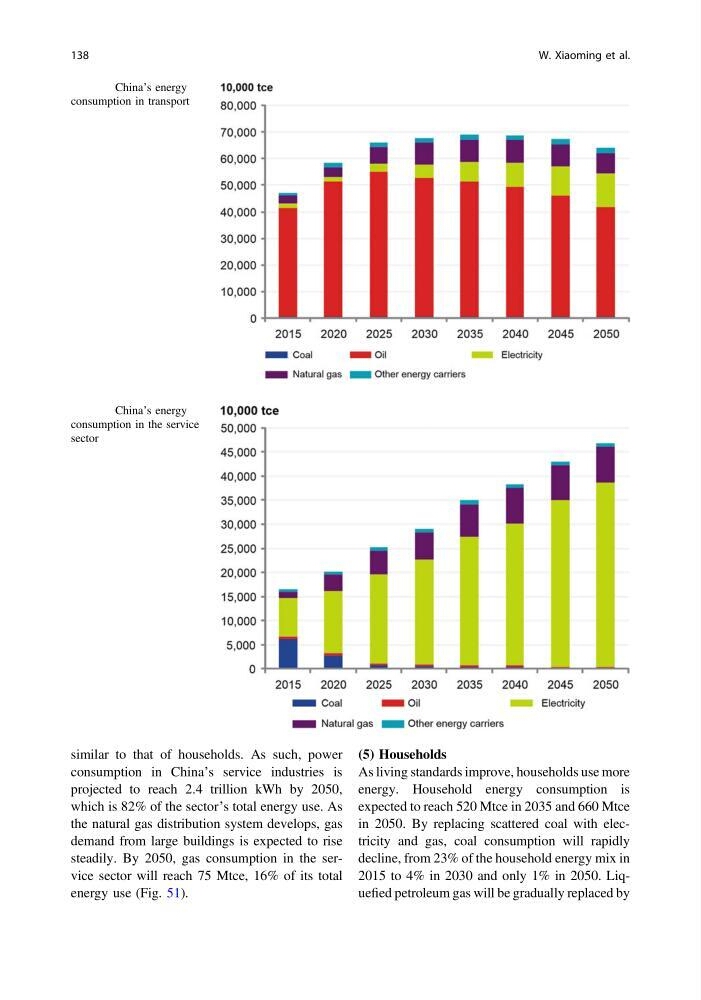
similar to that of households. As such, power
consumption in China’s service industries is
projected to reach 2.4 trillion kWh by 2050,
which is 82% of the sector’s total energy use. As
the natural gas distribution system develops, gas
demand from large buildings is expected to rise
steadily. By 2050, gas consumption in the service sector will reach 75 Mtce, 16% of its total
energy use (Fig. 51).
(5) Households
As living standards improve, households use more
energy. Household energy consumption is
expected to reach 520 Mtce in 2035 and 660 Mtce
in 2050. By replacing scattered coal with electricity and gas, coal consumption will rapidly
decline, from 23% of the household energy mix in
2015 to 4% in 2030 and only 1% in 2050. Liquefied petroleum gas will be gradually replaced by
Fig. 50 China’s energy
consumption in transport
Fig. 51 China’s energy
consumption in the service
sector
138
W. Xiaoming et al.
consumption in China’s service industries is
projected to reach 2.4 trillion kWh by 2050,
which is 82% of the sector’s total energy use. As
the natural gas distribution system develops, gas
demand from large buildings is expected to rise
steadily. By 2050, gas consumption in the service sector will reach 75 Mtce, 16% of its total
energy use (Fig. 51).
(5) Households
As living standards improve, households use more
energy. Household energy consumption is
expected to reach 520 Mtce in 2035 and 660 Mtce
in 2050. By replacing scattered coal with electricity and gas, coal consumption will rapidly
decline, from 23% of the household energy mix in
2015 to 4% in 2030 and only 1% in 2050. Liquefied petroleum gas will be gradually replaced by
Fig. 50 China’s energy
consumption in transport
Fig. 51 China’s energy
consumption in the service
sector
138
W. Xiaoming et al.