

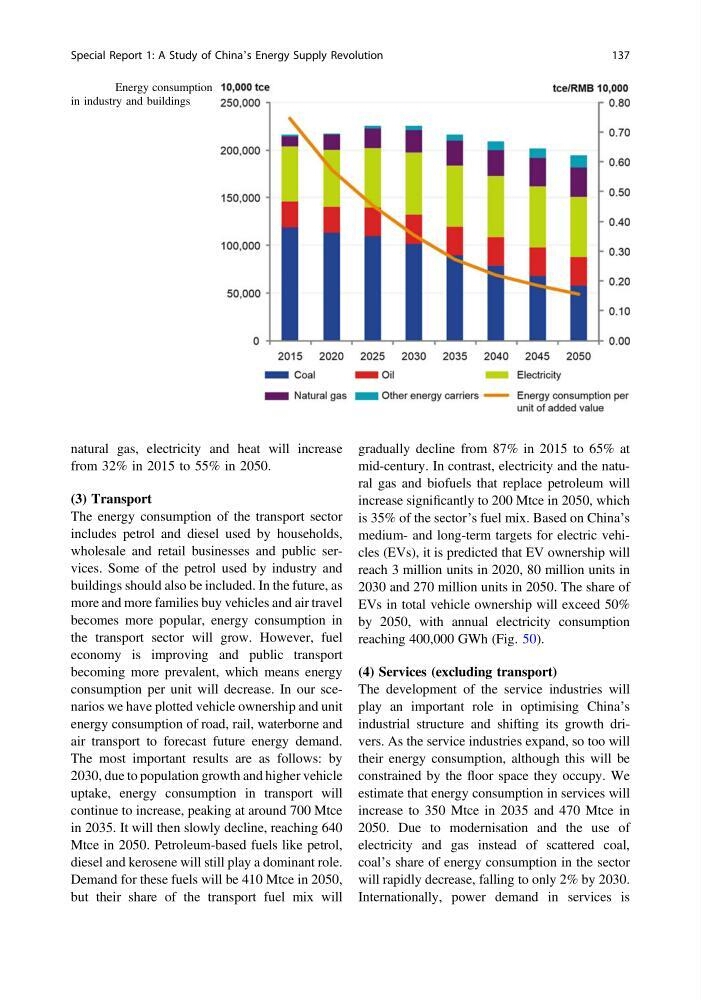
natural gas, electricity and heat will increase
from 32% in 2015 to 55% in 2050.
(3) Transport
The energy consumption of the transport sector
includes petrol and diesel used by households,
wholesale and retail businesses and public services. Some of the petrol used by industry and
buildings should also be included. In the future, as
more and more families buy vehicles and air travel
becomes more popular, energy consumption in
the transport sector will grow. However, fuel
economy is improving and public transport
becoming more prevalent, which means energy
consumption per unit will decrease. In our scenarios we have plotted vehicle ownership and unit
energy consumption of road, rail, waterborne and
air transport to forecast future energy demand.
The most important results are as follows: by
2030, due to population growth and higher vehicle
uptake, energy consumption in transport will
continue to increase, peaking at around 700 Mtce
in 2035. It will then slowly decline, reaching 640
Mtce in 2050. Petroleum-based fuels like petrol,
diesel and kerosene will still play a dominant role.
Demand for these fuels will be 410 Mtce in 2050,
but their share of the transport fuel mix will
gradually decline from 87% in 2015 to 65% at
mid-century. In contrast, electricity and the natural gas and biofuels that replace petroleum will
increase significantly to 200 Mtce in 2050, which
is 35% of the sector’s fuel mix. Based on China’s
medium- and long-term targets for electric vehicles (EVs), it is predicted that EV ownership will
reach 3 million units in 2020, 80 million units in
2030 and 270 million units in 2050. The share of
EVs in total vehicle ownership will exceed 50%
by 2050, with annual electricity consumption
reaching 400,000 GWh (Fig. 50).
(4) Services (excluding transport)
The development of the service industries will
play an important role in optimising China’s
industrial structure and shifting its growth drivers. As the service industries expand, so too will
their energy consumption, although this will be
constrained by the floor space they occupy. We
estimate that energy consumption in services will
increase to 350 Mtce in 2035 and 470 Mtce in
2050. Due to modernisation and the use of
electricity and gas instead of scattered coal,
coal’s share of energy consumption in the sector
will rapidly decrease, falling to only 2% by 2030.
Internationally, power demand in services is
Fig. 49 Energy consumption
in industry and buildings
Special Report 1: A Study of China’s Energy Supply Revolution
137
from 32% in 2015 to 55% in 2050.
(3) Transport
The energy consumption of the transport sector
includes petrol and diesel used by households,
wholesale and retail businesses and public services. Some of the petrol used by industry and
buildings should also be included. In the future, as
more and more families buy vehicles and air travel
becomes more popular, energy consumption in
the transport sector will grow. However, fuel
economy is improving and public transport
becoming more prevalent, which means energy
consumption per unit will decrease. In our scenarios we have plotted vehicle ownership and unit
energy consumption of road, rail, waterborne and
air transport to forecast future energy demand.
The most important results are as follows: by
2030, due to population growth and higher vehicle
uptake, energy consumption in transport will
continue to increase, peaking at around 700 Mtce
in 2035. It will then slowly decline, reaching 640
Mtce in 2050. Petroleum-based fuels like petrol,
diesel and kerosene will still play a dominant role.
Demand for these fuels will be 410 Mtce in 2050,
but their share of the transport fuel mix will
gradually decline from 87% in 2015 to 65% at
mid-century. In contrast, electricity and the natural gas and biofuels that replace petroleum will
increase significantly to 200 Mtce in 2050, which
is 35% of the sector’s fuel mix. Based on China’s
medium- and long-term targets for electric vehicles (EVs), it is predicted that EV ownership will
reach 3 million units in 2020, 80 million units in
2030 and 270 million units in 2050. The share of
EVs in total vehicle ownership will exceed 50%
by 2050, with annual electricity consumption
reaching 400,000 GWh (Fig. 50).
(4) Services (excluding transport)
The development of the service industries will
play an important role in optimising China’s
industrial structure and shifting its growth drivers. As the service industries expand, so too will
their energy consumption, although this will be
constrained by the floor space they occupy. We
estimate that energy consumption in services will
increase to 350 Mtce in 2035 and 470 Mtce in
2050. Due to modernisation and the use of
electricity and gas instead of scattered coal,
coal’s share of energy consumption in the sector
will rapidly decrease, falling to only 2% by 2030.
Internationally, power demand in services is
Fig. 49 Energy consumption
in industry and buildings
Special Report 1: A Study of China’s Energy Supply Revolution
137