

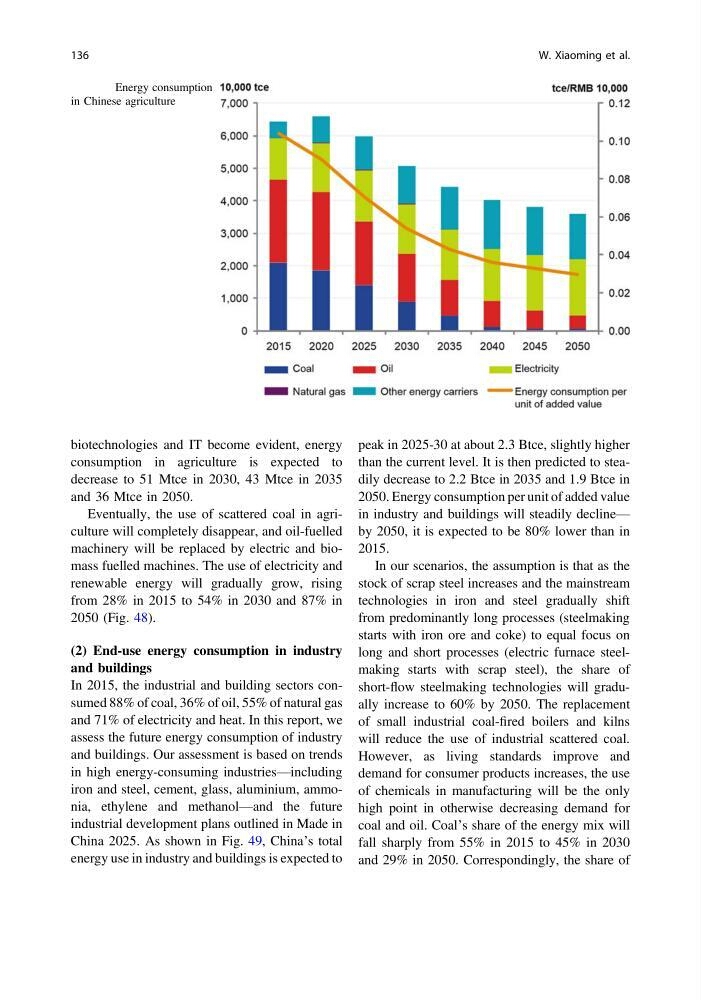
biotechnologies and IT become evident, energy
consumption in agriculture is expected to
decrease to 51 Mtce in 2030, 43 Mtce in 2035
and 36 Mtce in 2050.
Eventually, the use of scattered coal in agriculture will completely disappear, and oil-fuelled
machinery will be replaced by electric and biomass fuelled machines. The use of electricity and
renewable energy will gradually grow, rising
from 28% in 2015 to 54% in 2030 and 87% in
2050 (Fig. 48).
(2) End-use energy consumption in industry
and buildings
In 2015, the industrial and building sectors consumed 88% of coal, 36% of oil, 55% of natural gas
and 71% of electricity and heat. In this report, we
assess the future energy consumption of industry
and buildings. Our assessment is based on trends
in high energy-consuming industries—including
iron and steel, cement, glass, aluminium, ammonia, ethylene and methanol—and the future
industrial development plans outlined in Made in
China 2025. As shown in Fig. 49, China’s total
energy use in industry and buildings is expected to
peak in 2025-30 at about 2.3 Btce, slightly higher
than the current level. It is then predicted to steadily decrease to 2.2 Btce in 2035 and 1.9 Btce in
2050. Energy consumption per unit of added value
in industry and buildings will steadily decline—
by 2050, it is expected to be 80% lower than in
2015.
In our scenarios, the assumption is that as the
stock of scrap steel increases and the mainstream
technologies in iron and steel gradually shift
from predominantly long processes (steelmaking
starts with iron ore and coke) to equal focus on
long and short processes (electric furnace steelmaking starts with scrap steel), the share of
short-flow steelmaking technologies will gradually increase to 60% by 2050. The replacement
of small industrial coal-fired boilers and kilns
will reduce the use of industrial scattered coal.
However, as living standards improve and
demand for consumer products increases, the use
of chemicals in manufacturing will be the only
high point in otherwise decreasing demand for
coal and oil. Coal’s share of the energy mix will
fall sharply from 55% in 2015 to 45% in 2030
and 29% in 2050. Correspondingly, the share of
Fig. 48 Energy consumption
in Chinese agriculture
136
W. Xiaoming et al.
consumption in agriculture is expected to
decrease to 51 Mtce in 2030, 43 Mtce in 2035
and 36 Mtce in 2050.
Eventually, the use of scattered coal in agriculture will completely disappear, and oil-fuelled
machinery will be replaced by electric and biomass fuelled machines. The use of electricity and
renewable energy will gradually grow, rising
from 28% in 2015 to 54% in 2030 and 87% in
2050 (Fig. 48).
(2) End-use energy consumption in industry
and buildings
In 2015, the industrial and building sectors consumed 88% of coal, 36% of oil, 55% of natural gas
and 71% of electricity and heat. In this report, we
assess the future energy consumption of industry
and buildings. Our assessment is based on trends
in high energy-consuming industries—including
iron and steel, cement, glass, aluminium, ammonia, ethylene and methanol—and the future
industrial development plans outlined in Made in
China 2025. As shown in Fig. 49, China’s total
energy use in industry and buildings is expected to
peak in 2025-30 at about 2.3 Btce, slightly higher
than the current level. It is then predicted to steadily decrease to 2.2 Btce in 2035 and 1.9 Btce in
2050. Energy consumption per unit of added value
in industry and buildings will steadily decline—
by 2050, it is expected to be 80% lower than in
2015.
In our scenarios, the assumption is that as the
stock of scrap steel increases and the mainstream
technologies in iron and steel gradually shift
from predominantly long processes (steelmaking
starts with iron ore and coke) to equal focus on
long and short processes (electric furnace steelmaking starts with scrap steel), the share of
short-flow steelmaking technologies will gradually increase to 60% by 2050. The replacement
of small industrial coal-fired boilers and kilns
will reduce the use of industrial scattered coal.
However, as living standards improve and
demand for consumer products increases, the use
of chemicals in manufacturing will be the only
high point in otherwise decreasing demand for
coal and oil. Coal’s share of the energy mix will
fall sharply from 55% in 2015 to 45% in 2030
and 29% in 2050. Correspondingly, the share of
Fig. 48 Energy consumption
in Chinese agriculture
136
W. Xiaoming et al.