

appliances and cars) gradually increases, the recycling rate of scrap steel will also rise and is expected
to reach 20% by 2025, 25% by 2030 (the same as in
developed countries) and 40–70% by 2050.
(3) Energy use by the nonferrous metal sector is
expected to grow steadily until 2030
An important basic raw material, nonferrous
metals are widely used to make equipment and
products for many industries: power, transport,
machinery, electronics and aerospace. As the
Made in China 2025 strategic plan is implemented, the nonferrous metal sector is expected
to grow annually by around 3% until 2030,
which will cause its energy consumption to
continuously rise. After 2030, as the stock of
equipment and products made of nonferrous
metals increases and ore smelting is gradually
replaced by recycled scrap metal, the sector’s
energy consumption will fall sharply.
(4) Demand for traditional building materials will
gradually decrease, while demand for new
building materials will significantly increase
As demand diversifies and the low-carbon
economy develops, the growth space for traditional building materials (bricks, wood, plaster
and stone) gradually narrows. Demand for
cement and wall materials is expected to peak in
the present 13th Five-Year Plan (2016–20),
before contracting. Cement output will gradually
decrease from 2.35 Bt in 2015 to 1.8 Bt in 2030,
and to 1 Bt in 2050. These traditional materials
will be mainly used for the construction and
maintenance of public infrastructure and buildings. As floor space continues to grow to 2040,
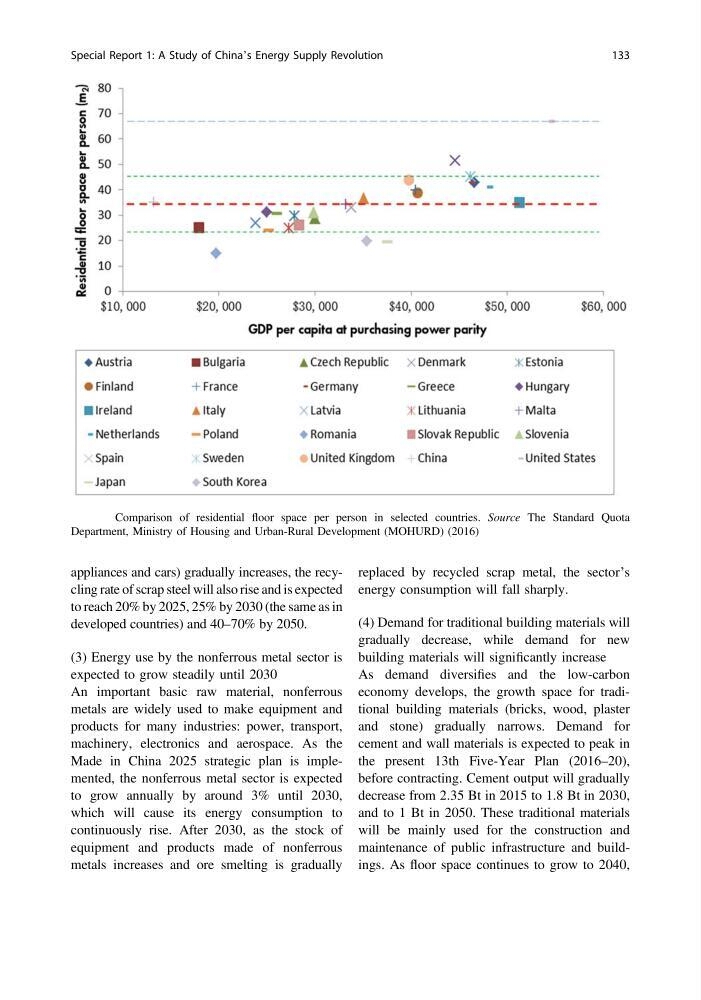
Fig. 45 Comparison of residential floor space per person in selected countries. Source The Standard Quota
Department, Ministry of Housing and Urban-Rural Development (MOHURD) (2016)
Special Report 1: A Study of China’s Energy Supply Revolution
133
to reach 20% by 2025, 25% by 2030 (the same as in
developed countries) and 40–70% by 2050.
(3) Energy use by the nonferrous metal sector is
expected to grow steadily until 2030
An important basic raw material, nonferrous
metals are widely used to make equipment and
products for many industries: power, transport,
machinery, electronics and aerospace. As the
Made in China 2025 strategic plan is implemented, the nonferrous metal sector is expected
to grow annually by around 3% until 2030,
which will cause its energy consumption to
continuously rise. After 2030, as the stock of
equipment and products made of nonferrous
metals increases and ore smelting is gradually
replaced by recycled scrap metal, the sector’s
energy consumption will fall sharply.
(4) Demand for traditional building materials will
gradually decrease, while demand for new
building materials will significantly increase
As demand diversifies and the low-carbon
economy develops, the growth space for traditional building materials (bricks, wood, plaster
and stone) gradually narrows. Demand for
cement and wall materials is expected to peak in
the present 13th Five-Year Plan (2016–20),
before contracting. Cement output will gradually
decrease from 2.35 Bt in 2015 to 1.8 Bt in 2030,
and to 1 Bt in 2050. These traditional materials
will be mainly used for the construction and
maintenance of public infrastructure and buildings. As floor space continues to grow to 2040,
Fig. 45 Comparison of residential floor space per person in selected countries. Source The Standard Quota
Department, Ministry of Housing and Urban-Rural Development (MOHURD) (2016)
Special Report 1: A Study of China’s Energy Supply Revolution
133