

(2) China’s growth in floor area
According to research by the Ministry of Housing
and Urban-Rural Development, China’s floor
space stock in 2015 was around 60 billion square
metres. It comprised 17.6 billion square metres of
urban residential floor space, 27.6 billion square
metres of rural residential floor space, and 14.0
billion square metres of urban commercial floor
space. In the experience of developed countries
(see Fig. 45), when China’s floor space peaks
urban residential floor space per person will be
around 40 square metres and public floor space per
person around 20 square metres (based on a conversion factor of 0.8 with the floor space per person
in developed countries). To ensure steady and
sustainable development of the real estate industry,
this report suggests that the time-to-peak should be
postponed to around 2040, in accordance with the
population forecast for that year. Based on the
projected population in 2040, the floor space peak
will be about 92 billion square metres (see Fig. 46).
In this pathway, the rapid expansion of the real
estate industry has ended and the annual floor space
will decrease from 3.2 billion square metres in the
13th Five-Year Plan (2016–20) to 2.3 billion
square metres in the 14th Five-Year Plan (2021–
25) and 1.7 billion square metres in the 15th
Five-Year Plan (2026–30). As a result, the ability
of the real estate industry to stimulate economic
growth will continue to weaken.
(3) Trends for major industrial products
(1) Vehicle ownership is expected to increase
In the experience of developed countries, car
ownership goes through three stages—slow
growth, explosive growth and saturation—as GDP
per capita increases. Currently, China’s GDP per
capita exceeds $8,000. Judging by the growth in
passenger car ownership in recent years, China’s
car industry has entered a fast growth stage, which
is expected to last until 2035. After which, it will
gradually reach saturation and a sharp slowdown in
growth. It is projected that China’s vehicle ownership will exceed 500 million in total by 2050 and
350 units per 1,000 people.
(2) Steel output is predicted to decline
Currently, more than 50% of crude steel in China is
used in the building sector. As future annual average floor space continues to decline, the demand for
crude steel will gradually decrease. It is predicted
that crude steel demand will decline to 730 Mt in
2020, 600 Mt in 2030 and 200–250 Mt in 2040.
The steel will be used mainly to make mechanical
equipment, household appliances and cars. As
China’s stock of steel products (equipment,
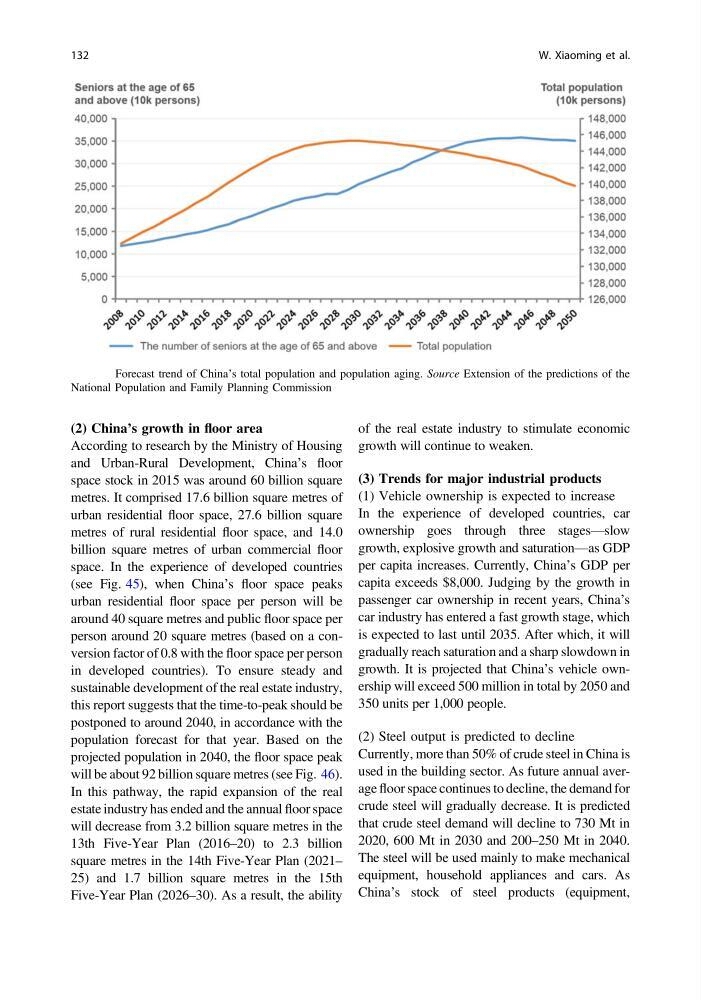
Fig. 44 Forecast trend of China’s total population and population aging. Source Extension of the predictions of the
National Population and Family Planning Commission
132
W. Xiaoming et al.
According to research by the Ministry of Housing
and Urban-Rural Development, China’s floor
space stock in 2015 was around 60 billion square
metres. It comprised 17.6 billion square metres of
urban residential floor space, 27.6 billion square
metres of rural residential floor space, and 14.0
billion square metres of urban commercial floor
space. In the experience of developed countries
(see Fig. 45), when China’s floor space peaks
urban residential floor space per person will be
around 40 square metres and public floor space per
person around 20 square metres (based on a conversion factor of 0.8 with the floor space per person
in developed countries). To ensure steady and
sustainable development of the real estate industry,
this report suggests that the time-to-peak should be
postponed to around 2040, in accordance with the
population forecast for that year. Based on the
projected population in 2040, the floor space peak
will be about 92 billion square metres (see Fig. 46).
In this pathway, the rapid expansion of the real
estate industry has ended and the annual floor space
will decrease from 3.2 billion square metres in the
13th Five-Year Plan (2016–20) to 2.3 billion
square metres in the 14th Five-Year Plan (2021–
25) and 1.7 billion square metres in the 15th
Five-Year Plan (2026–30). As a result, the ability
of the real estate industry to stimulate economic
growth will continue to weaken.
(3) Trends for major industrial products
(1) Vehicle ownership is expected to increase
In the experience of developed countries, car
ownership goes through three stages—slow
growth, explosive growth and saturation—as GDP
per capita increases. Currently, China’s GDP per
capita exceeds $8,000. Judging by the growth in
passenger car ownership in recent years, China’s
car industry has entered a fast growth stage, which
is expected to last until 2035. After which, it will
gradually reach saturation and a sharp slowdown in
growth. It is projected that China’s vehicle ownership will exceed 500 million in total by 2050 and
350 units per 1,000 people.
(2) Steel output is predicted to decline
Currently, more than 50% of crude steel in China is
used in the building sector. As future annual average floor space continues to decline, the demand for
crude steel will gradually decrease. It is predicted
that crude steel demand will decline to 730 Mt in
2020, 600 Mt in 2030 and 200–250 Mt in 2040.
The steel will be used mainly to make mechanical
equipment, household appliances and cars. As
China’s stock of steel products (equipment,
Fig. 44 Forecast trend of China’s total population and population aging. Source Extension of the predictions of the
National Population and Family Planning Commission
132
W. Xiaoming et al.