

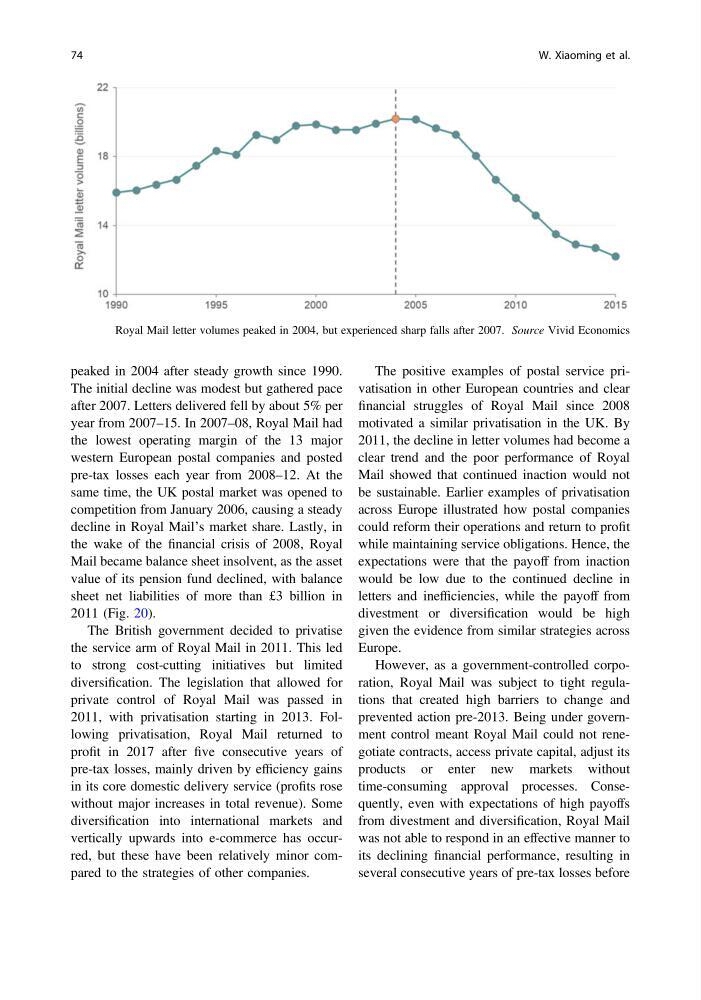
peaked in 2004 after steady growth since 1990.
The initial decline was modest but gathered pace
after 2007. Letters delivered fell by about 5% per
year from 2007–15. In 2007–08, Royal Mail had
the lowest operating margin of the 13 major
western European postal companies and posted
pre-tax losses each year from 2008–12. At the
same time, the UK postal market was opened to
competition from January 2006, causing a steady
decline in Royal Mail’s market share. Lastly, in
the wake of the financial crisis of 2008, Royal
Mail became balance sheet insolvent, as the asset
value of its pension fund declined, with balance
sheet net liabilities of more than £3 billion in
2011 (Fig. 20).
The British government decided to privatise
the service arm of Royal Mail in 2011. This led
to strong cost-cutting initiatives but limited
diversification. The legislation that allowed for
private control of Royal Mail was passed in
2011, with privatisation starting in 2013. Following privatisation, Royal Mail returned to
profit in 2017 after five consecutive years of
pre-tax losses, mainly driven by efficiency gains
in its core domestic delivery service (profits rose
without major increases in total revenue). Some
diversification into international markets and
vertically upwards into e-commerce has occurred, but these have been relatively minor compared to the strategies of other companies.
The positive examples of postal service privatisation in other European countries and clear
financial struggles of Royal Mail since 2008
motivated a similar privatisation in the UK. By
2011, the decline in letter volumes had become a
clear trend and the poor performance of Royal
Mail showed that continued inaction would not
be sustainable. Earlier examples of privatisation
across Europe illustrated how postal companies
could reform their operations and return to profit
while maintaining service obligations. Hence, the
expectations were that the payoff from inaction
would be low due to the continued decline in
letters and inefficiencies, while the payoff from
divestment or diversification would be high
given the evidence from similar strategies across
Europe.
However, as a government-controlled corporation, Royal Mail was subject to tight regulations that created high barriers to change and
prevented action pre-2013. Being under government control meant Royal Mail could not renegotiate contracts, access private capital, adjust its
products or enter new markets without
time-consuming approval processes. Consequently, even with expectations of high payoffs
from divestment and diversification, Royal Mail
was not able to respond in an effective manner to
its declining financial performance, resulting in
several consecutive years of pre-tax losses before
Fig. 20 Royal Mail letter volumes peaked in 2004, but experienced sharp falls after 2007. Source Vivid Economics
74
W. Xiaoming et al.
The initial decline was modest but gathered pace
after 2007. Letters delivered fell by about 5% per
year from 2007–15. In 2007–08, Royal Mail had
the lowest operating margin of the 13 major
western European postal companies and posted
pre-tax losses each year from 2008–12. At the
same time, the UK postal market was opened to
competition from January 2006, causing a steady
decline in Royal Mail’s market share. Lastly, in
the wake of the financial crisis of 2008, Royal
Mail became balance sheet insolvent, as the asset
value of its pension fund declined, with balance
sheet net liabilities of more than £3 billion in
2011 (Fig. 20).
The British government decided to privatise
the service arm of Royal Mail in 2011. This led
to strong cost-cutting initiatives but limited
diversification. The legislation that allowed for
private control of Royal Mail was passed in
2011, with privatisation starting in 2013. Following privatisation, Royal Mail returned to
profit in 2017 after five consecutive years of
pre-tax losses, mainly driven by efficiency gains
in its core domestic delivery service (profits rose
without major increases in total revenue). Some
diversification into international markets and
vertically upwards into e-commerce has occurred, but these have been relatively minor compared to the strategies of other companies.
The positive examples of postal service privatisation in other European countries and clear
financial struggles of Royal Mail since 2008
motivated a similar privatisation in the UK. By
2011, the decline in letter volumes had become a
clear trend and the poor performance of Royal
Mail showed that continued inaction would not
be sustainable. Earlier examples of privatisation
across Europe illustrated how postal companies
could reform their operations and return to profit
while maintaining service obligations. Hence, the
expectations were that the payoff from inaction
would be low due to the continued decline in
letters and inefficiencies, while the payoff from
divestment or diversification would be high
given the evidence from similar strategies across
Europe.
However, as a government-controlled corporation, Royal Mail was subject to tight regulations that created high barriers to change and
prevented action pre-2013. Being under government control meant Royal Mail could not renegotiate contracts, access private capital, adjust its
products or enter new markets without
time-consuming approval processes. Consequently, even with expectations of high payoffs
from divestment and diversification, Royal Mail
was not able to respond in an effective manner to
its declining financial performance, resulting in
several consecutive years of pre-tax losses before
Fig. 20 Royal Mail letter volumes peaked in 2004, but experienced sharp falls after 2007. Source Vivid Economics
74
W. Xiaoming et al.