

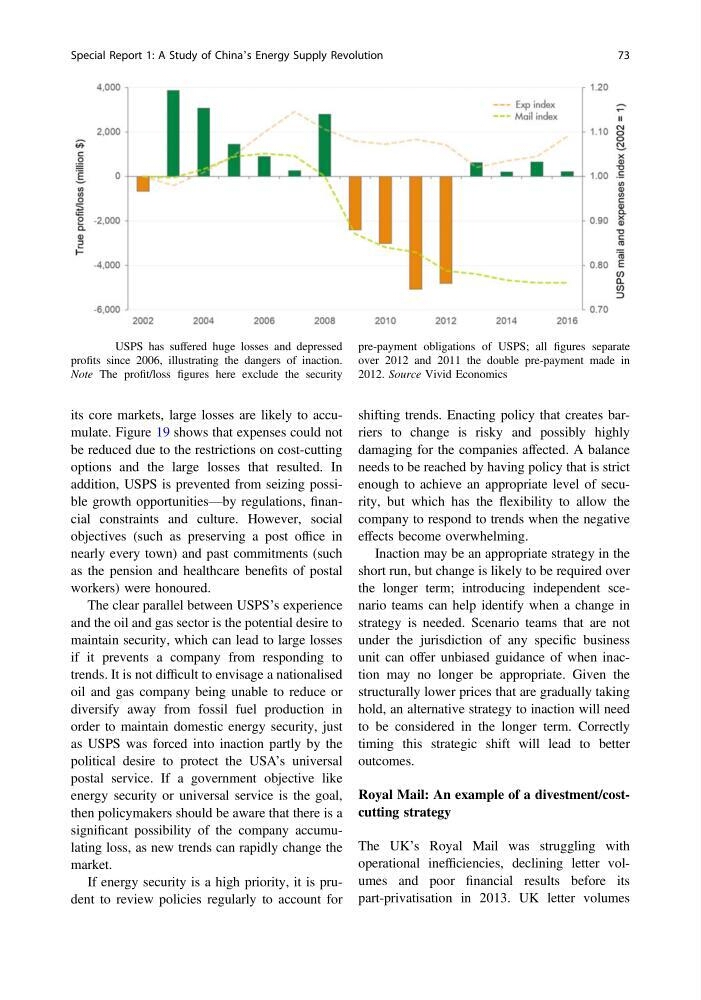
its core markets, large losses are likely to accumulate. Figure 19 shows that expenses could not
be reduced due to the restrictions on cost-cutting
options and the large losses that resulted. In
addition, USPS is prevented from seizing possible growth opportunities—by regulations, financial constraints and culture. However, social
objectives (such as preserving a post office in
nearly every town) and past commitments (such
as the pension and healthcare benefits of postal
workers) were honoured.
The clear parallel between USPS’s experience
and the oil and gas sector is the potential desire to
maintain security, which can lead to large losses
if it prevents a company from responding to
trends. It is not difficult to envisage a nationalised
oil and gas company being unable to reduce or
diversify away from fossil fuel production in
order to maintain domestic energy security, just
as USPS was forced into inaction partly by the
political desire to protect the USA’s universal
postal service. If a government objective like
energy security or universal service is the goal,
then policymakers should be aware that there is a
significant possibility of the company accumulating loss, as new trends can rapidly change the
market.
If energy security is a high priority, it is prudent to review policies regularly to account for
shifting trends. Enacting policy that creates barriers to change is risky and possibly highly
damaging for the companies affected. A balance
needs to be reached by having policy that is strict
enough to achieve an appropriate level of security, but which has the flexibility to allow the
company to respond to trends when the negative
effects become overwhelming.
Inaction may be an appropriate strategy in the
short run, but change is likely to be required over
the longer term; introducing independent scenario teams can help identify when a change in
strategy is needed. Scenario teams that are not
under the jurisdiction of any specific business
unit can offer unbiased guidance of when inaction may no longer be appropriate. Given the
structurally lower prices that are gradually taking
hold, an alternative strategy to inaction will need
to be considered in the longer term. Correctly
timing this strategic shift will lead to better
outcomes.
Royal Mail: An example of a divestment/costcutting strategy
The UK’s Royal Mail was struggling with
operational inefficiencies, declining letter volumes and poor financial results before its
part-privatisation in 2013. UK letter volumes
Fig. 19 USPS has suffered huge losses and depressed
profits since 2006, illustrating the dangers of inaction.
Note The profit/loss figures here exclude the security
pre-payment obligations of USPS; all figures separate
over 2012 and 2011 the double pre-payment made in
2012. Source Vivid Economics
Special Report 1: A Study of China’s Energy Supply Revolution
73
be reduced due to the restrictions on cost-cutting
options and the large losses that resulted. In
addition, USPS is prevented from seizing possible growth opportunities—by regulations, financial constraints and culture. However, social
objectives (such as preserving a post office in
nearly every town) and past commitments (such
as the pension and healthcare benefits of postal
workers) were honoured.
The clear parallel between USPS’s experience
and the oil and gas sector is the potential desire to
maintain security, which can lead to large losses
if it prevents a company from responding to
trends. It is not difficult to envisage a nationalised
oil and gas company being unable to reduce or
diversify away from fossil fuel production in
order to maintain domestic energy security, just
as USPS was forced into inaction partly by the
political desire to protect the USA’s universal
postal service. If a government objective like
energy security or universal service is the goal,
then policymakers should be aware that there is a
significant possibility of the company accumulating loss, as new trends can rapidly change the
market.
If energy security is a high priority, it is prudent to review policies regularly to account for
shifting trends. Enacting policy that creates barriers to change is risky and possibly highly
damaging for the companies affected. A balance
needs to be reached by having policy that is strict
enough to achieve an appropriate level of security, but which has the flexibility to allow the
company to respond to trends when the negative
effects become overwhelming.
Inaction may be an appropriate strategy in the
short run, but change is likely to be required over
the longer term; introducing independent scenario teams can help identify when a change in
strategy is needed. Scenario teams that are not
under the jurisdiction of any specific business
unit can offer unbiased guidance of when inaction may no longer be appropriate. Given the
structurally lower prices that are gradually taking
hold, an alternative strategy to inaction will need
to be considered in the longer term. Correctly
timing this strategic shift will lead to better
outcomes.
Royal Mail: An example of a divestment/costcutting strategy
The UK’s Royal Mail was struggling with
operational inefficiencies, declining letter volumes and poor financial results before its
part-privatisation in 2013. UK letter volumes
Fig. 19 USPS has suffered huge losses and depressed
profits since 2006, illustrating the dangers of inaction.
Note The profit/loss figures here exclude the security
pre-payment obligations of USPS; all figures separate
over 2012 and 2011 the double pre-payment made in
2012. Source Vivid Economics
Special Report 1: A Study of China’s Energy Supply Revolution
73