

2013. Privatisation offered an easy avenue to
reduce transformation costs and allow for new
strategies to be adopted.
While the British government considers a
universal service important, it has far more
lenient price controls on postage than the USA.
Post-privatisation, Royal Mail was still designated as the universal service provider, obligated
to provide a nationwide service for a uniform
price, six days a week. This designation meant
that a strong focus was still needed on the core
service of delivering letters, leading to a degree
of aversion to change. Large diversification
strategies inherently carried a great deal of risk
and could disrupt this core business. Hence, the
Royal Mail’s preferences pushed it more towards
cost-cutting strategies than diversification into
new markets.
The British government split the historic post
office into three parts in 2013 and only privatised
the postal service arm, leaving the network of
post offices under public ownership. These three
parts were the letter and parcel service operations
of Royal Mail, which were subsequently privatised in 2013; the network of post offices, which
remains in public hands; and the net liabilities of
the Royal Mail Pension Plan that were taken over
by the government to make Royal Mail solvent
again. In effect, the government bore a one-time
cost to enable privatisation and reduce transformation costs. This unbundling was implemented
to allow the post offices to be used by different
postal service providers and avoid wasted
spending on infrastructure.
Following privatisation in 2013, Royal Mail’s
financial situation improved dramatically, mainly
through divestment in its core business area.
While revenue growth was modest, with a compound annual growth rate of 1% between 2011
and 2017, profit levels increased substantially,
suggesting the focus was on efficiency gains
rather than entry into new areas. Between 2011
and 2016, Royal Mail achieved an overall
headcount reduction of 9.7% and reduced the
number of its mail processing centres from 57 to
38. This greatly improved the profitability of its
core domestic letters and parcels business,
reversing an operating loss of £120 million in
2011 to an operating profit of £411 million in
2017.
Although effective in the short run, this
divestment strategy is unlikely to offer a
long-term solution for generating profit growth.
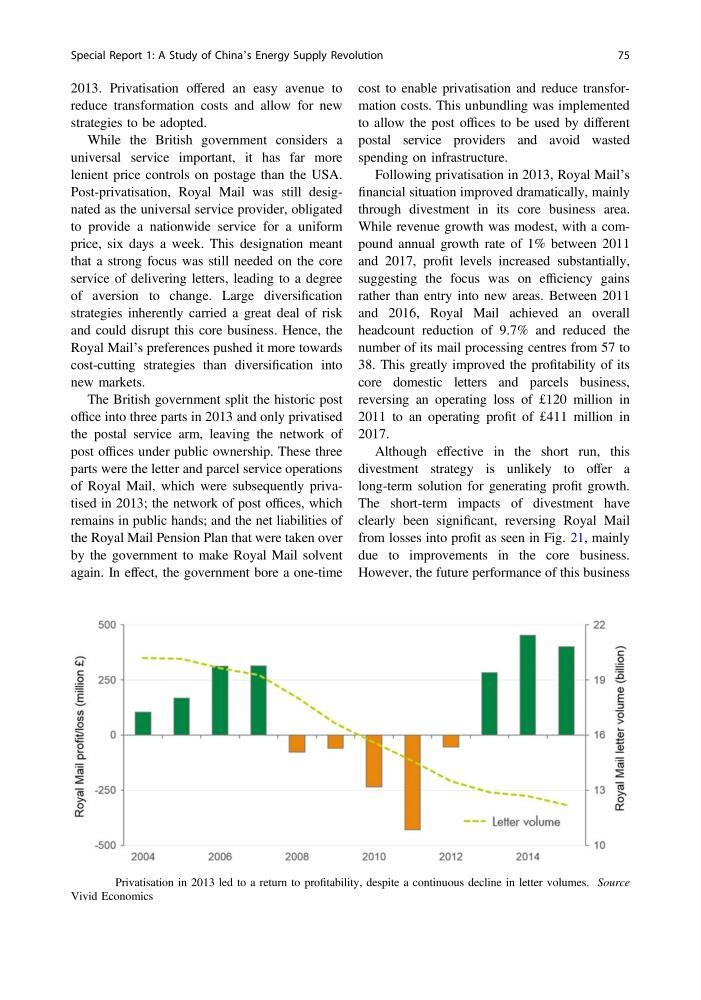
The short-term impacts of divestment have
clearly been significant, reversing Royal Mail
from losses into profit as seen in Fig. 21, mainly
due to improvements in the core business.
However, the future performance of this business
Fig. 21 Privatisation in 2013 led to a return to profitability, despite a continuous decline in letter volumes. Source
Vivid Economics
Special Report 1: A Study of China’s Energy Supply Revolution
75
reduce transformation costs and allow for new
strategies to be adopted.
While the British government considers a
universal service important, it has far more
lenient price controls on postage than the USA.
Post-privatisation, Royal Mail was still designated as the universal service provider, obligated
to provide a nationwide service for a uniform
price, six days a week. This designation meant
that a strong focus was still needed on the core
service of delivering letters, leading to a degree
of aversion to change. Large diversification
strategies inherently carried a great deal of risk
and could disrupt this core business. Hence, the
Royal Mail’s preferences pushed it more towards
cost-cutting strategies than diversification into
new markets.
The British government split the historic post
office into three parts in 2013 and only privatised
the postal service arm, leaving the network of
post offices under public ownership. These three
parts were the letter and parcel service operations
of Royal Mail, which were subsequently privatised in 2013; the network of post offices, which
remains in public hands; and the net liabilities of
the Royal Mail Pension Plan that were taken over
by the government to make Royal Mail solvent
again. In effect, the government bore a one-time
cost to enable privatisation and reduce transformation costs. This unbundling was implemented
to allow the post offices to be used by different
postal service providers and avoid wasted
spending on infrastructure.
Following privatisation in 2013, Royal Mail’s
financial situation improved dramatically, mainly
through divestment in its core business area.
While revenue growth was modest, with a compound annual growth rate of 1% between 2011
and 2017, profit levels increased substantially,
suggesting the focus was on efficiency gains
rather than entry into new areas. Between 2011
and 2016, Royal Mail achieved an overall
headcount reduction of 9.7% and reduced the
number of its mail processing centres from 57 to
38. This greatly improved the profitability of its
core domestic letters and parcels business,
reversing an operating loss of £120 million in
2011 to an operating profit of £411 million in
2017.
Although effective in the short run, this
divestment strategy is unlikely to offer a
long-term solution for generating profit growth.
The short-term impacts of divestment have
clearly been significant, reversing Royal Mail
from losses into profit as seen in Fig. 21, mainly
due to improvements in the core business.
However, the future performance of this business
Fig. 21 Privatisation in 2013 led to a return to profitability, despite a continuous decline in letter volumes. Source
Vivid Economics
Special Report 1: A Study of China’s Energy Supply Revolution
75