

Array, 640 MW) and has won the bid to
deliver the world’s first offshore wind farm of
more than 1 GW (Hornsea Project One, 1.2
GW).
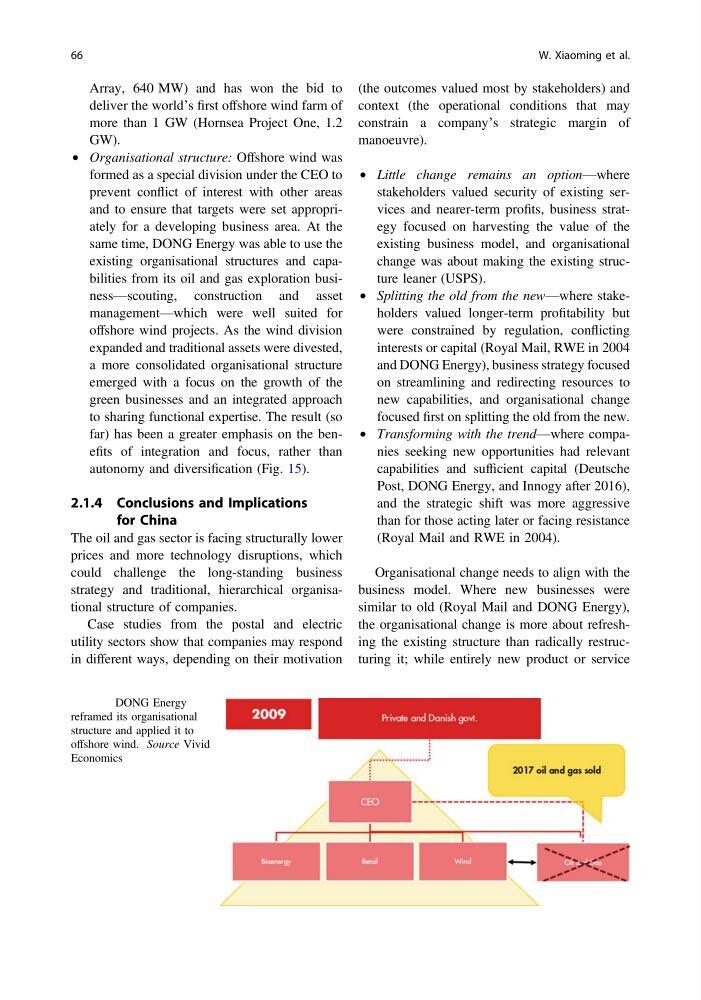
• Organisational structure: Offshore wind was
formed as a special division under the CEO to
prevent conflict of interest with other areas
and to ensure that targets were set appropriately for a developing business area. At the
same time, DONG Energy was able to use the
existing organisational structures and capabilities from its oil and gas exploration business—scouting, construction and asset
management—which were well suited for
offshore wind projects. As the wind division
expanded and traditional assets were divested,
a more consolidated organisational structure
emerged with a focus on the growth of the
green businesses and an integrated approach
to sharing functional expertise. The result (so
far) has been a greater emphasis on the benefits of integration and focus, rather than
autonomy and diversification (Fig. 15).
2.1.4 Conclusions and Implications
for China
The oil and gas sector is facing structurally lower
prices and more technology disruptions, which
could challenge the long-standing business
strategy and traditional, hierarchical organisational structure of companies.
Case studies from the postal and electric
utility sectors show that companies may respond
in different ways, depending on their motivation
(the outcomes valued most by stakeholders) and
context (the operational conditions that may
constrain a company’s strategic margin of
manoeuvre).
• Little change remains an option—where
stakeholders valued security of existing services and nearer-term profits, business strategy focused on harvesting the value of the
existing business model, and organisational
change was about making the existing structure leaner (USPS).
• Splitting the old from the new—where stakeholders valued longer-term profitability but
were constrained by regulation, conflicting
interests or capital (Royal Mail, RWE in 2004
and DONG Energy), business strategy focused
on streamlining and redirecting resources to
new capabilities, and organisational change
focused first on splitting the old from the new.
• Transforming with the trend—where companies seeking new opportunities had relevant
capabilities and sufficient capital (Deutsche
Post, DONG Energy, and Innogy after 2016),
and the strategic shift was more aggressive
than for those acting later or facing resistance
(Royal Mail and RWE in 2004).
Organisational change needs to align with the
business model. Where new businesses were
similar to old (Royal Mail and DONG Energy),
the organisational change is more about refreshing the existing structure than radically restructuring it; while entirely new product or service
Fig. 15 DONG Energy
reframed its organisational
structure and applied it to
offshore wind. Source Vivid
Economics
66
W. Xiaoming et al.
deliver the world’s first offshore wind farm of
more than 1 GW (Hornsea Project One, 1.2
GW).
• Organisational structure: Offshore wind was
formed as a special division under the CEO to
prevent conflict of interest with other areas
and to ensure that targets were set appropriately for a developing business area. At the
same time, DONG Energy was able to use the
existing organisational structures and capabilities from its oil and gas exploration business—scouting, construction and asset
management—which were well suited for
offshore wind projects. As the wind division
expanded and traditional assets were divested,
a more consolidated organisational structure
emerged with a focus on the growth of the
green businesses and an integrated approach
to sharing functional expertise. The result (so
far) has been a greater emphasis on the benefits of integration and focus, rather than
autonomy and diversification (Fig. 15).
2.1.4 Conclusions and Implications
for China
The oil and gas sector is facing structurally lower
prices and more technology disruptions, which
could challenge the long-standing business
strategy and traditional, hierarchical organisational structure of companies.
Case studies from the postal and electric
utility sectors show that companies may respond
in different ways, depending on their motivation
(the outcomes valued most by stakeholders) and
context (the operational conditions that may
constrain a company’s strategic margin of
manoeuvre).
• Little change remains an option—where
stakeholders valued security of existing services and nearer-term profits, business strategy focused on harvesting the value of the
existing business model, and organisational
change was about making the existing structure leaner (USPS).
• Splitting the old from the new—where stakeholders valued longer-term profitability but
were constrained by regulation, conflicting
interests or capital (Royal Mail, RWE in 2004
and DONG Energy), business strategy focused
on streamlining and redirecting resources to
new capabilities, and organisational change
focused first on splitting the old from the new.
• Transforming with the trend—where companies seeking new opportunities had relevant
capabilities and sufficient capital (Deutsche
Post, DONG Energy, and Innogy after 2016),
and the strategic shift was more aggressive
than for those acting later or facing resistance
(Royal Mail and RWE in 2004).
Organisational change needs to align with the
business model. Where new businesses were
similar to old (Royal Mail and DONG Energy),
the organisational change is more about refreshing the existing structure than radically restructuring it; while entirely new product or service
Fig. 15 DONG Energy
reframed its organisational
structure and applied it to
offshore wind. Source Vivid
Economics
66
W. Xiaoming et al.