

models (Deutsche Post and Innogy) involved
far-reaching change.
Governments can have a role to play in
shaping the motives and context of companies to
help guide outcomes, and they should consider
what types of response current policies are
encouraging. Through setting the conditions that
influence strategic and organisational change,
governments can determine the future role of the
oil and gas industry. Current policies are setting
the motive and context of companies that will
encourage a particular response that may not be
in line with the government’s aims. Consideration should be given to how motives and context
impact future responses and what the options are
for a government to influence these factors.
(1) Response archetypes for oil and gas
companies
There is no dominant or common response
strategy to the prevailing future trends—the
motivations and context behind each company
will determine what types of strategic and
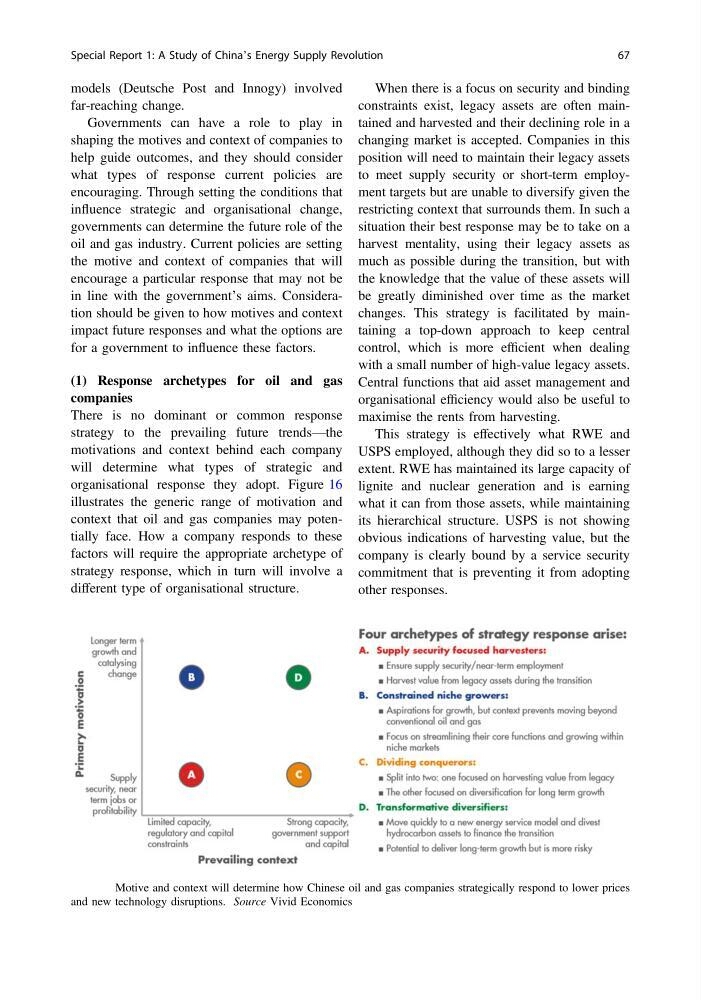
organisational response they adopt. Figure 16
illustrates the generic range of motivation and
context that oil and gas companies may potentially face. How a company responds to these
factors will require the appropriate archetype of
strategy response, which in turn will involve a
different type of organisational structure.
When there is a focus on security and binding
constraints exist, legacy assets are often maintained and harvested and their declining role in a
changing market is accepted. Companies in this
position will need to maintain their legacy assets
to meet supply security or short-term employment targets but are unable to diversify given the
restricting context that surrounds them. In such a
situation their best response may be to take on a
harvest mentality, using their legacy assets as
much as possible during the transition, but with
the knowledge that the value of these assets will
be greatly diminished over time as the market
changes. This strategy is facilitated by maintaining a top-down approach to keep central
control, which is more efficient when dealing
with a small number of high-value legacy assets.
Central functions that aid asset management and
organisational efficiency would also be useful to
maximise the rents from harvesting.
This strategy is effectively what RWE and
USPS employed, although they did so to a lesser
extent. RWE has maintained its large capacity of
lignite and nuclear generation and is earning
what it can from those assets, while maintaining
its hierarchical structure. USPS is not showing
obvious indications of harvesting value, but the
company is clearly bound by a service security
commitment that is preventing it from adopting
other responses.
Fig. 16 Motive and context will determine how Chinese oil and gas companies strategically respond to lower prices
and new technology disruptions. Source Vivid Economics
Special Report 1: A Study of China’s Energy Supply Revolution
67
far-reaching change.
Governments can have a role to play in
shaping the motives and context of companies to
help guide outcomes, and they should consider
what types of response current policies are
encouraging. Through setting the conditions that
influence strategic and organisational change,
governments can determine the future role of the
oil and gas industry. Current policies are setting
the motive and context of companies that will
encourage a particular response that may not be
in line with the government’s aims. Consideration should be given to how motives and context
impact future responses and what the options are
for a government to influence these factors.
(1) Response archetypes for oil and gas
companies
There is no dominant or common response
strategy to the prevailing future trends—the
motivations and context behind each company
will determine what types of strategic and
organisational response they adopt. Figure 16
illustrates the generic range of motivation and
context that oil and gas companies may potentially face. How a company responds to these
factors will require the appropriate archetype of
strategy response, which in turn will involve a
different type of organisational structure.
When there is a focus on security and binding
constraints exist, legacy assets are often maintained and harvested and their declining role in a
changing market is accepted. Companies in this
position will need to maintain their legacy assets
to meet supply security or short-term employment targets but are unable to diversify given the
restricting context that surrounds them. In such a
situation their best response may be to take on a
harvest mentality, using their legacy assets as
much as possible during the transition, but with
the knowledge that the value of these assets will
be greatly diminished over time as the market
changes. This strategy is facilitated by maintaining a top-down approach to keep central
control, which is more efficient when dealing
with a small number of high-value legacy assets.
Central functions that aid asset management and
organisational efficiency would also be useful to
maximise the rents from harvesting.
This strategy is effectively what RWE and
USPS employed, although they did so to a lesser
extent. RWE has maintained its large capacity of
lignite and nuclear generation and is earning
what it can from those assets, while maintaining
its hierarchical structure. USPS is not showing
obvious indications of harvesting value, but the
company is clearly bound by a service security
commitment that is preventing it from adopting
other responses.
Fig. 16 Motive and context will determine how Chinese oil and gas companies strategically respond to lower prices
and new technology disruptions. Source Vivid Economics
Special Report 1: A Study of China’s Energy Supply Revolution
67