

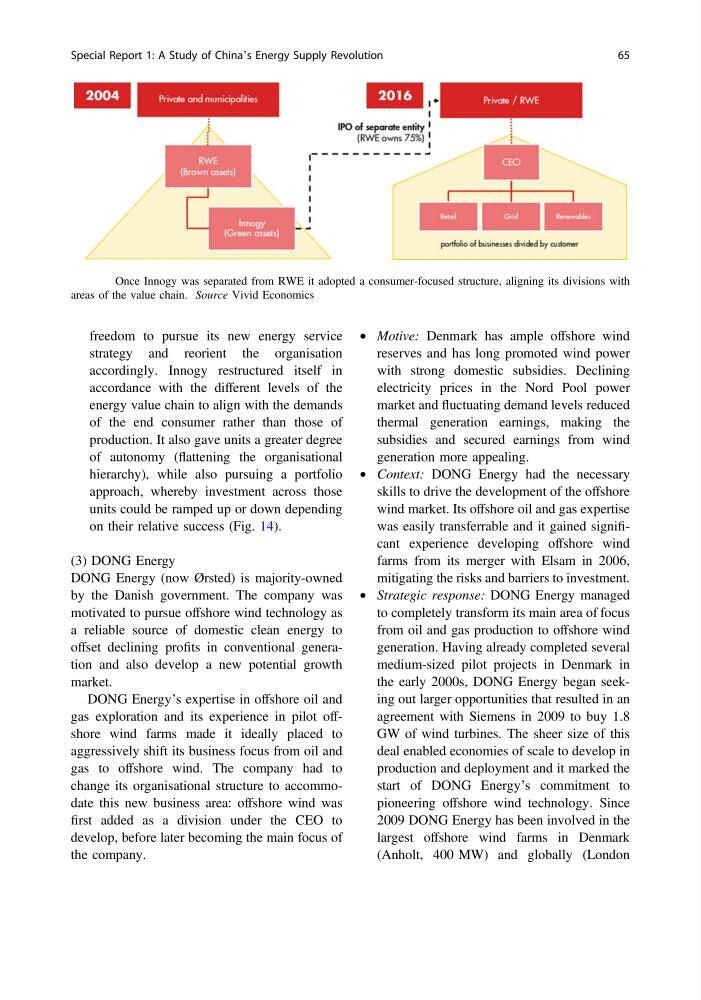
freedom to pursue its new energy service
strategy and reorient the organisation
accordingly. Innogy restructured itself in
accordance with the different levels of the
energy value chain to align with the demands
of the end consumer rather than those of
production. It also gave units a greater degree
of autonomy (flattening the organisational
hierarchy), while also pursuing a portfolio
approach, whereby investment across those
units could be ramped up or down depending
on their relative success (Fig. 14).
(3) DONG Energy
DONG Energy (now Ørsted) is majority-owned
by the Danish government. The company was
motivated to pursue offshore wind technology as
a reliable source of domestic clean energy to
offset declining profits in conventional generation and also develop a new potential growth
market.
DONG Energy’s expertise in offshore oil and
gas exploration and its experience in pilot offshore wind farms made it ideally placed to
aggressively shift its business focus from oil and
gas to offshore wind. The company had to
change its organisational structure to accommodate this new business area: offshore wind was
first added as a division under the CEO to
develop, before later becoming the main focus of
the company.
• Motive: Denmark has ample offshore wind
reserves and has long promoted wind power
with strong domestic subsidies. Declining
electricity prices in the Nord Pool power
market and fluctuating demand levels reduced
thermal generation earnings, making the
subsidies and secured earnings from wind
generation more appealing.
• Context: DONG Energy had the necessary
skills to drive the development of the offshore
wind market. Its offshore oil and gas expertise
was easily transferrable and it gained significant experience developing offshore wind
farms from its merger with Elsam in 2006,
mitigating the risks and barriers to investment.
• Strategic response: DONG Energy managed
to completely transform its main area of focus
from oil and gas production to offshore wind
generation. Having already completed several
medium-sized pilot projects in Denmark in
the early 2000s, DONG Energy began seeking out larger opportunities that resulted in an
agreement with Siemens in 2009 to buy 1.8
GW of wind turbines. The sheer size of this
deal enabled economies of scale to develop in
production and deployment and it marked the
start of DONG Energy’s commitment to
pioneering offshore wind technology. Since
2009 DONG Energy has been involved in the
largest offshore wind farms in Denmark
(Anholt, 400 MW) and globally (London
Fig. 14 Once Innogy was separated from RWE it adopted a consumer-focused structure, aligning its divisions with
areas of the value chain. Source Vivid Economics
Special Report 1: A Study of China’s Energy Supply Revolution
65
strategy and reorient the organisation
accordingly. Innogy restructured itself in
accordance with the different levels of the
energy value chain to align with the demands
of the end consumer rather than those of
production. It also gave units a greater degree
of autonomy (flattening the organisational
hierarchy), while also pursuing a portfolio
approach, whereby investment across those
units could be ramped up or down depending
on their relative success (Fig. 14).
(3) DONG Energy
DONG Energy (now Ørsted) is majority-owned
by the Danish government. The company was
motivated to pursue offshore wind technology as
a reliable source of domestic clean energy to
offset declining profits in conventional generation and also develop a new potential growth
market.
DONG Energy’s expertise in offshore oil and
gas exploration and its experience in pilot offshore wind farms made it ideally placed to
aggressively shift its business focus from oil and
gas to offshore wind. The company had to
change its organisational structure to accommodate this new business area: offshore wind was
first added as a division under the CEO to
develop, before later becoming the main focus of
the company.
• Motive: Denmark has ample offshore wind
reserves and has long promoted wind power
with strong domestic subsidies. Declining
electricity prices in the Nord Pool power
market and fluctuating demand levels reduced
thermal generation earnings, making the
subsidies and secured earnings from wind
generation more appealing.
• Context: DONG Energy had the necessary
skills to drive the development of the offshore
wind market. Its offshore oil and gas expertise
was easily transferrable and it gained significant experience developing offshore wind
farms from its merger with Elsam in 2006,
mitigating the risks and barriers to investment.
• Strategic response: DONG Energy managed
to completely transform its main area of focus
from oil and gas production to offshore wind
generation. Having already completed several
medium-sized pilot projects in Denmark in
the early 2000s, DONG Energy began seeking out larger opportunities that resulted in an
agreement with Siemens in 2009 to buy 1.8
GW of wind turbines. The sheer size of this
deal enabled economies of scale to develop in
production and deployment and it marked the
start of DONG Energy’s commitment to
pioneering offshore wind technology. Since
2009 DONG Energy has been involved in the
largest offshore wind farms in Denmark
(Anholt, 400 MW) and globally (London
Fig. 14 Once Innogy was separated from RWE it adopted a consumer-focused structure, aligning its divisions with
areas of the value chain. Source Vivid Economics
Special Report 1: A Study of China’s Energy Supply Revolution
65