

68
I. C. Ishak et al.
Keywords Oil spill · Port · Prevention · Ship crash · Ship collision
8.1 Introduction
The total length of the Malaysia coastline is about 4600 km [1]. Malaysian water
comprises more than 500,000 square km [1]. Thus, it is inevitably visible to high
risks especially with an increase in shipping activities [1]. The registered Malaysian
ships and foreign-registered ships calling at Malaysian ports have been recorded as
more than 75,000 in 2017 [1]. The heavy and developing shipping activities reveal
to a potential accident risk which precedes to oil and chemical spills. It has produced
a negative effect, harm to our marine environment, and create destruction in the
Malaysian waters [1]. Malaysia requires to follow the rule set by the Environmental
Quality Act [EQA] 1974, Section 47 [2] and the Exclusive Economic Zone [EEZ]
Act 1984 [1]. When there is an oil spill incident occurring, every single oil spill shall
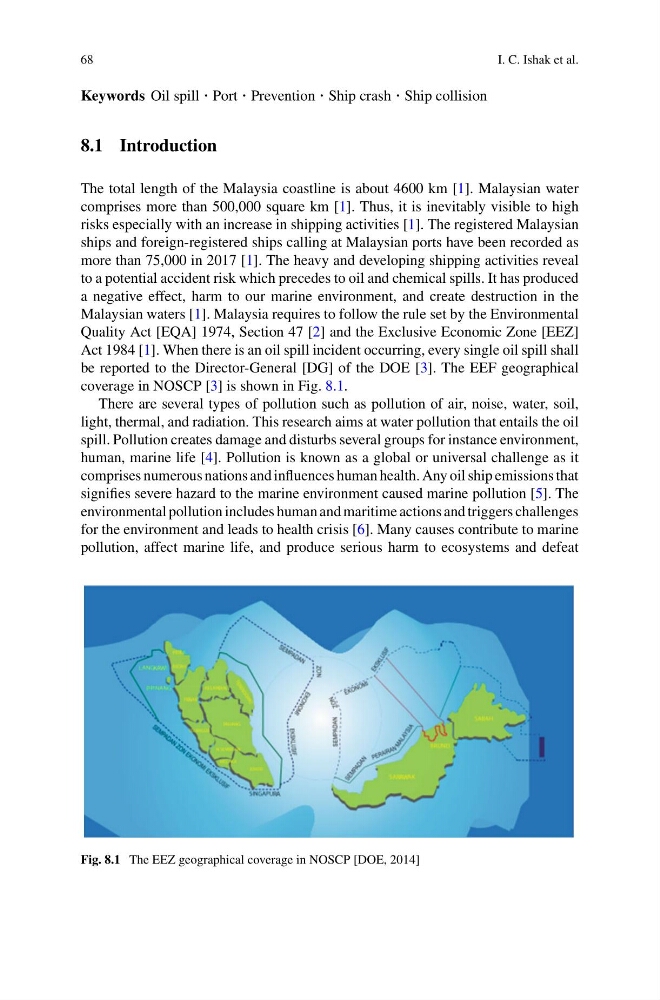
be reported to the Director-General [DG] of the DOE [3]. The EEF geographical
coverage in NOSCP [3] is shown in Fig. 8.1.
There are several types of pollution such as pollution of air, noise, water, soil,
light, thermal, and radiation. This research aims at water pollution that entails the oil
spill. Pollution creates damage and disturbs several groups for instance environment,
human, marine life [4]. Pollution is known as a global or universal challenge as it
comprises numerous nations and influences human health. Any oil ship emissions that
signifies severe hazard to the marine environment caused marine pollution [5]. The
environmental pollution includes human and maritime actions and triggers challenges
for the environment and leads to health crisis [6]. Many causes contribute to marine
pollution, affect marine life, and produce serious harm to ecosystems and defeat
Fig. 8.1 The EEZ geographical coverage in NOSCP [DOE, 2014]
I. C. Ishak et al.
Keywords Oil spill · Port · Prevention · Ship crash · Ship collision
8.1 Introduction
The total length of the Malaysia coastline is about 4600 km [1]. Malaysian water
comprises more than 500,000 square km [1]. Thus, it is inevitably visible to high
risks especially with an increase in shipping activities [1]. The registered Malaysian
ships and foreign-registered ships calling at Malaysian ports have been recorded as
more than 75,000 in 2017 [1]. The heavy and developing shipping activities reveal
to a potential accident risk which precedes to oil and chemical spills. It has produced
a negative effect, harm to our marine environment, and create destruction in the
Malaysian waters [1]. Malaysia requires to follow the rule set by the Environmental
Quality Act [EQA] 1974, Section 47 [2] and the Exclusive Economic Zone [EEZ]
Act 1984 [1]. When there is an oil spill incident occurring, every single oil spill shall
be reported to the Director-General [DG] of the DOE [3]. The EEF geographical
coverage in NOSCP [3] is shown in Fig. 8.1.
There are several types of pollution such as pollution of air, noise, water, soil,
light, thermal, and radiation. This research aims at water pollution that entails the oil
spill. Pollution creates damage and disturbs several groups for instance environment,
human, marine life [4]. Pollution is known as a global or universal challenge as it
comprises numerous nations and influences human health. Any oil ship emissions that
signifies severe hazard to the marine environment caused marine pollution [5]. The
environmental pollution includes human and maritime actions and triggers challenges
for the environment and leads to health crisis [6]. Many causes contribute to marine
pollution, affect marine life, and produce serious harm to ecosystems and defeat
Fig. 8.1 The EEZ geographical coverage in NOSCP [DOE, 2014]