

34
A. M. Saat et al.
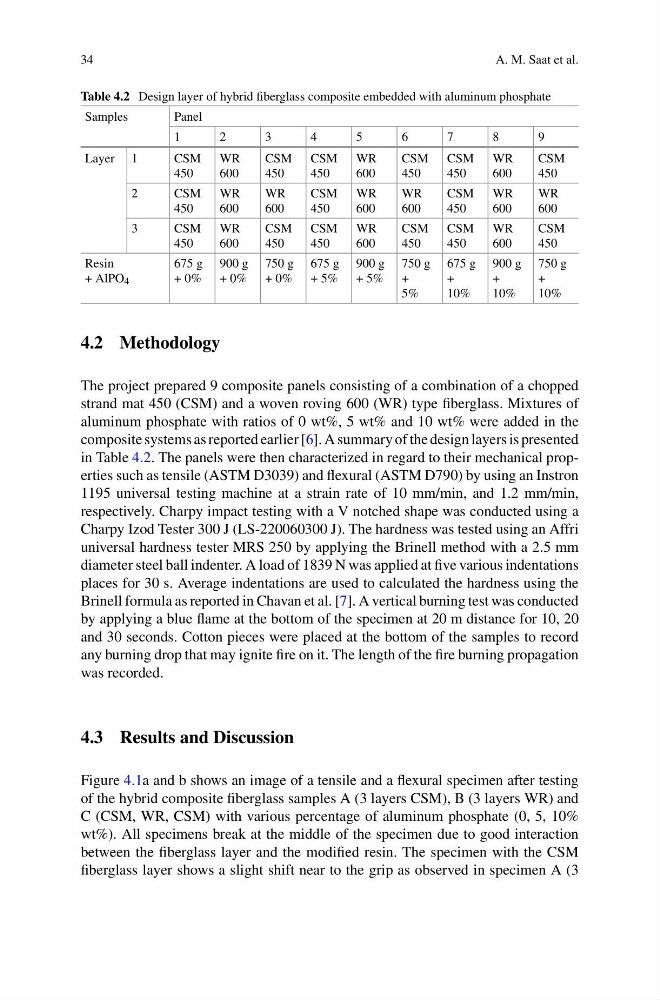
Table 4.2 Design layer of hybrid fiberglass composite embedded with aluminum phosphate
Samples
Panel
1
2
3
4
5
6
7
8
9
Layer 1
CSM
450
WR
600
CSM
450
CSM
450
WR
600
CSM
450
CSM
450
WR
600
CSM
450
2
CSM
450
WR
600
WR
600
CSM
450
WR
600
WR
600
CSM
450
WR
600
WR
600
3
CSM
450
WR
600
CSM
450
CSM
450
WR
600
CSM
450
CSM
450
WR
600
CSM
450
Resin
+ AlPO 4
675 g
+ 0%
900 g
+ 0%
750 g
+ 0%
675 g
+ 5%
900 g
+ 5%
750 g
+
5%
675 g
+
10%
900 g
+
10%
750 g
+
10%
4.2 Methodology
The project prepared 9 composite panels consisting of a combination of a chopped
strand mat 450 (CSM) and a woven roving 600 (WR) type fiberglass. Mixtures of
aluminum phosphate with ratios of 0 wt%, 5 wt% and 10 wt% were added in the
composite systems as reported earlier [6]. A summary of the design layers is presented
in Table 4.2. The panels were then characterized in regard to their mechanical properties such as tensile (ASTM D3039) and flexural (ASTM D790) by using an Instron
1195 universal testing machine at a strain rate of 10 mm/min, and 1.2 mm/min,
respectively. Charpy impact testing with a V notched shape was conducted using a
Charpy Izod Tester 300 J (LS-220060300 J). The hardness was tested using an Affri
universal hardness tester MRS 250 by applying the Brinell method with a 2.5 mm
diameter steel ball indenter. A load of 1839 N was applied at five various indentations
places for 30 s. Average indentations are used to calculated the hardness using the
Brinell formula as reported in Chavan et al. [7]. A vertical burning test was conducted
by applying a blue flame at the bottom of the specimen at 20 m distance for 10, 20
and 30 seconds. Cotton pieces were placed at the bottom of the samples to record
any burning drop that may ignite fire on it. The length of the fire burning propagation
was recorded.
4.3 Results and Discussion
Figure 4.1a and b shows an image of a tensile and a flexural specimen after testing
of the hybrid composite fiberglass samples A (3 layers CSM), B (3 layers WR) and
C (CSM, WR, CSM) with various percentage of aluminum phosphate (0, 5, 10%
wt%). All specimens break at the middle of the specimen due to good interaction
between the fiberglass layer and the modified resin. The specimen with the CSM
fiberglass layer shows a slight shift near to the grip as observed in specimen A (3
A. M. Saat et al.
Table 4.2 Design layer of hybrid fiberglass composite embedded with aluminum phosphate
Samples
Panel
1
2
3
4
5
6
7
8
9
Layer 1
CSM
450
WR
600
CSM
450
CSM
450
WR
600
CSM
450
CSM
450
WR
600
CSM
450
2
CSM
450
WR
600
WR
600
CSM
450
WR
600
WR
600
CSM
450
WR
600
WR
600
3
CSM
450
WR
600
CSM
450
CSM
450
WR
600
CSM
450
CSM
450
WR
600
CSM
450
Resin
+ AlPO 4
675 g
+ 0%
900 g
+ 0%
750 g
+ 0%
675 g
+ 5%
900 g
+ 5%
750 g
+
5%
675 g
+
10%
900 g
+
10%
750 g
+
10%
4.2 Methodology
The project prepared 9 composite panels consisting of a combination of a chopped
strand mat 450 (CSM) and a woven roving 600 (WR) type fiberglass. Mixtures of
aluminum phosphate with ratios of 0 wt%, 5 wt% and 10 wt% were added in the
composite systems as reported earlier [6]. A summary of the design layers is presented
in Table 4.2. The panels were then characterized in regard to their mechanical properties such as tensile (ASTM D3039) and flexural (ASTM D790) by using an Instron
1195 universal testing machine at a strain rate of 10 mm/min, and 1.2 mm/min,
respectively. Charpy impact testing with a V notched shape was conducted using a
Charpy Izod Tester 300 J (LS-220060300 J). The hardness was tested using an Affri
universal hardness tester MRS 250 by applying the Brinell method with a 2.5 mm
diameter steel ball indenter. A load of 1839 N was applied at five various indentations
places for 30 s. Average indentations are used to calculated the hardness using the
Brinell formula as reported in Chavan et al. [7]. A vertical burning test was conducted
by applying a blue flame at the bottom of the specimen at 20 m distance for 10, 20
and 30 seconds. Cotton pieces were placed at the bottom of the samples to record
any burning drop that may ignite fire on it. The length of the fire burning propagation
was recorded.
4.3 Results and Discussion
Figure 4.1a and b shows an image of a tensile and a flexural specimen after testing
of the hybrid composite fiberglass samples A (3 layers CSM), B (3 layers WR) and
C (CSM, WR, CSM) with various percentage of aluminum phosphate (0, 5, 10%
wt%). All specimens break at the middle of the specimen due to good interaction
between the fiberglass layer and the modified resin. The specimen with the CSM
fiberglass layer shows a slight shift near to the grip as observed in specimen A (3