

328
A. Abu et al.
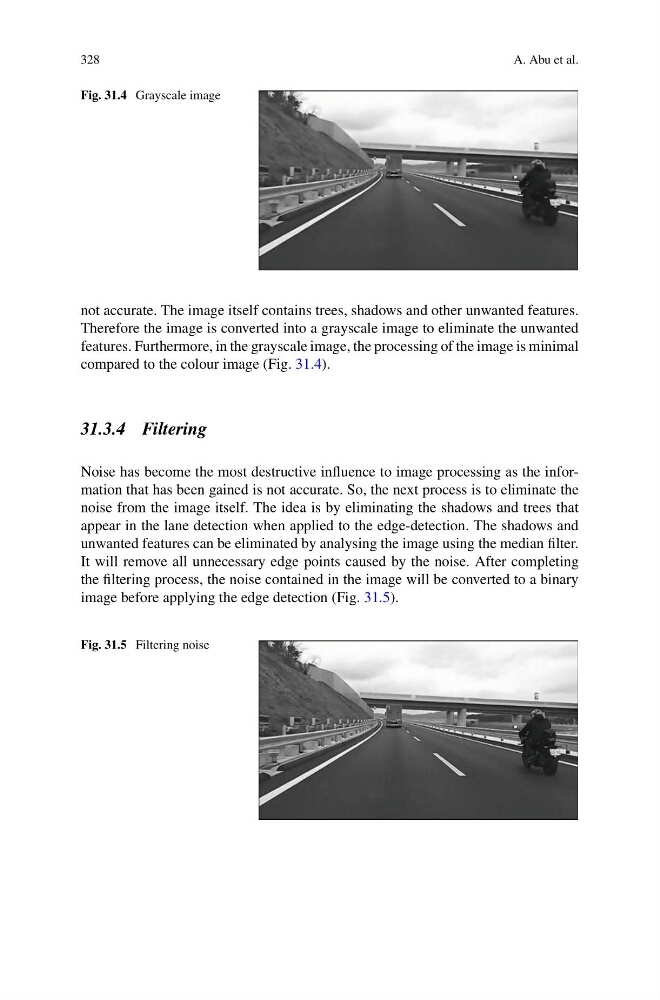
Fig. 31.4 Grayscale image
not accurate. The image itself contains trees, shadows and other unwanted features.
Therefore the image is converted into a grayscale image to eliminate the unwanted
features. Furthermore, in the grayscale image, the processing of the image is minimal
compared to the colour image (Fig. 31.4).
31.3.4 Filtering
Noise has become the most destructive influence to image processing as the information that has been gained is not accurate. So, the next process is to eliminate the
noise from the image itself. The idea is by eliminating the shadows and trees that
appear in the lane detection when applied to the edge-detection. The shadows and
unwanted features can be eliminated by analysing the image using the median filter.
It will remove all unnecessary edge points caused by the noise. After completing
the filtering process, the noise contained in the image will be converted to a binary
image before applying the edge detection (Fig. 31.5).
Fig. 31.5 Filtering noise
A. Abu et al.
Fig. 31.4 Grayscale image
not accurate. The image itself contains trees, shadows and other unwanted features.
Therefore the image is converted into a grayscale image to eliminate the unwanted
features. Furthermore, in the grayscale image, the processing of the image is minimal
compared to the colour image (Fig. 31.4).
31.3.4 Filtering
Noise has become the most destructive influence to image processing as the information that has been gained is not accurate. So, the next process is to eliminate the
noise from the image itself. The idea is by eliminating the shadows and trees that
appear in the lane detection when applied to the edge-detection. The shadows and
unwanted features can be eliminated by analysing the image using the median filter.
It will remove all unnecessary edge points caused by the noise. After completing
the filtering process, the noise contained in the image will be converted to a binary
image before applying the edge detection (Fig. 31.5).
Fig. 31.5 Filtering noise