

138
S. B. Ismail et al.
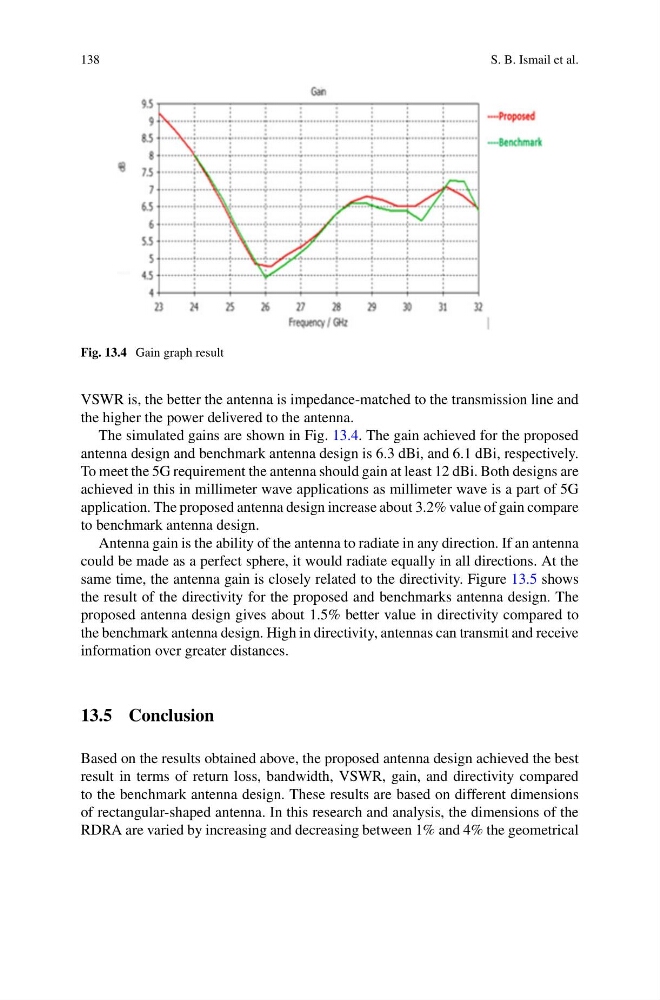
Fig. 13.4 Gain graph result
VSWR is, the better the antenna is impedance-matched to the transmission line and
the higher the power delivered to the antenna.
The simulated gains are shown in Fig. 13.4. The gain achieved for the proposed
antenna design and benchmark antenna design is 6.3 dBi, and 6.1 dBi, respectively.
To meet the 5G requirement the antenna should gain at least 12 dBi. Both designs are
achieved in this in millimeter wave applications as millimeter wave is a part of 5G
application. The proposed antenna design increase about 3.2% value of gain compare
to benchmark antenna design.
Antenna gain is the ability of the antenna to radiate in any direction. If an antenna
could be made as a perfect sphere, it would radiate equally in all directions. At the
same time, the antenna gain is closely related to the directivity. Figure 13.5 shows
the result of the directivity for the proposed and benchmarks antenna design. The
proposed antenna design gives about 1.5% better value in directivity compared to
the benchmark antenna design. High in directivity, antennas can transmit and receive
information over greater distances.
13.5 Conclusion
Based on the results obtained above, the proposed antenna design achieved the best
result in terms of return loss, bandwidth, VSWR, gain, and directivity compared
to the benchmark antenna design. These results are based on different dimensions
of rectangular-shaped antenna. In this research and analysis, the dimensions of the
RDRA are varied by increasing and decreasing between 1% and 4% the geometrical
S. B. Ismail et al.
Fig. 13.4 Gain graph result
VSWR is, the better the antenna is impedance-matched to the transmission line and
the higher the power delivered to the antenna.
The simulated gains are shown in Fig. 13.4. The gain achieved for the proposed
antenna design and benchmark antenna design is 6.3 dBi, and 6.1 dBi, respectively.
To meet the 5G requirement the antenna should gain at least 12 dBi. Both designs are
achieved in this in millimeter wave applications as millimeter wave is a part of 5G
application. The proposed antenna design increase about 3.2% value of gain compare
to benchmark antenna design.
Antenna gain is the ability of the antenna to radiate in any direction. If an antenna
could be made as a perfect sphere, it would radiate equally in all directions. At the
same time, the antenna gain is closely related to the directivity. Figure 13.5 shows
the result of the directivity for the proposed and benchmarks antenna design. The
proposed antenna design gives about 1.5% better value in directivity compared to
the benchmark antenna design. High in directivity, antennas can transmit and receive
information over greater distances.
13.5 Conclusion
Based on the results obtained above, the proposed antenna design achieved the best
result in terms of return loss, bandwidth, VSWR, gain, and directivity compared
to the benchmark antenna design. These results are based on different dimensions
of rectangular-shaped antenna. In this research and analysis, the dimensions of the
RDRA are varied by increasing and decreasing between 1% and 4% the geometrical