

13 A Design of a Dielectric Resonator Antenna …
139
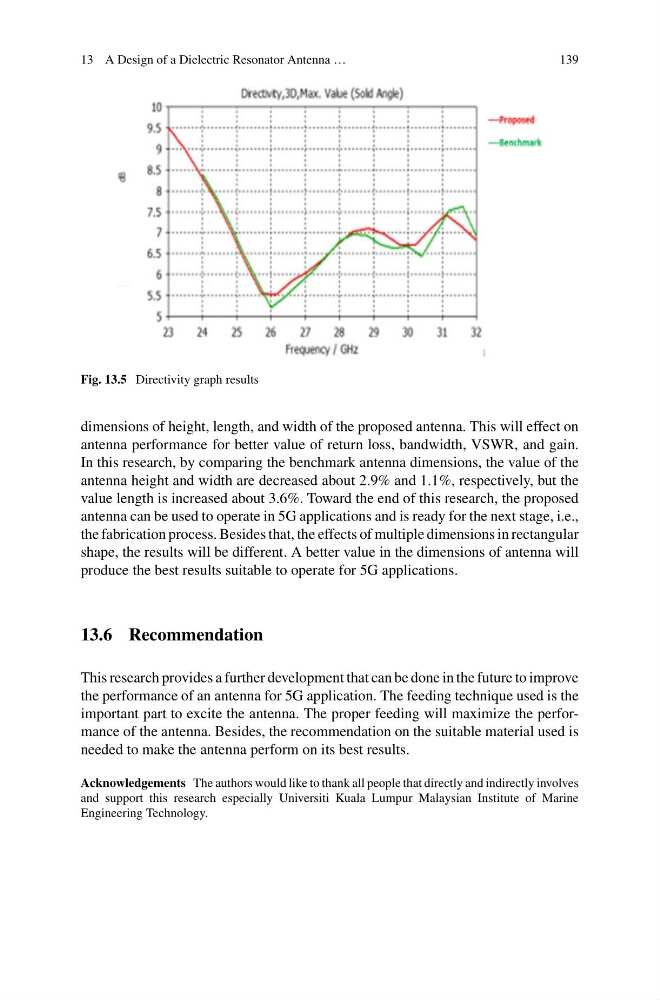
Fig. 13.5 Directivity graph results
dimensions of height, length, and width of the proposed antenna. This will effect on
antenna performance for better value of return loss, bandwidth, VSWR, and gain.
In this research, by comparing the benchmark antenna dimensions, the value of the
antenna height and width are decreased about 2.9% and 1.1%, respectively, but the
value length is increased about 3.6%. Toward the end of this research, the proposed
antenna can be used to operate in 5G applications and is ready for the next stage, i.e.,
the fabrication process. Besides that, the effects of multiple dimensions in rectangular
shape, the results will be different. A better value in the dimensions of antenna will
produce the best results suitable to operate for 5G applications.
13.6 Recommendation
This research provides a further development that can be done in the future to improve
the performance of an antenna for 5G application. The feeding technique used is the
important part to excite the antenna. The proper feeding will maximize the performance of the antenna. Besides, the recommendation on the suitable material used is
needed to make the antenna perform on its best results.
Acknowledgements The authors would like to thank all people that directly and indirectly involves
and support this research especially Universiti Kuala Lumpur Malaysian Institute of Marine
Engineering Technology.
139
Fig. 13.5 Directivity graph results
dimensions of height, length, and width of the proposed antenna. This will effect on
antenna performance for better value of return loss, bandwidth, VSWR, and gain.
In this research, by comparing the benchmark antenna dimensions, the value of the
antenna height and width are decreased about 2.9% and 1.1%, respectively, but the
value length is increased about 3.6%. Toward the end of this research, the proposed
antenna can be used to operate in 5G applications and is ready for the next stage, i.e.,
the fabrication process. Besides that, the effects of multiple dimensions in rectangular
shape, the results will be different. A better value in the dimensions of antenna will
produce the best results suitable to operate for 5G applications.
13.6 Recommendation
This research provides a further development that can be done in the future to improve
the performance of an antenna for 5G application. The feeding technique used is the
important part to excite the antenna. The proper feeding will maximize the performance of the antenna. Besides, the recommendation on the suitable material used is
needed to make the antenna perform on its best results.
Acknowledgements The authors would like to thank all people that directly and indirectly involves
and support this research especially Universiti Kuala Lumpur Malaysian Institute of Marine
Engineering Technology.