

136
S. B. Ismail et al.
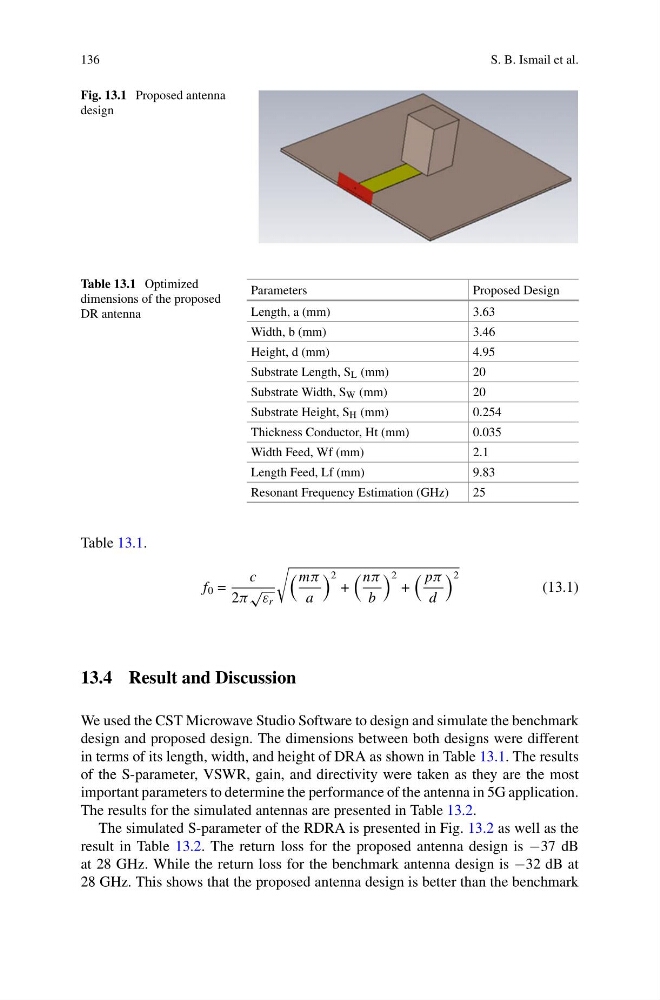
Fig. 13.1 Proposed antenna
design
Table 13.1 Optimized
dimensions of the proposed
DR antenna
Parameters
Proposed Design
Length, a (mm)
3.63
Width, b (mm)
3.46
Height, d (mm)
4.95
Substrate Length, S L (mm)
20
Substrate Width, S W (mm)
20
Substrate Height, S H (mm)
0.254
Thickness Conductor, Ht (mm)
0.035
Width Feed, Wf (mm)
2.1
Length Feed, Lf (mm)
9.83
Resonant Frequency Estimation (GHz)
25
Table 13.1.
f 0 =
c
2π
√
ε r
mπ
a
2
+
nπ
b
2
+
pπ
d
2
(13.1)
13.4 Result and Discussion
We used the CST Microwave Studio Software to design and simulate the benchmark
design and proposed design. The dimensions between both designs were different
in terms of its length, width, and height of DRA as shown in Table 13.1. The results
of the S-parameter, VSWR, gain, and directivity were taken as they are the most
important parameters to determine the performance of the antenna in 5G application.
The results for the simulated antennas are presented in Table 13.2.
The simulated S-parameter of the RDRA is presented in Fig. 13.2 as well as the
result in Table 13.2. The return loss for the proposed antenna design is −37 dB
at 28 GHz. While the return loss for the benchmark antenna design is −32 dB at
28 GHz. This shows that the proposed antenna design is better than the benchmark
S. B. Ismail et al.
Fig. 13.1 Proposed antenna
design
Table 13.1 Optimized
dimensions of the proposed
DR antenna
Parameters
Proposed Design
Length, a (mm)
3.63
Width, b (mm)
3.46
Height, d (mm)
4.95
Substrate Length, S L (mm)
20
Substrate Width, S W (mm)
20
Substrate Height, S H (mm)
0.254
Thickness Conductor, Ht (mm)
0.035
Width Feed, Wf (mm)
2.1
Length Feed, Lf (mm)
9.83
Resonant Frequency Estimation (GHz)
25
Table 13.1.
f 0 =
c
2π
√
ε r
mπ
a
2
+
nπ
b
2
+
pπ
d
2
(13.1)
13.4 Result and Discussion
We used the CST Microwave Studio Software to design and simulate the benchmark
design and proposed design. The dimensions between both designs were different
in terms of its length, width, and height of DRA as shown in Table 13.1. The results
of the S-parameter, VSWR, gain, and directivity were taken as they are the most
important parameters to determine the performance of the antenna in 5G application.
The results for the simulated antennas are presented in Table 13.2.
The simulated S-parameter of the RDRA is presented in Fig. 13.2 as well as the
result in Table 13.2. The return loss for the proposed antenna design is −37 dB
at 28 GHz. While the return loss for the benchmark antenna design is −32 dB at
28 GHz. This shows that the proposed antenna design is better than the benchmark