

80
N. Khalid et al.
due to its flatter underbody. A semi-displacement hull is powered faster than a fully
displacement hull by double the capacity with a suitable power capacity [3].
III. Planning
In order to create a hydro-dynamically lifted hull when moving with a flat bottom,
planing hulls came into creation. Among the conditions to be considered in the
creation of the planing hulls are the saturated exterior of the hull area and the stern
squatting effect of the wave. It’s reduced by the moving water shoving the flat surfaces
out of the water.
D. Types of Hulls
The three common hull types for fishing vessels are the flat bottom hull, deep v
hull and round bottom hull. The description of the three types of hulls is given below.
i. Flat Bottom Hull
A flat-bottomed boat is a vessel with a flat, two-chine hull which is popular in
shallow areas, such as rivers. This is because there is less opportunity for it to embark
on land. Its flat structure also makes it more stable in tranquil waters. As they do not
perform well in uneven waters, especially at planning velocities, flat bottom boats
are more commonly used in tranquil waters such as ponds, tiny lakes and streams.
Amateur builders would find this hull type the most suitable as it is the simplest to
construct with fewer tools and is less costly than more intricate-shaped hull designs.
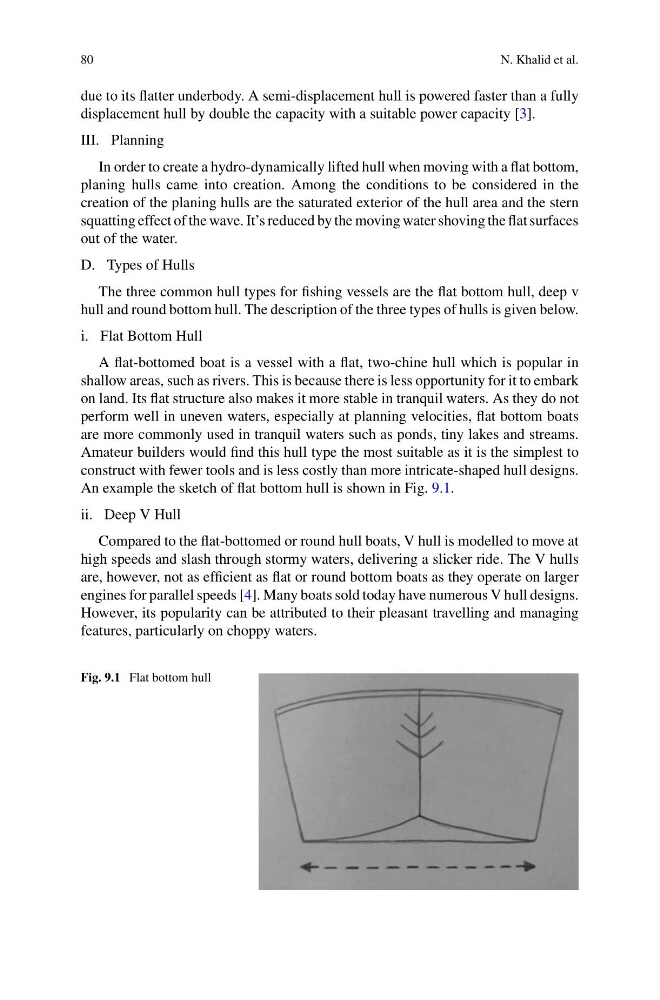
An example the sketch of flat bottom hull is shown in Fig. 9.1.
ii. Deep V Hull
Compared to the flat-bottomed or round hull boats, V hull is modelled to move at
high speeds and slash through stormy waters, delivering a slicker ride. The V hulls
are, however, not as efficient as flat or round bottom boats as they operate on larger
engines for parallel speeds [4]. Many boats sold today have numerous V hull designs.
However, its popularity can be attributed to their pleasant travelling and managing
features, particularly on choppy waters.
Fig. 9.1 Flat bottom hull
N. Khalid et al.
due to its flatter underbody. A semi-displacement hull is powered faster than a fully
displacement hull by double the capacity with a suitable power capacity [3].
III. Planning
In order to create a hydro-dynamically lifted hull when moving with a flat bottom,
planing hulls came into creation. Among the conditions to be considered in the
creation of the planing hulls are the saturated exterior of the hull area and the stern
squatting effect of the wave. It’s reduced by the moving water shoving the flat surfaces
out of the water.
D. Types of Hulls
The three common hull types for fishing vessels are the flat bottom hull, deep v
hull and round bottom hull. The description of the three types of hulls is given below.
i. Flat Bottom Hull
A flat-bottomed boat is a vessel with a flat, two-chine hull which is popular in
shallow areas, such as rivers. This is because there is less opportunity for it to embark
on land. Its flat structure also makes it more stable in tranquil waters. As they do not
perform well in uneven waters, especially at planning velocities, flat bottom boats
are more commonly used in tranquil waters such as ponds, tiny lakes and streams.
Amateur builders would find this hull type the most suitable as it is the simplest to
construct with fewer tools and is less costly than more intricate-shaped hull designs.
An example the sketch of flat bottom hull is shown in Fig. 9.1.
ii. Deep V Hull
Compared to the flat-bottomed or round hull boats, V hull is modelled to move at
high speeds and slash through stormy waters, delivering a slicker ride. The V hulls
are, however, not as efficient as flat or round bottom boats as they operate on larger
engines for parallel speeds [4]. Many boats sold today have numerous V hull designs.
However, its popularity can be attributed to their pleasant travelling and managing
features, particularly on choppy waters.
Fig. 9.1 Flat bottom hull