

9 Analysis on Wave Generation and Hull …
81
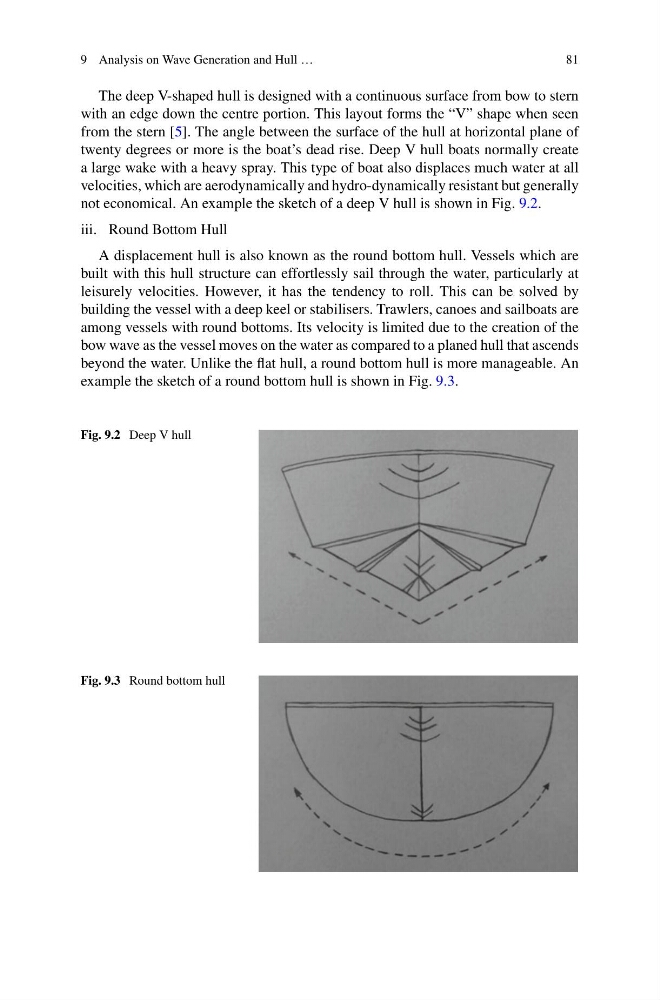
The deep V-shaped hull is designed with a continuous surface from bow to stern
with an edge down the centre portion. This layout forms the “V” shape when seen
from the stern [5]. The angle between the surface of the hull at horizontal plane of
twenty degrees or more is the boat’s dead rise. Deep V hull boats normally create
a large wake with a heavy spray. This type of boat also displaces much water at all
velocities, which are aerodynamically and hydro-dynamically resistant but generally
not economical. An example the sketch of a deep V hull is shown in Fig. 9.2.
iii. Round Bottom Hull
A displacement hull is also known as the round bottom hull. Vessels which are
built with this hull structure can effortlessly sail through the water, particularly at
leisurely velocities. However, it has the tendency to roll. This can be solved by
building the vessel with a deep keel or stabilisers. Trawlers, canoes and sailboats are
among vessels with round bottoms. Its velocity is limited due to the creation of the
bow wave as the vessel moves on the water as compared to a planed hull that ascends
beyond the water. Unlike the flat hull, a round bottom hull is more manageable. An
example the sketch of a round bottom hull is shown in Fig. 9.3.
Fig. 9.2 Deep V hull
Fig. 9.3 Round bottom hull
81
The deep V-shaped hull is designed with a continuous surface from bow to stern
with an edge down the centre portion. This layout forms the “V” shape when seen
from the stern [5]. The angle between the surface of the hull at horizontal plane of
twenty degrees or more is the boat’s dead rise. Deep V hull boats normally create
a large wake with a heavy spray. This type of boat also displaces much water at all
velocities, which are aerodynamically and hydro-dynamically resistant but generally
not economical. An example the sketch of a deep V hull is shown in Fig. 9.2.
iii. Round Bottom Hull
A displacement hull is also known as the round bottom hull. Vessels which are
built with this hull structure can effortlessly sail through the water, particularly at
leisurely velocities. However, it has the tendency to roll. This can be solved by
building the vessel with a deep keel or stabilisers. Trawlers, canoes and sailboats are
among vessels with round bottoms. Its velocity is limited due to the creation of the
bow wave as the vessel moves on the water as compared to a planed hull that ascends
beyond the water. Unlike the flat hull, a round bottom hull is more manageable. An
example the sketch of a round bottom hull is shown in Fig. 9.3.
Fig. 9.2 Deep V hull
Fig. 9.3 Round bottom hull