

Photoluminescent Printed Fabrics: Design and Development …
91
0
0.02
0.04
0.06
0.08
0.1
0.12
0.14
0.16
0.18
C3(5%)
C4 (10%)
C5(20%)
Intensity of light (lux)
Lux Meter Reading
B1
G1
B4
G4
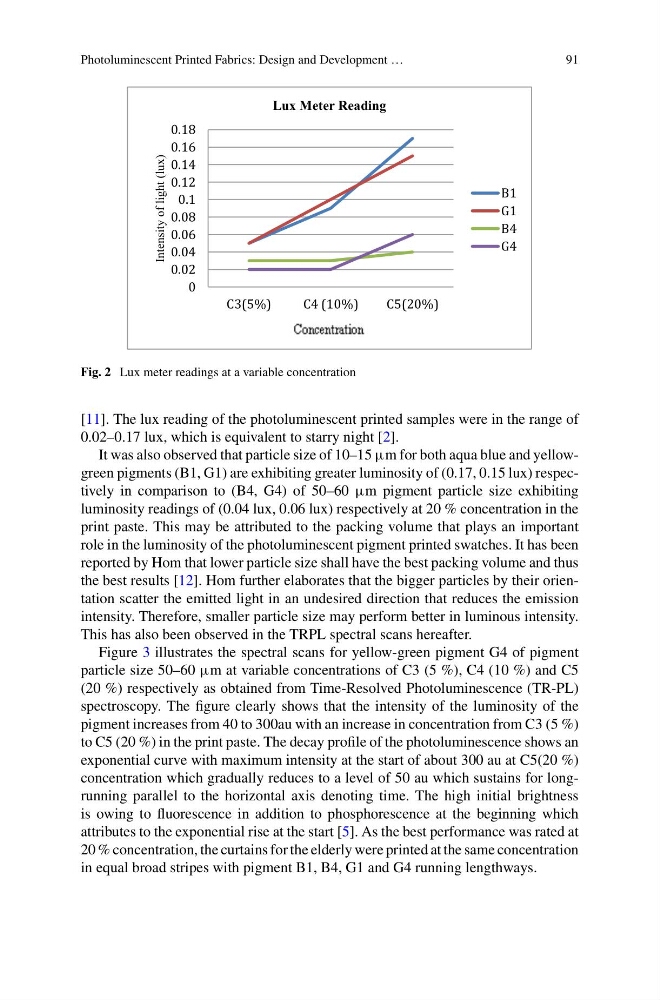
Fig. 2 Lux meter readings at a variable concentration
[11]. The lux reading of the photoluminescent printed samples were in the range of
0.02–0.17 lux, which is equivalent to starry night [2].
It was also observed that particle size of 10–15 μm for both aqua blue and yellowgreen pigments (B1, G1) are exhibiting greater luminosity of (0.17, 0.15 lux) respectively in comparison to (B4, G4) of 50–60 μm pigment particle size exhibiting
luminosity readings of (0.04 lux, 0.06 lux) respectively at 20 % concentration in the
print paste. This may be attributed to the packing volume that plays an important
role in the luminosity of the photoluminescent pigment printed swatches. It has been
reported by Hom that lower particle size shall have the best packing volume and thus
the best results [12]. Hom further elaborates that the bigger particles by their orientation scatter the emitted light in an undesired direction that reduces the emission
intensity. Therefore, smaller particle size may perform better in luminous intensity.
This has also been observed in the TRPL spectral scans hereafter.
Figure 3 illustrates the spectral scans for yellow-green pigment G4 of pigment
particle size 50–60 μm at variable concentrations of C3 (5 %), C4 (10 %) and C5
(20 %) respectively as obtained from Time-Resolved Photoluminescence (TR-PL)
spectroscopy. The figure clearly shows that the intensity of the luminosity of the
pigment increases from 40 to 300au with an increase in concentration from C3 (5 %)
to C5 (20 %) in the print paste. The decay profile of the photoluminescence shows an
exponential curve with maximum intensity at the start of about 300 au at C5(20 %)
concentration which gradually reduces to a level of 50 au which sustains for longrunning parallel to the horizontal axis denoting time. The high initial brightness
is owing to fluorescence in addition to phosphorescence at the beginning which
attributes to the exponential rise at the start [5]. As the best performance was rated at
20 % concentration, the curtains for the elderly were printed at the same concentration
in equal broad stripes with pigment B1, B4, G1 and G4 running lengthways.
91
0
0.02
0.04
0.06
0.08
0.1
0.12
0.14
0.16
0.18
C3(5%)
C4 (10%)
C5(20%)
Intensity of light (lux)
Lux Meter Reading
B1
G1
B4
G4
Fig. 2 Lux meter readings at a variable concentration
[11]. The lux reading of the photoluminescent printed samples were in the range of
0.02–0.17 lux, which is equivalent to starry night [2].
It was also observed that particle size of 10–15 μm for both aqua blue and yellowgreen pigments (B1, G1) are exhibiting greater luminosity of (0.17, 0.15 lux) respectively in comparison to (B4, G4) of 50–60 μm pigment particle size exhibiting
luminosity readings of (0.04 lux, 0.06 lux) respectively at 20 % concentration in the
print paste. This may be attributed to the packing volume that plays an important
role in the luminosity of the photoluminescent pigment printed swatches. It has been
reported by Hom that lower particle size shall have the best packing volume and thus
the best results [12]. Hom further elaborates that the bigger particles by their orientation scatter the emitted light in an undesired direction that reduces the emission
intensity. Therefore, smaller particle size may perform better in luminous intensity.
This has also been observed in the TRPL spectral scans hereafter.
Figure 3 illustrates the spectral scans for yellow-green pigment G4 of pigment
particle size 50–60 μm at variable concentrations of C3 (5 %), C4 (10 %) and C5
(20 %) respectively as obtained from Time-Resolved Photoluminescence (TR-PL)
spectroscopy. The figure clearly shows that the intensity of the luminosity of the
pigment increases from 40 to 300au with an increase in concentration from C3 (5 %)
to C5 (20 %) in the print paste. The decay profile of the photoluminescence shows an
exponential curve with maximum intensity at the start of about 300 au at C5(20 %)
concentration which gradually reduces to a level of 50 au which sustains for longrunning parallel to the horizontal axis denoting time. The high initial brightness
is owing to fluorescence in addition to phosphorescence at the beginning which
attributes to the exponential rise at the start [5]. As the best performance was rated at
20 % concentration, the curtains for the elderly were printed at the same concentration
in equal broad stripes with pigment B1, B4, G1 and G4 running lengthways.